Titanium stands out among structural metals for its exceptional strength‑to‑weight ratio, outstanding corrosion resistance and reliable biocompatibility. Traditional titanium manufacturing including CNC machining, forging and casting faces high material waste, heavy tool wear and limitations for complex miniature geometries. Metal Injection Molding (MIM) makes it possible to produce intricate near‑net‑shape titanium parts for medium‑to‑high‑volume projects.
Nevertheless, titanium MIM cannot simply adopt wrought‑titanium datasheet performance. Titanium is highly chemically‑reactive during high‑temperature sintering. Oxygen and carbon contamination will lead to brittleness and degraded ductility. Final part performance depends heavily on low‑interstitial powder quality, high‑vacuum sintering environment, HIP post‑processing, geometry design and inspection criteria. Copying wrought‑titanium specifications directly onto MIM drawings often results in brittle components or batch‑to‑batch property fluctuation.
This guide covers mainstream titanium MIM alloy grades, core material characteristics, manufacturing challenges, DFM design guidance, surface‑treatment options, real‑world case study, plus a practical comparison between titanium MIM and steel MIM for design engineers and procurement specialists.
What Is Titanium MIM? Key Pros and Typical Applications
Titanium MIM mixes fine low‑oxygen titanium‑alloy powder with polymer‑wax binder to create homogeneous feedstock. After injection molding, multi‑stage debinding and strict high‑vacuum sintering, high‑density titanium components are formed. For high‑reliability projects, HIP (Hot Isostatic Pressing) can eliminate residual porosity to further boost ductility and fatigue performance.
Main commercial titanium MIM grades:CP‑Ti (Commercially Pure Titanium)Good ductility, excellent biocompatibility and corrosion resistance. Lower tensile strength compared with Ti‑6Al‑4V. Widely used for wearable device structural parts and non‑implant medical auxiliary hardware.
Ti‑6Al‑4V (Grade 5 Titanium Alloy)The most widely‑used titanium MIM alloy. Balances high tensile strength, lightweight property and corrosion resistance. Applied in miniature aerospace auxiliary fittings, high‑end wearable hardware and high‑load precision components.
Critical engineering note: Oxygen pickup is the top risk for titanium MIM. Once oxygen dissolves into titanium matrix during sintering, it cannot be removed. Excess oxygen content causes severe brittleness, even if dimension inspection passes.
Key Properties of Titanium MIM Materials
Note: Data applies to high‑density sintered titanium MIM parts under well‑controlled low‑oxygen processing; real‑world performance degrades with rising oxygen / carbon impurities and residual porosity.
| Property | CP‑Ti MIM | Ti‑6Al‑4V MIM |
|---|
| Density (g/cm³) | 4.51 | 4.43 |
| Tensile Strength (MPa) | 240‑410 | 710‑900 |
| Elongation at Break | 15‑24 % | 8‑14 % |
| Corrosion Resistance | Excellent | Excellent |
| Biocompatibility | Outstanding | Very Good |
| Relative Raw‑Material Cost | Very High | Very High |
| Typical Sintered Density | 95‑98 % theoretical | 95‑98 % theoretical |
Core Manufacturing Challenges for Titanium MIM
Oxygen & carbon contamination risk: Titanium reacts actively with oxygen, carbon and nitrogen at elevated temperature. High‑purity spherical low‑interstitial powder and high‑vacuum sintering furnace are mandatory to avoid embrittlement.
Strict sinter‑atmosphere requirement: Must adopt high‑vacuum or ultra‑high‑purity argon environment; nitrogen atmosphere is forbidden because titanium absorbs nitrogen element to form brittle phases.
Residual porosity impact: As‑sintered parts retain minor closed pores. High‑fatigue‑critical components require subsequent HIP treatment to eliminate pores and improve ductility and fatigue life.
Sinter shrinkage & distortion: Titanium MIM has large sinter shrinkage; asymmetric thin‑wall structures are prone to sinter warpage, requiring optimized mold compensation and sinter support layout.
DFM Design‑for‑Manufacturability Guidelines for Titanium MIM
Tolerance allocation guidelines
Critical mating / functional surfaces: ±0.03‑0.05 mm
Mounting holes and locating features: ±0.06‑0.12 mm
Non‑critical outer contours: ±0.12‑0.20 mm
Key design tips
Avoid extremely thin unsupported walls; keep minimum wall thickness ≥1.2 mm, limit unsupported wall height‑to‑thickness ratio ≤8:1.
Adopt symmetric geometry as much as possible; add fillet radii R ≥1.5 mm for abrupt wall‑thickness transitions to lower sinter‑distortion risk.
If high‑fatigue service is required, clearly specify HIP post‑processing requirement on drawing.
Define oxygen‑content acceptance limit, mechanical‑property targets at RFQ phase, instead of only marking alloy grade.
Available Surface Treatments for Titanium MIM Components

Warning: Conventional electroplating is not preferred for titanium MIM unless special pre‑treatment is implemented, because plating adhesion can be poor.
Factory Case Study: Ti‑6Al‑4V MIM Miniature Wearable Structural Buckle
A premium wearable‑device manufacturer encountered brittle fracture failure on Ti‑6Al‑4V MIM buckles from a prior supplier. Dimensional inspection was qualified, but parts fractured under cyclic bending durability testing.
Root‑cause analysis revealed two major failure sources:
Poor vacuum sealing of sintering furnace caused oxygen pickup, raising interstitial‑element content and resulting in material brittleness.
No dedicated sinter‑support layout; asymmetric geometry induced residual sinter stress.
Optimized manufacturing workflow:
Adopt low‑oxygen spherical Ti‑6Al‑4V MIM powder; perform regular helium leak‑detection for sintering furnace to guarantee high‑vacuum environment.
Optimize part orientation and custom sinter setter support to minimize sinter residual stress.
Add batch‑lot oxygen‑content testing and bending‑durability sampling inspection as formal quality‑control gate.
Final result: Mass‑produced titanium MIM buckles passed repeated cyclic bending test, meeting lightweight and corrosion‑resistance requirements for annual output of 92 000 units.
Harbermetal: Your Trusted Titanium MIM Parts Partner In China
Many engineers specify titanium MIM relying purely on wrought‑titanium datasheets, ignoring oxygen‑contamination risks during sintering, which will turn components brittle even if dimensions look correct. You don’t need to go through multiple costly sampling iterations debugging titanium sintering parameters. Submit your 2D/3D drawings together with mechanical, corrosion and fatigue functional requirements to Harbermetal. Our engineering team completes full‑phase DFM feasibility assessment, defines powder‑grade, sinter‑atmosphere, HIP and inspection acceptance criteria before mold investment, helping you avoid mass‑production brittle‑failure risks for titanium MIM projects.
Harber Industrial Limited (Harbermetal) is an ISO‑certified full‑chain Chinese MIM manufacturer with hands‑on project experience for CP‑Ti and Ti‑6Al‑4V titanium MIM precision components. We are not a trading intermediary and own complete in‑house workflow: low‑interstitial titanium feedstock validation, mold design & fabrication, metal injection molding, multi‑stage low‑rate debinding, high‑vacuum precision sintering, HIP densification treatment, secondary‑CNC sizing and specialized titanium‑oriented surface finishing.
Our engineering team treats titanium MIM as a complete system project rather than simple alloy‑grade selection. We evaluate geometry symmetry, thin‑wall risk, define mandatory low‑oxygen sinter‑atmosphere specifications, judge whether HIP post‑processing is necessary, and provide objective suggestions if titanium MIM is not economically feasible and alternative materials such as high‑grade stainless steel should be considered. We deliver custom titanium MIM parts for wearable consumer electronics, aerospace auxiliary hardware and non‑implant medical‑auxiliary equipment. Oxygen‑content test records, mechanical‑property reports and batch‑traceability documentation are available upon request for prototype validation and medium‑to‑high‑volume serial‑production orders.
Titanium vs Steel: mim Materials Guide
When selecting MIM materials, engineers frequently compare titanium‑base MIM and steel‑base (stainless‑steel) MIM including 304L, 316L, 17‑4PH. Each material family has distinct strengths, limitations and cost positioning, and the best choice depends on weight‑reduction targets, corrosion requirement, mechanical‑load, magnetic‑acceptance and project budget.
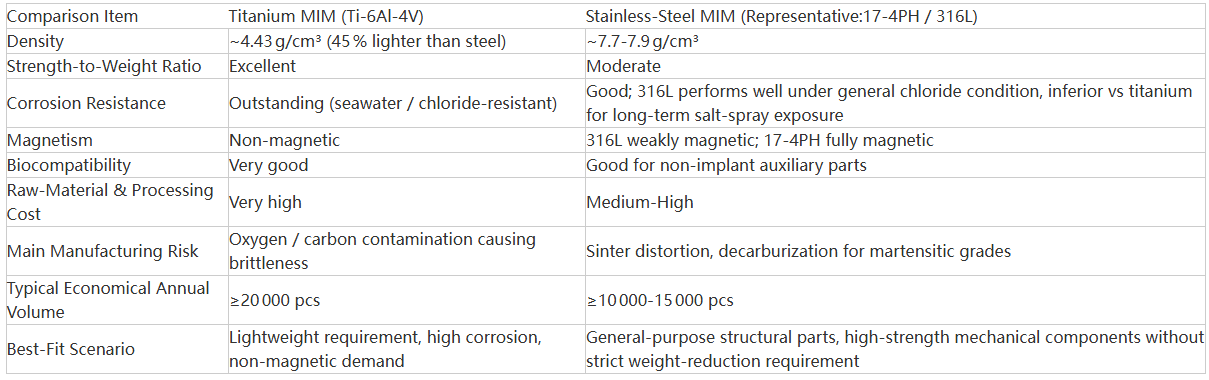
Core material‑selection takeaways:
Choose titanium MIM: When lightweight, superior salt‑water corrosion resistance or non‑magnetic biocompatible performance is your core priority, and higher material‑processing budget is acceptable.
Choose stainless‑steel MIM: When weight reduction is not critical, you want balanced performance with more‑controllable project cost.
Many projects can achieve cost optimization by hybrid‑design: use titanium only for key functional components, and adopt high‑performance stainless‑steel MIM for non‑critical structural parts. Harbermetal’s engineers can perform side‑by‑side material comparison for your drawings to support your final material decision.
Contact informationEmail: sales@harber‑mim.comTel: +86 0769‑82389116
Final Thoughts
Titanium MIM opens new design possibilities for miniature complex lightweight components with excellent corrosion‑resistance and biocompatibility. But alloy‑grade name alone cannot guarantee component performance. Low‑oxygen powder selection, high‑vacuum sinter‑atmosphere control, HIP requirement, geometry optimization and well‑defined acceptance criteria are equally critical.
When developing titanium MIM parts, avoid directly migrating wrought‑titanium datasheet indexes. Complete comprehensive DFM review before mold investment and mark oxygen‑content, mechanical‑property and fatigue‑related critical requirements clearly on drawings. Partnering with an experienced full‑chain MIM manufacturer such as Harbermetal effectively mitigates brittleness, sinter‑distortion and batch‑consistency risks in serial mass‑production.
Frequently Asked Questions About Titanium MIM
Q: Is MIM titanium performance fully equal to wrought titanium?A: Not completely. Residual porosity and risk of oxygen‑carbon contamination during sintering will influence ductility and fatigue life. HIP treatment can greatly narrow this performance gap. Acceptance criteria shall adopt MIM‑oriented test specifications instead of purely wrought‑titanium datasheets.
Q: What is the biggest hidden risk for titanium MIM production?A: Oxygen pickup during debinding and sintering. Excess oxygen dissolves in titanium matrix and causes irreversible embrittlement, even though dimension measurements are within tolerance.
Q: Does every titanium MIM component need HIP treatment?A: Not mandatory. HIP is strongly recommended for parts working under high‑cyclic‑fatigue loads; general static‑load structural components may skip HIP if density and impurity indicators meet specifications.
Q: What batch‑size makes titanium MIM economically viable?A: Due to expensive low‑oxygen titanium powder and high‑requirement sinter‑furnace overhead, titanium MIM generally shows comprehensive‑cost advantages starting from 20 000 pieces annually. For very‑low‑volume complex parts, CNC‑machined wrought titanium may be a more practical alternative.
Ready to launch your titanium MIM component project? Submit your drawings and functional specifications for a free manufacturability assessment and quotation.
 en
en
 de
de jp
jp kor
kor fra
fra spa
spa ru
ru pt
pt it
it