Many design engineers are familiar with cast and CNC‑machined bronze, but sintered bronze produced via Metal Injection Molding (MIM) delivers unique performance thanks to its controllable porous microstructure. MIM bronze combines near‑net‑shape complex 3‑D geometry capability with bronze’s natural advantages: good wear resistance, self‑lubricating potential, decent corrosion resistance and solid electrical‑thermal conductivity.
Nevertheless, sintered bronze MIM cannot simply copy the performance data of wrought or cast bronze. Final component properties are heavily determined by powder formulation, sintering atmosphere, controlled porosity level, oil‑impregnation process and post‑treatment. Directly applying cast bronze datasheet specifications on MIM drawings often leads to unstable friction performance, inconsistent density or poor dimensional repeatability.
This guide covers mainstream sintered bronze MIM alloy grades, core material characteristics, sintering‑related manufacturing challenges, design‑for‑manufacturability guidelines, available surface treatments, typical industrial applications and practical sourcing advice for custom bronze MIM projects.
What Is Sintered Bronze MIM? Key Pros and Typical Applications
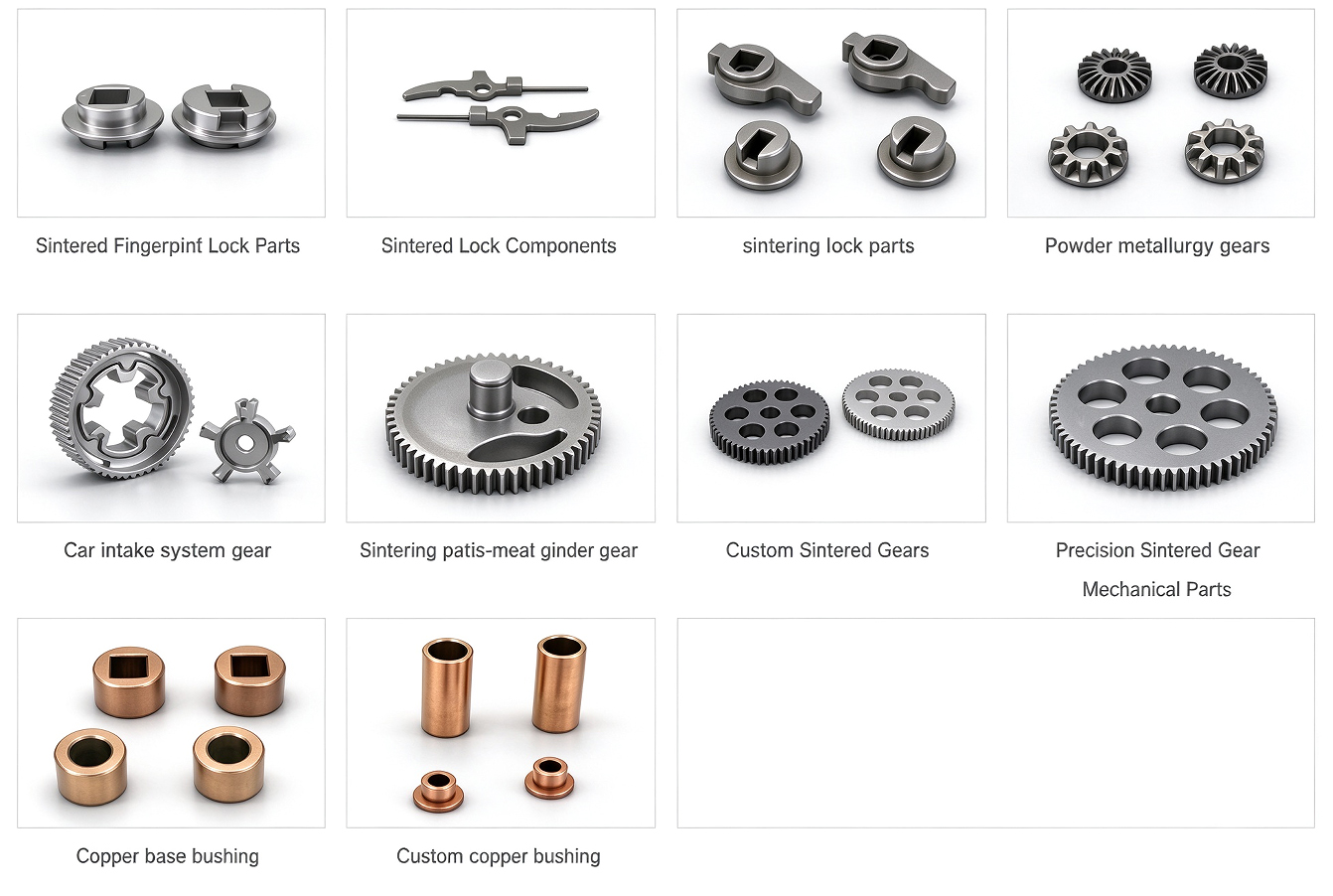
Sintered bronze MIM uses pre‑alloyed bronze powder (primarily copper‑tin‑based) mixed with polymer‑wax binder to produce feedstock. After injection molding, debinding and controlled‑atmosphere sintering, finished MIM bronze components are formed. Engineers can tune open porosity precisely: high‑porosity grades are for self‑lubricating bearing applications; high‑density low‑porosity grades target structural and electrical contact components.
Core advantages of sintered bronze MIM:
Manufacture intricate multi‑feature miniature bronze geometries impossible for conventional pressed‑and‑sinter bronze parts.
Tunable open‑pore structure for vacuum oil‑impregnation to realize maintenance‑free self‑lubrication.
Good anti‑friction and moderate corrosion resistance.
Acceptable electrical and thermal conductivity for miniature contact and thermal‑transfer components.
Mainstream sintered bronze MIM alloy families:Cu‑Sn10 Tin Bronze (90Cu‑10Sn MIM Bronze)The most widely‑adopted MIM bronze grade. Tin promotes liquid‑phase sintering to boost densification. Balances strength, wear resistance and corrosion performance. Used for miniature bushings, sliding friction components and general structural bronze parts.
Phosphor Bronze MIM (Cu‑Sn‑P)Phosphorus refines grain structure, improves sinterability, fatigue performance and wear resistance. Well‑suited for small springs, electrical connectors and switch contact parts requiring good elasticity.
Leaded bearing bronze MIMOptimized for low‑speed high‑load friction scenarios. Lead improves anti‑seize property. Restricted by environmental regulations in certain markets.
Critical engineering note: Bronze MIM sintering requires protective inert or reducing‑gas atmosphere. Oxidation during sintering will drastically degrade mechanical and conductive performance.
Key Properties Comparison of Sintered Bronze MIM Alloys
Note: Test values differ greatly depending on sintered density and porosity. Self‑lubricating variants retain intentional open pores, while structural MIM bronze targets ≥94 % relative density.
| Property | Cu‑Sn10 Tin Bronze MIM | Phosphor Bronze MIM | Leaded Bearing Bronze MIM |
|---|
| Typical Density (g/cm³) | 7.2‑8.3 | 7.3‑8.4 | 7.4‑8.4 |
| Tensile Strength (MPa) | 180‑450 | 220‑480 | 170‑420 |
| Hardness | 60‑105 HB | 70‑110 HB | 55‑95 HB |
| Porosity Range | 3‑25 % (tunable) | 3‑20 % | 5‑22 % |
| Self‑lubricating Potential | Excellent (after oil impregnation) | Good | Excellent |
| Electrical Conductivity | Medium | Medium‑High | Medium |
| Corrosion Resistance | Good | Very Good | Good |
| Main Application | Self‑lubricating miniature bushings, sliding parts | Electrical connectors, small elastic components | Low‑speed heavy‑load friction parts |
Sintering‑Related Manufacturing Challenges for Bronze MIM
Bronze MIM brings unique process risks that ferrous‑base MIM materials do not exhibit:
Oxidation risk: Copper‑tin powder oxidizes easily under improper furnace atmosphere; surface oxide degrades conductivity and anti‑friction performance. Strict nitrogen / hydrogen mixed protective atmosphere is mandatory.
Tin evaporation risk: Tin element has relatively low vapor pressure at sintering temperature. Over‑high sinter temperature causes tin loss and shifts alloy chemical composition.
Controllable porosity trade‑off: Higher porosity improves oil‑storage capacity for bearings but reduces mechanical strength; low‑porosity high‑density bronze gains strength yet loses self‑lubricating pore channels. Porosity target must be clearly defined at RFQ phase.
Post‑machining pore‑smearing risk: Aggressive cutting can smear and seal surface open pores. For self‑lubricating bronze bearing parts, improper machining destroys oil‑release function.
Design‑for‑Manufacturability Guidelines for Bronze MIM Parts
Tolerance allocation guidelines
Critical friction / mating surfaces: ±0.04‑0.06 mm. Avoid heavy finishing cuts if parts rely on open‑pore self‑lubrication.
Mounting holes and locating features: ±0.06‑0.12 mm.
Non‑critical outer contours: ±0.12‑0.20 mm.
Key design tips
Avoid extremely thin unsupported walls; maintain minimum wall thickness ≥1.0 mm. Prevent sinter sagging and distortion.
Adopt relatively symmetric geometry; add fillet radii R≥1.5 mm for abrupt wall‑thickness transitions to lower sinter‑distortion risk.
If self‑lubricating function is required, specify target porosity and oil‑impregnation requirements on drawings.
When post‑CNC sizing is needed for bronze bearing components, define sharp tool parameters to minimize pore smearing; arrange vacuum oil‑impregnation as final process step after all machining work finishes.
Available Surface Treatments for Sintered Bronze MIM Parts

Important warning: Do not perform heavy grinding or honing on self‑lubricating bronze MIM bearing surfaces unless pore‑smearing risk is fully evaluated.
Factory Case Study: MIM Cu‑Sn10 Self‑Lubricating Bushing for Power‑Tool Gearboxes
A power‑tool manufacturer encountered short service‑life issues with miniature sintered bronze bushings from a prior supplier. Components suffered rapid wear in gearbox cyclic tests.
Root‑cause analysis revealed two major problems:
Uncontrolled sintering atmosphere generated surface oxidation, increasing friction coefficient.
Post‑machining smeared surface pores; subsequent oil‑impregnation failed to form stable lubricating oil‑film during operation.
Optimized manufacturing workflow:
Adopt strict nitrogen‑hydrogen mixed protective sintering atmosphere to suppress oxidation and tin volatilization.
Optimize MIM mold gate layout and sintering setter support to stabilize target open‑porosity rate.
Adjust post‑processing sequence: complete all dimension‑sizing first, then execute vacuum oil‑impregnation as final step to keep pore channels unblocked.
Final result: MIM bronze miniature bushings passed long‑term gearbox cyclic wear testing. Stable self‑lubricating performance achieved for annual batch volume of 108 000 pieces.
Harbermetal: Your Trusted Nickel Bronze MIM Parts Partner In China
Many engineers pick sintered bronze MIM only by alloy grade name, ignoring oxidation risk, tin volatilization and pore‑smearing problems during post‑processing, resulting in failed self‑lubricating or conductive performance. You don’t need to spend multiple sampling cycles debugging bronze sintering parameters. Send your 2D/3D drawings together with friction, conductivity or porosity functional requirements to Harbermetal. Our engineering team completes full‑phase DFM feasibility assessment, defines sintering atmosphere, porosity target and post‑treatment workflow before mold investment, helping you avoid costly mass‑production functional failures.
Harber Industrial Limited (Harbermetal) is an ISO‑certified full‑chain Chinese MIM manufacturer with rich hands‑on experience in sintered bronze MIM component production. We are not trading intermediaries and own complete in‑house workflow: bronze‑base feedstock validation, mold design & fabrication, metal injection molding, multi‑stage debinding, precise protective‑atmosphere sintering, secondary‑CNC sizing, vacuum oil‑impregnation and diversified surface passivation / plating treatments.
Our engineering team treats sintered bronze MIM as a system solution rather than only alloy selection. We evaluate geometry structure, porosity target, self‑lubrication demand, electrical‑conductivity requirements, analyze sinter‑oxidation and tin‑loss risks, and give objective recommendations: including suggestions whether conventional press‑and‑sinter bronze or CNC‑machined cast bronze may be more economical for certain low‑complexity parts. We process Cu‑Sn10 tin bronze, phosphor bronze and lead‑bearing bronze MIM grades for power‑tools, industrial equipment, electronic connectors and lock‑hardware projects. Density, porosity test records and batch traceability documents are available upon request for prototype validation and medium‑to‑high‑volume serial orders.
Start your mim Bronze Project with Harbermetal
Whether you need small‑quantity prototype sampling for complex bronze MIM components, or mass‑volume production of self‑lubricating bronze MIM bushings and miniature electrical contact parts, Harbermetal provides one‑stop technical support covering drawing review, material selection, DFM optimization, sampling validation and stable serial manufacturing.
Submit your 2D drawings, STEP / IGES 3D files, functional requirements (including porosity, oil‑impregnation, hardness, conductivity specs) and estimated annual output. Our application engineers will return manufacturability feedback and transparent quotation promptly. We help global OEM customers balance component functional performance, batch‑to‑batch consistency and total‑project cost for sintered bronze MIM projects.
Contact informationEmail: sales@harber‑mim.comTel: +86 0769‑82389116
Final Thoughts
Sintered bronze MIM opens unique design possibilities for miniature complex bronze components, especially for parts requiring integrated self‑lubricating property or compact conductive structures. But alloy grade alone cannot guarantee end‑use performance. Sintering atmosphere control, tin‑volatilization suppression, precisely‑tuned porosity, proper machining sequence and correct post‑treatment such as oil‑impregnation are equally important.
When developing sintered bronze MIM parts, avoid simply migrating cast‑bronze datasheet parameters. Carry out comprehensive DFM review before mold investment and mark porosity, lubrication and conductivity acceptance criteria clearly on drawings. Working together with an experienced full‑chain MIM manufacturer like Harbermetal effectively prevents oxidation, pore‑smearing and friction‑performance‑related mass‑production risks.
Frequently Asked Questions About Sintered Bronze MIM Parts
Q: Is sintered MIM bronze performance equal to cast bronze?A: No. Sintered MIM bronze has controllable internal porosity. Mechanical strength, wear and conductivity performance vary greatly with density and pore structure. Use MIM‑specific acceptance criteria instead of cast bronze datasheet.
Q: Can every sintered bronze MIM part realize self‑lubrication?A: Only components with designed open interconnected pores plus vacuum oil‑impregnation achieve self‑lubricating function. Fully‑dense low‑porosity bronze MIM cannot store lubricating oil.
Q: What is the most common failure for bronze MIM bearing parts?A: Sinter‑induced surface oxidation, tin element loss at high temperature, or post‑machining smearing closes surface pores, destroying oil‑release channels for friction surfaces.
Q: What batch‑size makes sintered bronze MIM economically viable?A: MIM shows obvious comprehensive‑cost advantages generally starting from 10 000‑20 000 pieces annually. For simple‑shape low‑volume parts, conventional pressed‑and‑sinter bronze or CNC‑machined bronze may represent a better choice.
Ready to launch your sintered bronze MIM component project? Submit your drawings and functional specifications for a free manufacturability assessment and quotation.
 en
 de
 jp
 kor
 fra
 spa
 ru
 pt
 it