High‑temperature working conditions present severe challenges for miniature precision components. Conventional stainless‑steel MIM grades such as 17‑4 PH and 316L suffer strength drop‑off, oxidation and creep deformation under sustained elevated‑temperature exposure. Nickel‑base superalloy MIM materials fill this technical gap, retaining mechanical strength, creep resistance and oxidation stability at temperatures where ordinary steels fail.
Even so, nickel‑alloy MIM is not a drop‑in replacement for wrought nickel‑base alloys. Final component performance is highly sensitive to powder purity, strict vacuum sinter‑atmosphere control, carbon‑oxygen impurity limitation, solution‑aging heat‑treatment, geometry design and post‑processing. Simply copying wrought Inconel datasheet parameters directly to MIM drawings will frequently lead to inter‑granular oxidation, insufficient density, distortion and degraded high‑temperature service life.
This article covers mainstream nickel‑base MIM alloy grades, property comparisons, tolerance & distortion‑control tips, qualified surface‑treatment selections, a real‑world manufacturing case, and practical procurement advice for high‑temperature MIM projects.
What Are Nickel‑Base MIM Alloys? Key Pros & Typical High‑Temperature Applications
Nickel‑base MIM superalloys are complex multi‑element pre‑alloyed powders blended with polymer‑wax binder for metal injection molding. After debinding and high‑purity vacuum sintering plus dedicated solution and aging heat‑treatment, finished parts deliver outstanding high‑temperature tensile strength, creep‑rupture resistance, thermal‑cycling stability and hot‑oxidation resistance.
The most widely adopted commercial MIM nickel‑base superalloys are Inconel 718 and Inconel 625. Each grade has distinct strength‑vs‑corrosion trade‑offs for aerospace auxiliary hardware, automotive exhaust sub‑components, industrial furnace fittings, chemical‑processing miniature valve parts and energy‑equipment high‑heat assemblies.
Inconel 718 (MIM)The most mature MIM‑grade nickel superalloy. Strengthened by γ″ and γ′ precipitation phases. Maintains excellent mechanical performance up to 650 °C. Balances high‑temperature strength and feedstock manufacturability. Widely used for turbo‑machinery miniature fittings, high‑temperature fasteners, exhaust system small structural components.
Inconel 625 (MIM)Reliable performance under combined high‑temperature and aggressive corrosive‑media conditions. Molybdenum‑niobium alloying delivers superior aqueous‑corrosion and high‑temperature oxidation resistance. Preferred for chemical‑processing hardware, marine‑thermal‑cycle assemblies and high‑temperature valve bodies.
Critical engineering note: Nickel‑base MIM superalloys demand premium gas‑atomized low‑impurity powder. Impurity pickup of carbon, oxygen, nitrogen during debinding and sintering will form brittle inter‑particle boundary precipitates and drastically degrade high‑temperature mechanical performance.
Key Properties Comparison for Nickel‑Base MIM Superalloys
Reference data applies to high‑density (≥96 % theoretical density), fully sintered plus solution‑aged MIM specimens. Real‑world performance declines with rising porosity and impurity contamination.
| Property | MIM Inconel 718 | MIM Inconel 625 |
|---|
| Max continuous service temperature | ~650 °C | ~800 °C |
| Density (g/cm³) | 8.20 | 8.44 |
| Room‑Temperature Ultimate Tensile Strength (MPa) | 1100‑1300 | 900‑1100 |
| Yield Strength (MPa) | 900‑1100 | 700‑850 |
| Elongation at Break | 8‑12 % | 10‑15 % |
| High‑Temperature Creep Resistance | Excellent | Very Good |
| Oxidation Resistance | Good | Excellent |
| Aqueous Corrosion Resistance | Moderate | Outstanding |
| Main Required Heat‑Treatment | Solution annealing + double aging | Solution annealing / stress‑relief annealing |
| Relative Raw‑Material Cost | Very High | Very‑High |
| Representative Use‑Case | High‑temp structural miniature parts, turbo‑fittings | Corrosion + high‑temp combined service, chemical‑equipment components |
How to Control Distortion, Tolerance and High‑Temperature Performance Consistency
Nickel‑base superalloys feature high sintering temperature, large shrinkage ratio and are extremely sensitive to residual stress. Sinter‑induced warpage, heat‑treatment distortion and impurity contamination will undermine high‑temperature creep and oxidation performance, even when room‑temperature dimension inspection passes.
Tolerance‑allocation guidelines for nickel‑alloy MIM parts
High‑temperature mating / sealing surfaces: Tight tolerance ±0.03‑0.04 mm. These interfaces determine assembly clearance and hot‑state sealing performance; define flatness and parallelism explicitly on drawings.
Mounting holes and locating features: ±0.05‑0.10 mm, moderate tolerance balancing cost and assembly accuracy.
Non‑critical outer contours and internal pockets: ±0.10‑0.20 mm, adopt looser tolerances to cut manufacturing expense.
Critical design tips for avoiding distortion & performance degradation
Avoid extremely thin unsupported walls: Maintain minimum wall thickness ≥1.2 mm; limit unsupported wall height‑to‑thickness ratio ≤7:1, to prevent sinter sagging and heat‑treatment warpage.
Prioritize symmetric part geometry: Asymmetric designs cause uneven sinter shrinkage and thermal‑stress distortion. Add transition fillets (R ≥ 1.5 mm) for abrupt wall‑thickness transitions.
Reserve secondary‑machining allowance followed by stress‑relief: Any CNC sizing introduces residual stress; stress‑relief annealing is mandatory post‑machining before high‑temperature service.
Define complete acceptance criteria on drawings: Specify target heat‑treatment condition, allowable impurity limits, high‑temperature test requirements instead of only writing “Inconel 718 / 625” as material specification.
Most frequent manufacturing risk: Prior‑particle‑boundary (PPB) oxide / carbide precipitation caused by oxygen or carbon pickup during sintering, which acts as crack‑initiation points under high‑temperature cyclic load. Furnace vacuum integrity and powder starting‑purity are non‑negotiable.
Suitable Surface Treatments for Nickel‑Alloy MIM High‑Temperature Components
Surface‑treatment selection must match operating temperature, oxidation requirement and assembly condition. Some coatings degrade rapidly under sustained high‑heat exposure.
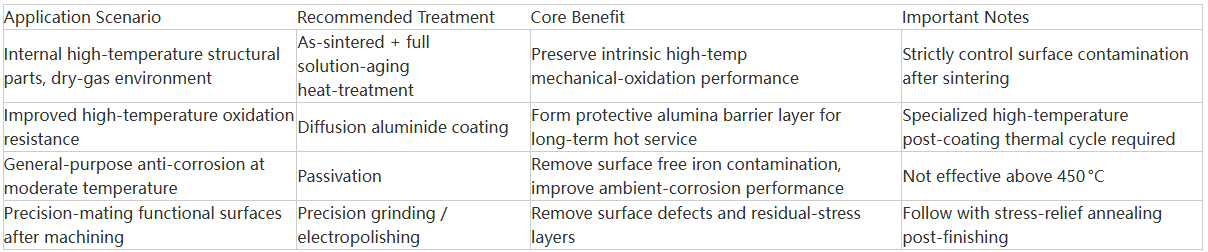
Warning: Organic coatings, PTFE and conventional electroplating are not suitable for parts operating above 250 °C, as coatings will decompose or delaminate under high‑temperature service.
Factory Case Study: MIM Inconel 718 Miniature Furnace Nozzle Assembly
An industrial thermal‑equipment customer encountered early‑stage fracture failure on Inconel 718 MIM miniature furnace nozzles from a former supplier. Although room‑temperature tensile testing met specification, components fractured under cyclic 550 °C thermal‑shock durability testing.
Root‑cause analysis uncovered two major failure drivers:
Insufficient vacuum level during sintering caused oxygen pickup and prior‑particle‑boundary oxide precipitation, creating internal crack‑origination sites.
Incomplete solution‑aging heat‑treatment, failing to fully develop the γ″ strengthening precipitates responsible for high‑temperature creep resistance.
Optimized manufacturing workflow implementation:
Adopted low‑oxygen gas‑atomized Inconel 718 MIM powder; upgraded high‑vacuum sintering profile to restrict oxygen ingress throughout debinding and sintering phases.
Implemented standardized solution‑annealing plus two‑stage aging thermal cycle, locking in target high‑temperature mechanical properties.
Added batch‑lot metallographic inspection and thermal‑shock sampling test as formal quality‑control gate before shipment.
Final result: Mass‑produced nozzle assemblies passed repeated 550 °C thermal‑cycling durability validation, meeting all high‑temperature service requirements for annual output of 86 000 units.
Harbermetal: Your Trusted Nickel Alloy MIM Parts Partner In China
Many engineers select Inconel nickel‑base superalloys purely relying on wrought‑alloy datasheets, without recognizing that sintering‑atmosphere leakage, carbon‑oxygen contamination and incorrect aging cycles can completely ruin high‑temperature service life of MIM nickel‑alloy components. You don’t need to consume multiple sampling cycles debugging superalloy MIM performance. Send your 2D/3D drawings plus high‑temperature functional requirements to Harbermetal. Our engineering team carries out full‑phase DFM feasibility assessment, defines sintering, heat‑treatment and inspection acceptance standards before mold investment, helping you avoid costly mass‑production high‑temperature component failures.
Harber Industrial Limited (Harbermetal) is an ISO‑certified full‑chain Chinese MIM manufacturer with hands‑on project experience for high‑performance nickel‑base superalloy MIM components. We are not an intermediary trading company and own complete in‑house workflows: high‑quality superalloy feedstock evaluation, mold development, metal‑injection‑molding, multi‑stage debinding, high‑vacuum precision sintering, dedicated solution‑aging heat‑treatment, secondary‑CNC sizing and specialized high‑temperature‑oriented surface finishing.
Our engineering team treats nickel‑base superalloy MIM as a complete system project rather than only a material‑grade selection. We assess geometry symmetry, wall‑thickness distribution, risk of sinter distortion, define mandatory high‑purity sinter‑atmosphere requirements and formal heat‑treatment specifications. We execute feasibility reviews for Inconel 718 and Inconel 625 projects and give objective recommendations if nickel‑alloy MIM is not economically or technically suitable and alternative materials should be considered.
We deliver custom nickel‑base MIM high‑temperature components serving industrial thermal equipment, automotive high‑heat assemblies and chemical‑processing equipment. Metallographic reports, high‑temperature property test records and full batch‑traceability documentation can be provided upon request. Whether you require prototype validation or medium‑to‑high‑volume serial production, Harbermetal balances high‑temperature functional performance, dimensional stability and total‑project cost.
Contact information
Email: sales@harber‑mim.com
Tel: +86 0769‑82389116
Final Thoughts
Nickel‑base superalloy MIM opens new design possibilities for complex miniature components operating under high‑temperature, thermal‑cycling and combined corrosive environments. Nevertheless, the alloy grade name alone cannot guarantee end‑use performance. Powder purity, strict vacuum sinter‑atmosphere control, impurity‑element containment, precise solution‑aging heat‑treatment, geometry symmetry and well‑defined high‑temperature acceptance criteria are equally essential.
When developing nickel‑alloy MIM high‑temperature‑service parts, avoid simply transplanting wrought‑superalloy datasheet indexes. Conduct comprehensive DFM review before tooling investment, mark high‑temperature‑related critical‑features and test‑specifications on drawings. Partnering with an experienced full‑chain MIM manufacturer such as Harbermetal effectively mitigates risks of PPB‑oxide defects, heat‑treatment distortion and premature high‑temperature component failure in serial mass‑production.
Frequently Asked Questions About Nickel Alloy MIM Parts
Q: Does MIM Inconel performance fully match wrought Inconel superalloy?
A: Not completely. Residual micro‑porosity and risk of carbon‑oxygen contamination during sintering may degrade creep and thermal‑shock resistance. Acceptance criteria should adopt MIM‑oriented test standards instead of purely wrought‑alloy datasheets. Solution‑aging heat‑treatment is mandatory for unlocking target high‑temperature mechanical performance.
Q: Can nickel‑alloy MIM parts be operated continuously above 800 °C?
A: MIM Inconel 625 can sustain short‑term exposure above 800 °C, but long‑term continuous service above this threshold requires dedicated oxidation‑resistant coating and strict metallographic validation; it is not a default capability.
Q: What is the biggest hidden failure risk for nickel‑base superalloy MIM?
A: Oxygen / carbon contamination in sintering furnace generating prior‑particle‑boundary oxides and carbides. These micro‑defects become crack initiation sources under thermal cycling and high‑temperature load, even when room‑strength test data looks acceptable.
Q: What production volume makes nickel‑alloy MIM economically viable?
A: Due to expensive superalloy powder, special sinter‑furnace and heat‑treatment overheads, MIM nickel‑base superalloys generally show comprehensive‑cost advantages starting from 15 000‑25 000 pieces per year. For very‑low‑volume complex parts, CNC‑machining from wrought superalloy bar stock may represent a more reliable alternative.
Ready to launch your nickel‑alloy MIM high‑temperature‑component project? Submit your drawings and functional specifications for a free manufacturability assessment and quotation.
 en
en
 de
de jp
jp kor
kor fra
fra spa
spa ru
ru pt
pt it
it