en
 de
 jp
 kor
 fra
 spa
 ru
 pt
 it


Sheet Metal Stamping: Process, Tooling and Uses (2026 Guide)
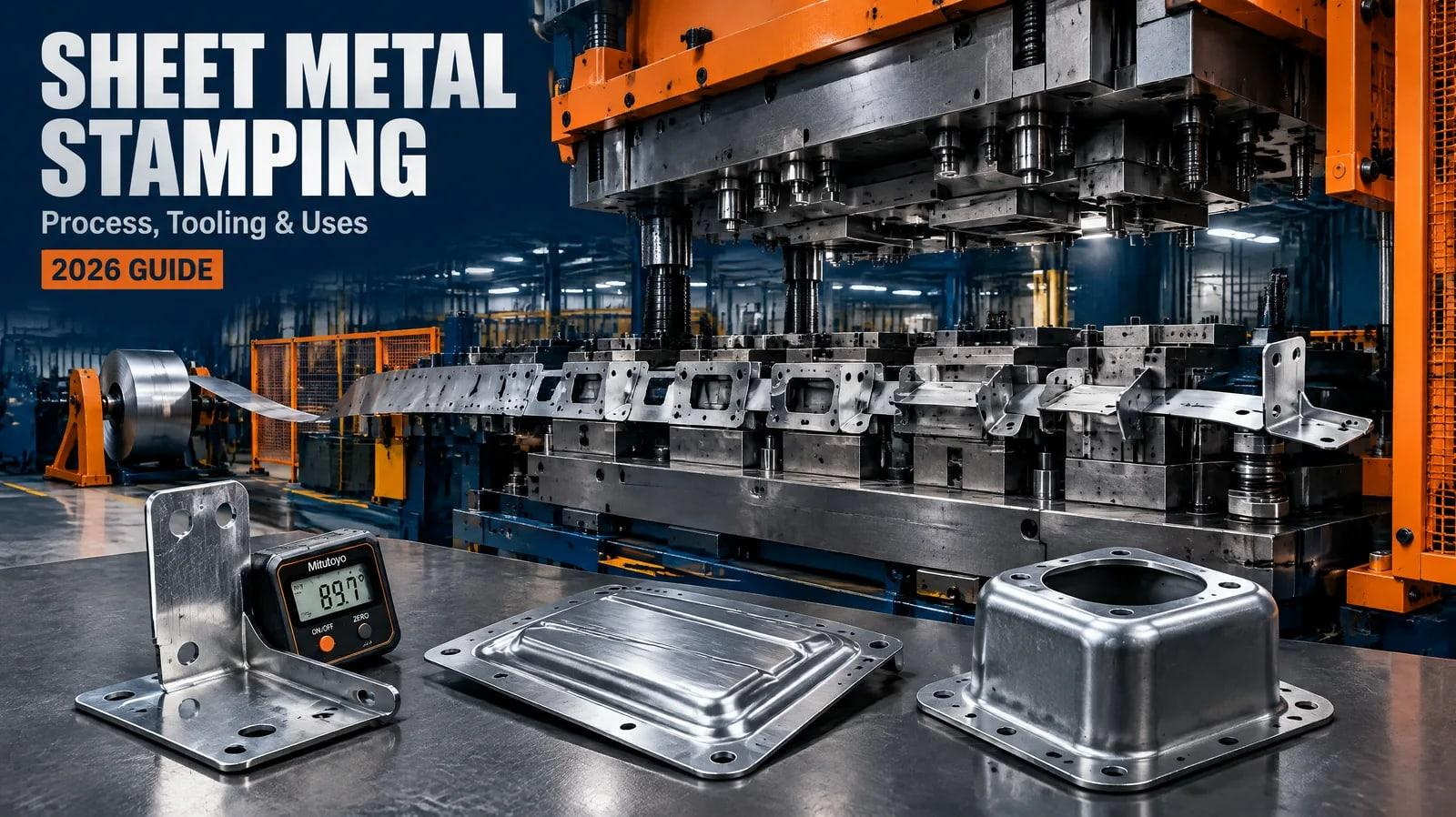
Sheet metal stamping refers to forming a flat sheet use a die and press. It is a cold-forming process as the sheet or coil undergoes no heating. Further, a custom die cut, bend and form a flat sheet or coil into a finished part. High-volume runs are suitable for progressive dies, transfer dies are suitable for large or deep-drawn parts and the tooling cost versus the volume decides which one is economical.
You probably already know stamping makes brackets, panels and housings fast and cheaply at scale. What most die suppliers skip is how to choose between die types, which design rules apply to which material, and how to check angles after springback. This guide to 2026 explains the process, tooling and applications and flags where good advice isn’t good enough.
Essential Points
● Sheet metal stamping is a cold-forming process that uses a press and custom die to turn flat sheet or coil into finished parts without applied heat.
● The operations can be separated into two categories, separation blanking, punching, piercing, trimming, and forming bending, flanging, drawing, coining, embossing.
● Progressive dies transport a strip through multiple stations and suit high working volumes, while transfer dies move separate blanks and more suitable for large or deep drawn parts.
● Stainless steel requires larger hole diameters and bend radii than aluminum or mild steel, according to material controls design limits.
● The most used stamping tolerances are ±0.1 to ±0.5 mm, while ±0.05 mm can be achieved on critical features.
● Because stamping tooling is costly to set up, runs under about 5,000 units often use soft tooling or other processes, according to Fictiv.
● The angle tolerances need to be checked by measurement and agreed with the toolmaker because of angle shifts due to springback.
What is Sheet Metal Stamping?
Sheet metal stamping is a cold-forming manufacturing method that uses presses and custom dies to cut, bend or draw flat sheet into repeatable shapes (Jiga, 2026). The metal arrives as individual blanks or as a continuous coil. No heat is applied, and typical parts include brackets, panels, clips and housings.
Stamping shapes material (by cold forming) instead of removing (as in cnc machining) or melting (as in 3d printing). (Source: Jiga, 2026) A CNC mill is used to carve a bracket from solid. A press utilizing one operation creates identical brackets from a flat strip.
The place where the cost lies is different. Both CNC and 3D printing charge mainly for machine time, so parts of similar size cost roughly the same. Because the cost is applied to the die in stamping, the per-piece cost decreases as volume increases. The writer has stated, not quoted figure.
How does sheet metal stamping work?
The die was built per the latest design after design reviews subjected to six stages - review of inspection - appraisal - and mould making among others.
1. Design and design for manufacturability review Review the hole sizes, bend radii and tolerances of the selected material. A late modification would necessitate costly new tooling.
2. Mold Construction. According to Jiga, dies are made from tool steels and machined using CNC, wire cutting, EDM and grinding. The long lead-time poses a risk to sites.
3. Preparing materials and feeding the coil. The coil is straightened and fed into the machine. Thickness variation appears as a component variation.
4. Stroke the press or presses. The punch forces the sheet down into the die. As the strip moves ahead, progressive dies take multiple hits.
5. Additional process and finishing. The components may have to undergo various processes.
6. Examination. For a first article samples critical dimensions and angles are measured.
The turning point occurs at steps 1 and 2. A stamping die is inexpensive on paper to change, and costly in steel to change, so ask the toolmaker for a DFM review before the die is cut.
What Are the Most Common Types of Stamping?
Operations for stamping can be put into two categories: separation operations that cut metals apart and forming operations that reshape metals. According to the most recent statistics, HLC Metal Parts has experienced this split in their update (Source: HLC Metal Parts, 2026). The table that follows it adds the most important flaw to monitor for each operation.
Operation | Group | What it does | Defect to watch |
Blanking | Separation | Cuts the part outline from sheet | Burrs on the edge |
Punching | Separation | Cuts holes or shapes | Burrs, slug pulling |
Piercing | Separation | Makes holes, slug is scrap | Distorted hole shape |
Trimming | Separation | Removes excess material | Rough edges |
Notching | Separation | Cuts away edge material | Tearing at corners |
Bending | Forming | Folds metal along a line | Springback, cracking |
Flanging | Forming | Turns up an edge | Edge cracking |
Drawing | Forming | Stretches sheet into a cup or box | Wrinkling, tearing |
Coining | Forming | Compresses metal to fine detail | Heavy die wear |
Embossing | Forming | Raises or recesses a pattern | Local thinning |
Blanking and piercing utilize identical cutting action. The only difference is which piece you leave with – when blanking, the cut-out is the part and when piercing it is scrap. This is relevant when reading a wine quote because the two are often priced as two separate die stations.
What distinguishes progressive die stamping from transfer and compound die stamping?
The part's movement through the tool determines what die type will be used. Each die type trades off speed against part size, and flexibility. In progressive die stamping, a metal strip is fed through different stations which each carry out a certain process until the finished part is taken away from the strip (Source: Worthy Hardware). Transfer die stamping involves initially separating the part from the strip before the mechanical fingers or grippers move it from station to station.
Die type | How it works | Best for | Trade-offs |
Progressive | Strip advances through stations | Small, simple parts at high volume | Expensive tooling, hard to change (Jiga, 2026) |
Transfer | Blanks moved station to station | Large, complex or deep-drawn parts | Slow to moderate speed (Source: Eigen Engineering, 2026); larger footprint, higher initial investment (Source: Jiga) |
Compound | Several cuts in one stroke | Flat parts such as washers | Limited to simple flat shapes |
Single-station | One operation per stroke | Prototypes, very low volume | More handling per part |
The definitions used for compound and single station rows are the standard shop definitions. The pages examined present a thin cover.
A sudden decision route assists. When the part is small and the design is frozen, progressive is a good start. Examine the transfer if it's large or incorrectly drawn. If it's flat and simple, inquire about a compound.
Some sources don't agree on volume. LEADRP indicates that progressive dies incur a high tooling cost and requires 10,000+ units (LEADRP, 2026), but provides no source for verification. Fictiv establishes soft tooling limit at 5,000. The gap between five thousand and ten thousand is still unresolved–ask your toolmaker. To find more related tooling categories, check out industrial tools and parts.
Presses, automation and long-run progressive stamping.
The stamping press is the machine that drives the punch into the die; one source gives a punching force range of 10 to 350 tons (Intran 2025) Before relying on that number, it is advisable to check it since it comes from one source. Force requirements increase as the size, thickness, and strength of the part increase.
According to JLCCNC’s report, new presses being installed are predominantly hydraulic presses with many being servo-driven and computer-controlled progressive die systems (JLCCNC, 2026). Basically, with the servo and computer control, the shop can change the motion of the strokes and monitor each hit. Automation means coil feeders, in-die sensors and transfer grippers that cut labour and help catch misfeeds. According to the writer, this offers an explanation of the trend.
Hard tooling designed for millions of cycles is used in long run progressive stamping. Here’s what the math is to break even: tool cost/ per-part saving. Let's say you have a die that costs $40,000. You have a laser cut and bent part that costs $4.00. You have a stamped part that is $0.80. The $3.20 saving per part gives the break-even point of 12,500 units. These figures are illustrative, not prescriptive. The price to stamp each part is lower than automating.
What materials and design rules are applicable to stamped parts?
The design limitations in metal forming are influenced by the choice of material. The forming of ductile aluminum material is easy like 6061-T6. Stainless steel is not only corrosion-resistant but also has an extremely high level of toughness and strength and TZR Metal ties titanium to stainless to make medical parts (Source: TZR Metal).
Number design discrepancies among guides. This table places them next to each other.
Rule | Value | Source |
Min hole diameter, ductile aluminum | At least 1.2x thickness | |
Min hole diameter, higher-strength stainless | At least 2x thickness | |
Min hole diameter, generic advice | Not less than thickness | Other guides reviewed |
Hole-to-bend spacing | 2x thickness plus form radius, up to 3–4x thickness | Guides reviewed |
Stainless bend radius | 1.5–2x thickness | (Source: Yijin Solution) |
Discrepancies in figures due to ductility punch fragility and hole size. A thin punch may break while pushing through tough stainless. For a thickness of 2mm, the minimum hole is approximately 2.4mm in aluminum and 4.0mm in higher-strength stainless or about 67% larger. General advice would permit 2.0 mm, which fails on stainless. A 2 mm sheet with a 2 mm form radius generally gives spacing of 6 mm at the low rule and 6-8 mm at 3-4x.
The standard tolerances generally range from ±0.1 to 0.5 mm. However, for high-precision applications, it is possible to achieve ±0.05 mm on certain critical features (Jiga 2026). Consider any number in this document as starting point and check with the tool maker.
How are bend angles and springback in stamped parts measured?
The unintentional return of a bend component towards its flat shape, after the press releases, is called Springback. Therefore, the die angle and finished angle would differ. According to Jiga, springback and material flow should be considered during sheet metal stamping design (Jiga, 2026) Stainless usually has greater springback than mild steel. So die angles should often be set past the target (overbent).
The five leading pages evaluated for this guide do not provide a method to check the bend angles. This are general shop practices and not sourced claims, So check them with your supplier.
● You could use a bevel protractor or angle gauge for the first parts quick checks.
● Optical comparator or vision system: apply tighter tolerances/“touchless.”
● CMM for complete reports on critical angles.
● Go/No-Go Fixture For Fast Production Check
Indicate the target angle, the tolerances, the measure surface, and the sample size in the drawing. Protolabs has a ±1° tolerance on bend angles for sheet metal fabrication. This is a construction figure, not a stamping-die guarantee.
Linear tolerance is also reduced by angle tolerance. If a 1° an error occurs on a 25 mm face, then the edge moves about 0.44 mm (25 mm × tan 1°). The angle and linear tolerances to set together because that uses up nearly a ±0.5 mm budget by itself.
What Industries Use Metal Stamping such as Plumbing Parts
Whether it’s automotive or medical, each of these areas which engage in metal stamping have one dominant constraint.
Industry | Typical stamped parts | Main constraint |
Automotive | Brackets, panels, heat shields | Cost at volume, strength |
Aerospace | Brackets, clips, light panels | Weight |
Electronics | Connectors, shields, contacts | Tight tolerance |
Medical | Instrument and device parts | Corrosion resistance, cleanliness |
Plumbing and HVAC | Fittings, flanges, mounting brackets | Corrosion resistance, leak control |
An engine heat shield is a sample project used by Fractory. If something comes in contact with water, plumbing typically chooses stainless or brass metals. For automobile programs, see these automotive metal parts.
Publishers have different market estimates. The vision of Grand View Research estimates the year of 2025 at USD 257.3 billion and USD 266.3 billion in 2026 and USD 373.9 billion in 2033. The IMARC Group estimates the market to be USD 226.3 billion, Research and Markets puts it at USD 213.41 billion and Polaris Market Research says USD 256.29 billion. The higher number is about 21% above the lower number, which means there is a USD 43.89 billion spread, so use a range. According to Grand View, the automotive stamping revenue was estimated at 90.6 billion dollars in 2025 (2026).
When is Stamping Not the Right Choice?
When a part is large enough that making dies to stamp it would not be practical, stamping is the wrong choice, as shown here. Stamping also is not the right choice when volume will be low and design may still change. High-cost tooling associated with progressive dies makes it difficult to make design changes. A soft tooling would usually suit short runs of less than about 5000.
Go through these three points before you invest in tooling.
● Does the Volume account exceed 5,000 units?
● Design Stability: Has the design been qualified and baselined?
● Is the part size compatible with the progressive die or transfer die?
Based on this analysis, if two out of the three answers is no, use laser cutting and bending, or soft tooling. Once a design is settled, move to hard tooling.
Common Question Answering
What Is the Cost of Stamping Tooling and When Does It Pay Off?
Stamping tooling incurs significant initial costs, and no universal pricing applies to all components. The expense varies according to the size of the part, the number of stations, and the type of die used. When the saving per part times volume exceeds die cost, it will ‘pay back’. Typically, soft tooling is the best option below around 5000 units.
What distinguishes metal stamping from CNC machining and laser cutting processes?
Stamping a die forms part of a sheet, while CNC machining takes away material and laser cutting burn processes a profile. Tooling is required for stamping but fast running is possible. Laser cutting doesn't require tooling; therefore, it's suitable for prototypes and low volume work. In addition to stamping, features like bends and draws can also be formed in the tool.
What defects can you find in stamping dies and how to prevent?
Some common defects produced are burrs, wrinkling, cracking, springback, etc. Proper die clearance and using sharp tool can reduce burrs. Holding the blank properly prevents wrinkling. Larger bend radii prevent cracking from occurring. Overshooting handles the springback effect. These are commonplace shop practices; check with your toolmaker.
What is ‘long-run progressive stamping’?
Long-run progressive stamping consists of high-volume production utilizing hard progressive tooling, built for millions of cycles. The die always feeds strip automatically, which keeps the cost per part low. This is useful for stable designs. If the part will likely change, we say it is a poor fit.
What is Fine Blanking?
Fine blanking is a type of blanking that produce smooth edges with minimal burr. It uses closer clearances and additional clamping force during the cut. It is often selected when the edge of a part must work without secondary finishing. One supplier may exceed your budget but another may not.
In conclusion,
Reward steady design at volume, punish change after die cut. Before asking for quotes, your designs should already be frozen, your annual volume estimated and your hole, bend and angle numbers also verified against your material. Once the numbers are sent to the toolmaker, request a DFM review. For volume production of less than 5000, price the cost of soft tooling or laser cutting first.