en
 de
 jp
 kor
 fra
 spa
 ru
 pt
 it


Iron and Steel: Thorough Comparison for Metal Components (2026)
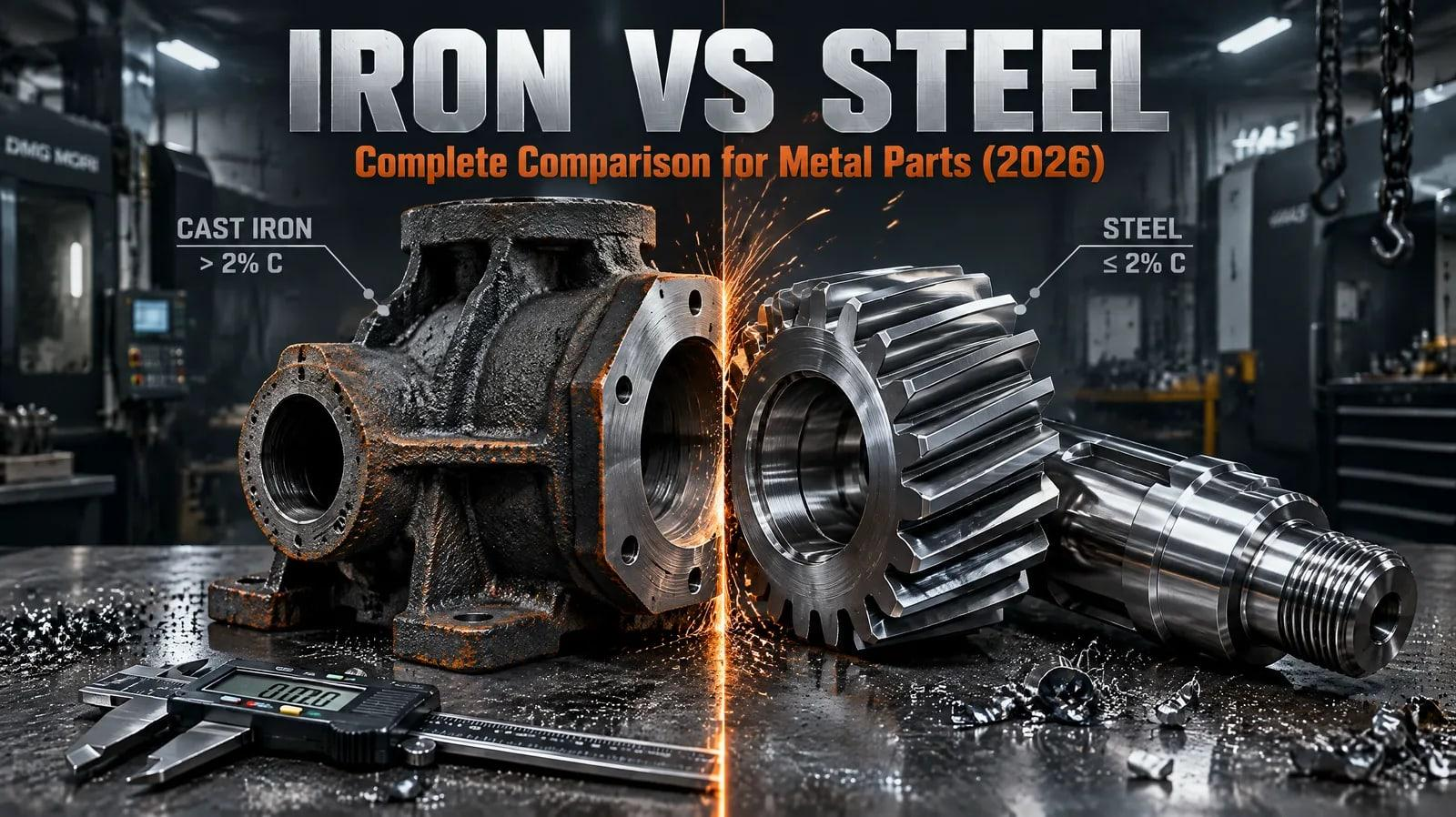
Steel is an iron-carbon alloy with carbon up to about 2% , while iron in manufacturing usually means cast iron with more than 2% carbon. Steel is capable of casting, forging, rolling and welding, and has generally higher strength and toughness. Casting of cast iron is cheaper, machineable with ease and damps vibration and is, therefore suited for complex housings and bases.
You likely already know that steel is an iron carbon alloy and as such it is usually the stronger choice. Most comparisons fail to see; the component creator seldom get the choice of pure iron or steel. Manufacturers will select a casting family out of cast iron and processes out of steel whereby cost per part, machining time and welding. This 2026 Gray Iron vs Ductile Iron vs Cast Steel vs Forged Steel comparison guide enables you to match each material to the part you are building.
Main Points
● Steel is an alloy of iron and carbon with carbon content probably up to about 2%; cast iron contains more than about 2% carbon (Britannica, 2025)
● The term component iron generally refers to a family of cast iron (gray, ductile, malleable, white) rather than pure iron, which is too soft for most engineering uses.
● Steel can be cast, forged, rolled, and welded, while cast iron can only be cast.
● Cast iron is typically easier and cheaper to cast compared to steel because the melting temperature of cast iron is lower and it shrinks less.
● Ductile iron demonstrates strength similar to steel in many cast parts, excellent vibration damping capability, and faster machining compared to its closest rival forged steel in service, where fatigue strength is critical.
● When a welded assembly is required, the steel is chosen. Cast iron is the better choice for complex housings and bases. Steel is preferred for high shock loads. Steel is the choice for fatigue critical parts.
● The expenses associated with the finished component and not the price per pound must dictate material selection, as machining time and process-choice may outweigh raw-material expense.
What is iron in metal component manufacturing?
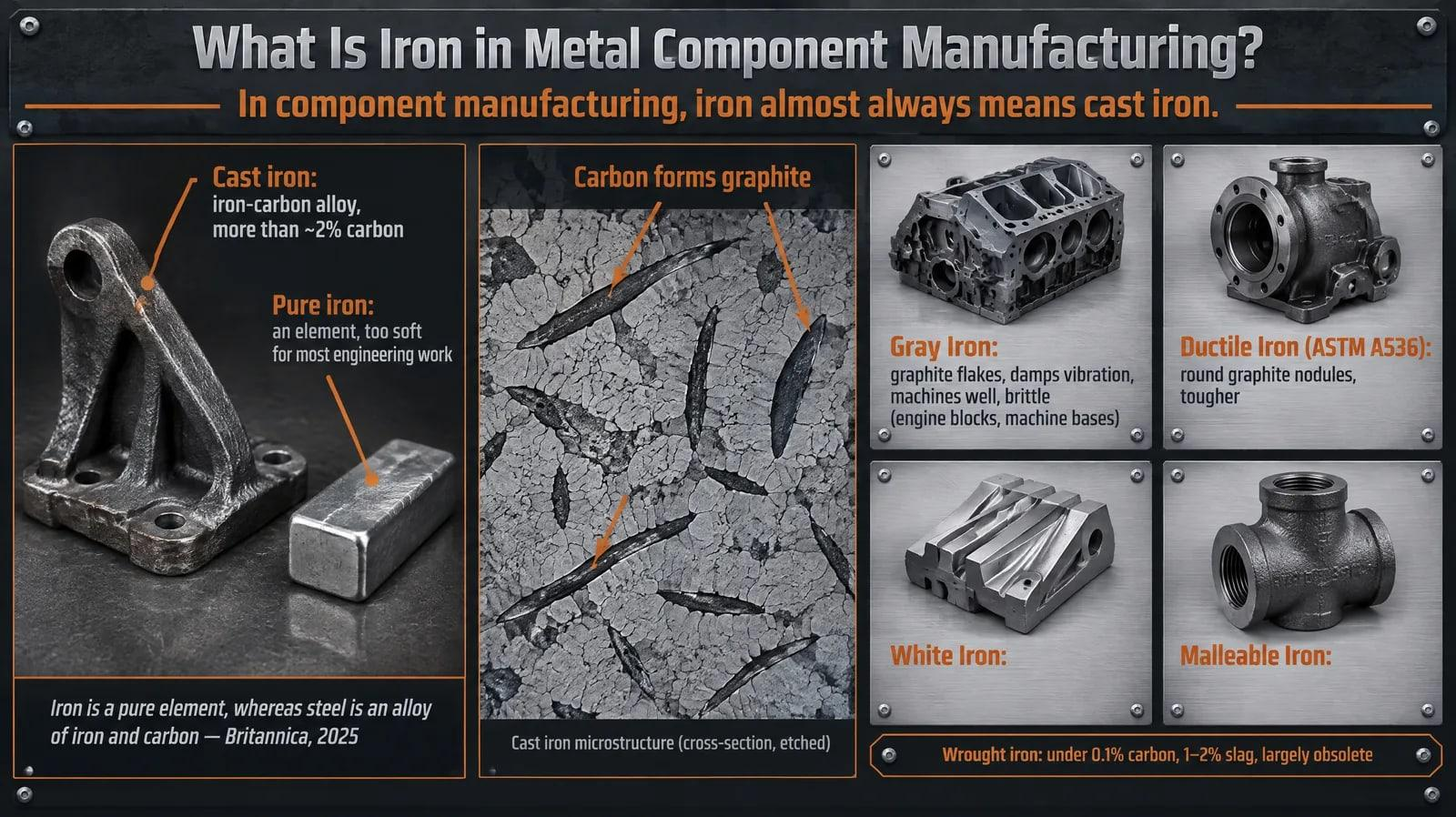
In the field of component manufacturing, when someone says iron or specifies iron, it usually means cast iron. Pure iron is something else entirely. Britannica defines iron to be a pure element whereas steel is an alloy of iron with carbon in ([Britannica, 2025])(https://www.britannica.com/technology/What-Is-the-Difference-Between-Iron-and-Steel) Since pure iron is too malleable to be used for engineering work, no one mentions it for a clamp.
Wrought iron is the ancient exception. It has less than 0.1% carbon but more than 1–2% slag, and it is now largely obsolete.
You will almost always see four families of cast iron.
● Gray cast iron: difficile carbonization where Fe3C precipitates. It dampens vibration, but it produces good machinery which is brittle. Consider machine bases and engine blocks.
● Ductile iron (ASTM A536) is tougher since the carbon forms round nodules. Consider housings for pumps and gearboxes.
● Malleable iron is a kind of white iron that is heat-treated and used for small parts like pipe fittings because it is thin.
● White iron contains carbon in the form of cementite. It won’t wear out quickly but is too brittle.
The carbon line shifts. There is a limit above which the carbon content in steel classifies the metal as steel. Different sources have drawn the upper limit at different values. For example, a source draws it at 2%, while another at 2.06%. Meanwhile, others draw the limit at 2.11% and 2.14%. The first one, which is the lowest limit, belongs to Britannica and the one which is the highest limit is taken from Wikipedia specifically the page for steel. All these values are after research of various types and have merit of the their own. The rounding and phase-diagram conventions are real disagreements. Say it’s “about 2%,” and move on.
What is steel in production of metal component?
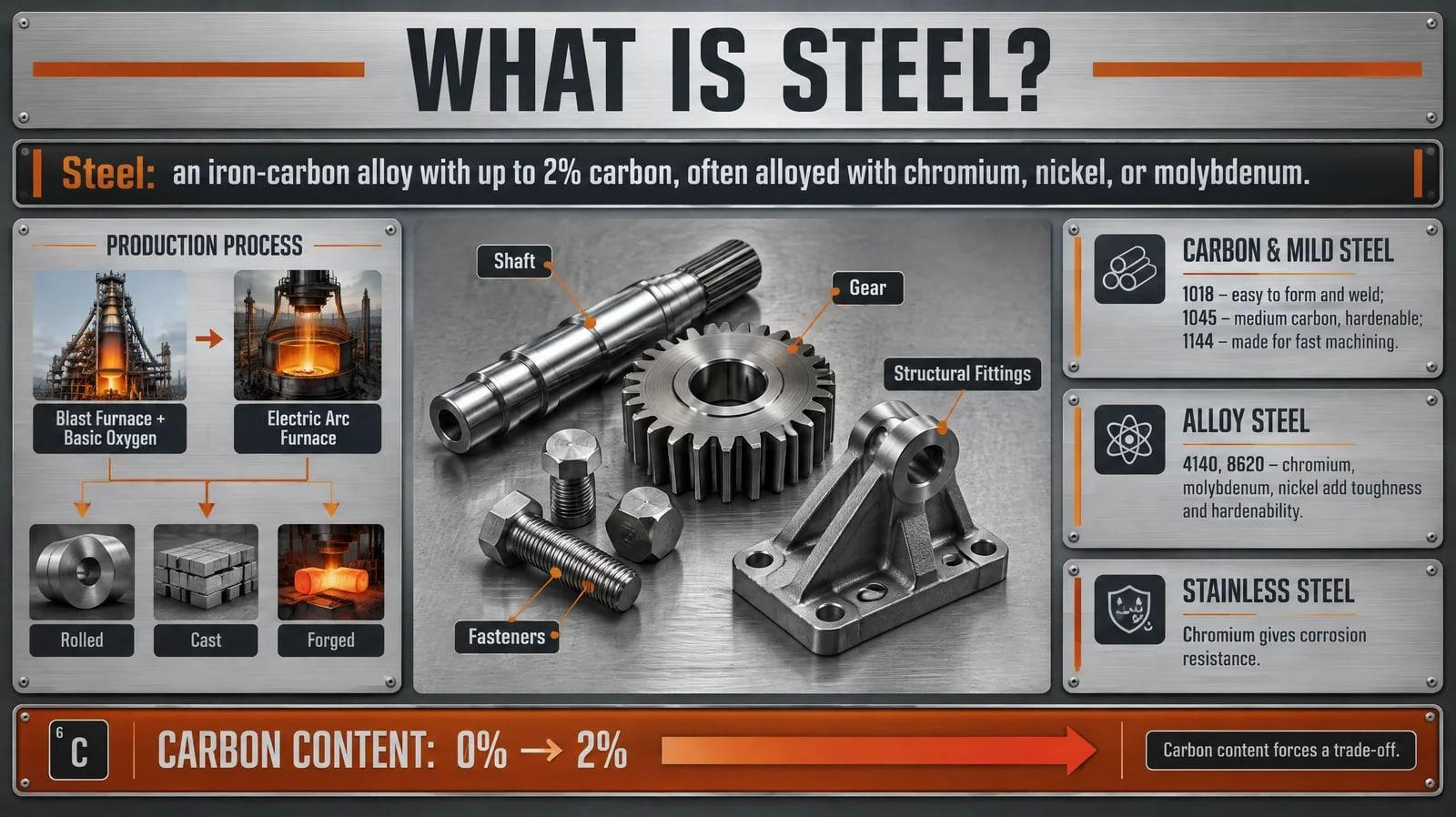
Steel is an iron-carbon alloy (with carbon content usually up to 2 percent) with additional elements, such as chromium, nickel or molybdenum (Britannica, 2025). Steelmakers manufacture steel using a variety of methods including blast furnace, basic oxygen, and electric arc methods. Subsequently it is rolled by mills, cast by foundries and forged into shape by forges.
Groups Of 3 Are Significant.
● An economical option for non-metallic materials. Design Guidelines for carbon and alloy steel. Carbon Steel and Mild Steel for 1045 (with high endurance limit).
● Alloy steels, including grades 4140 and 8620, have added elements to impart toughness and hardenability for useful and practical purposes.
● Stainless steel's chromium imparts corrosion resistance.
Shafts, gears, bolts and nuts, and other structural fittings.
A trade-off is required due to carbon content. Generally, steels up to about 0.20% carbon are weldable, however, a steel needs at least 0.2% carbon to be hardenable (Elementar, 2025). Those two boundaries are at the same number. This is why one grade seldom provides simple welding and complete through-hardening, and why designers instead favour case-hardening grades like 8620, which put a hard skin over a tougher core.
Comparing Cast Iron and steel at a glance
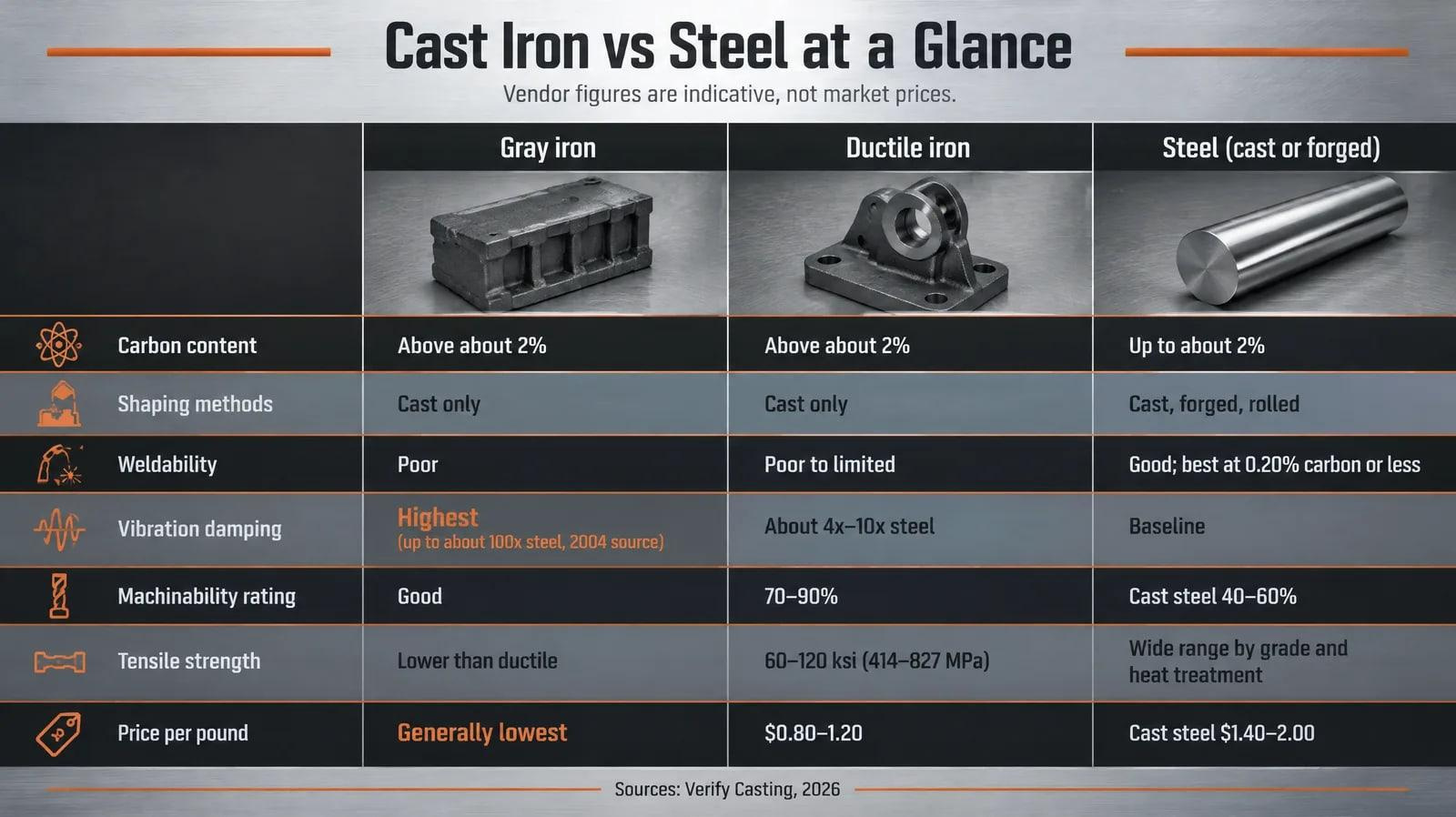
We show you the families among which you really choose, on the dimensions that drive most sourcing decisions. Use the vendor figures as guides only, not to be regarded as market prices or guaranteed properties.
Dimension | Gray iron | Ductile iron | Steel (cast or forged) |
Carbon content | Above about 2% | Above about 2% | Up to about 2% |
Shaping methods | Cast only | Cast only | Cast, forged, rolled |
Weldability | Poor | Poor to limited | Good; best at 0.20% carbon or less |
Vibration damping | Highest (up to about 100x steel, 2004 source) | About 4x–10x steel | Baseline |
Machinability rating | Good | 70–90% | Cast steel 40–60% |
Tensile strength | Lower than ductile | 60–120 ksi (414–827 MPa) | Wide range by grade and heat treatment |
Price per pound | Generally lowest | $0.80–1.20 | Cast steel $1.40–2.00 |
According to vendor reports, ductile and cast steel offer strength, machinability, and price advantages. According to Gear Solutions, 2004 (gearsolutions.com/features/the-details-of-ductile-iron/), damping. Next, according to Elementar, 2025 (www.elementar.com/en-us/the-carbon-content-in-steel-a-decisive-factor-for-material-properties), weldability. Verify Casting, 2016 (www.verifycasting.com/blog/ductile-iron-casting-advantages).
What are the differences and similarities between iron and steel?
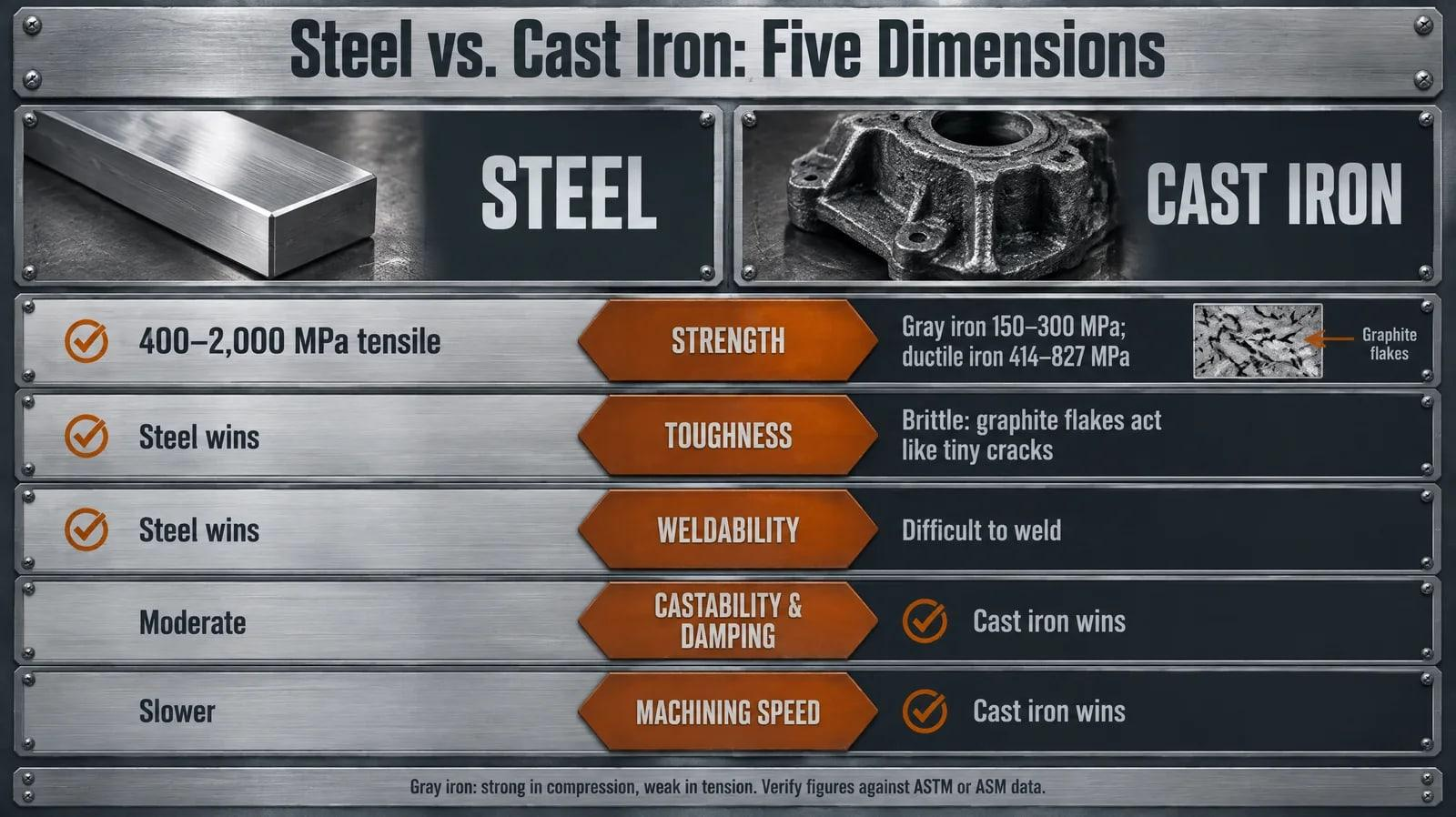
While steel typically takes the prize in terms of strength, toughness and weldability; castability, damping and machining speed favour cast iron. The following segments will examine each aspect in turn.
Is steel stronger compared to iron?
Despite steel’s superiority over iron in terms of tensile strength, ductile iron closes most of that gap. According to one low-authority page, steel is rated approximately 400–2,000 MPa while cast iron is rated 150–300 MPa (LEADRP, 2026). Ductile iron has a tensile strength range of 414–827 MPa (60,000–120,000 psi). The first page only describes gray iron, so that is likely why. Verify numbers against ASTM or ASM data
Strength cannot be defined by a single number. Because of the graphite flakes, gray iron is weak in tension and impact but strong in compression, as they act like microscopic cracks. Ductile iron has round nodules that avoid this issue. However, it still lags forged steel in fatigue.
Not all dissonances have the same source. Gear Solutions explains that gray iron has a cost that can be 100 times that of steel. It also states that ductile iron has a price that is about 10 times that of steel. Another source quotes 6.6 times SAE 1018 steel, based on the ASM Cast Iron Handbook (Penticton Foundry, 2015). A pointer hits up to 4–6 times. In summary, consider a range of 4−10 times for ductile iron, rather than a one-off number.
Sculpting, Moulding, Shaping and Jointing.
The casting process is the only way to manufacture cast iron whereas for steel the manufacturing process can be casting, forging, rolling, welding, etc. Ductile iron pours at an approximate temperature of 2600 °F and steel at 2900 °F. Because steel shrinks more as it solidifies, foundries often add larger risers (reservoirs of extra molten metal). This implies a larger amount of metal dropped, severed, and remelted per good part.
Iron benefits from machining. According to vendor ratings, the ductile iron is rated at 70-90% and cast steel at 40-60% (Verify Casting, 2026). The average 80% score is easier to machine than 50% so ductile iron is 60% better on that scale
Welding is where metal fights. Due to its brittleness, cast iron with high carbon content should not be used in production assemblies. Though specialist repair welds exist, they are not a design. One surprise was that “castings are generally more weldable than “equivalent” forgings,” says the SFSA.
Price per finished part and not price per pound
Cost per finished part determines the majority of material swaps and major advancement in engineering. According to vendor estimates, ductile iron is priced at 80 cents to 1.20 per pound. Furthermore, cast steel is priced at 1.40-2.00. At midpoints ($1.00 vs $1.70), ductile iron is about 41% cheaper per pound.
This situation proved that bigger lever works. A hydraulic bushing shifted from 1144 steel to 65-45-12 ductile iron barstock and cost 30% less as turning speed increased from 650 to 1,400 surface feet per minute (sfm). The speed increase is 2.15x. When feed and diameter are kept constant, the cutting time becomes about 46 per cent of the original. Less metal was saved than machine-time by it.
This is a singular situation not a norm. Steel prevails when an assembly has a fatigue-forged component or a welded component. Ask for the quotes for both the goods.
Corrosion and Working Environment.
By default neither material wins on corrosion. Some pages said cast iron is less susceptible to corrosion; others said iron rusts more. Both are partly right, because the outcome depends on grade and environment. Stainless handles will not corrode whereas, usually iron parts are coated or galvanised (Quaker City Castings, 2026). Try it out in your actual service conditions before you commit to it.
Which one should you select? A decision framework by component.
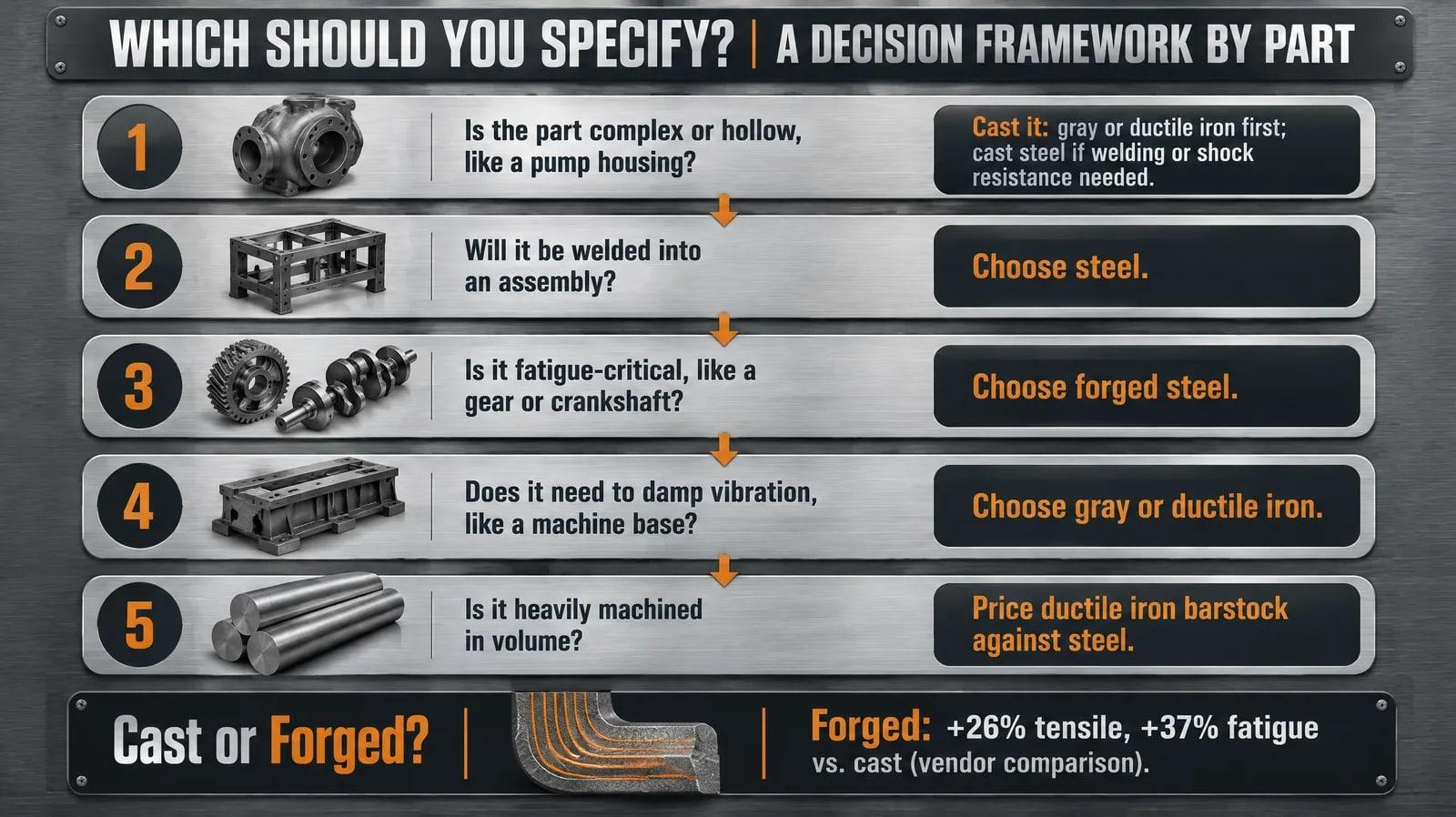
The combination of part geometry, loading, and joining method can lead to faster material selection. Answer these questions one by one.
1. Is a complex or hollow, for instance a pump housing? Throw it. Opt for gray or ductile iron first; opt for cast steel if welding or shock resistance is necessary.
2. Will it be welded together as a whole? Select metal.
3. Will fatigue have critical impact on a gear or a crankshaft? Select forged steel.
4. Will it provide vibration dampening, such as with a machine base? Opt for gray or ductile iron.
5. Is it produced in machined volume? Cost of steel vs. ductile iron
Cast or forged component should you choose?
Forging modifies grain flow which enhances the fatigue life of the part. One vendor’s representative comparison shows its forged parts as +26% tensile and +37% fatigue versus cast (Align MFG, 2025). The forged part is 26% higher than the cast part; thus, the cast part is about 21% lower than the forged part (1/1.26=0.79). On the other hand, castings present isometric properties in all directions, and they suit large sections. A steel casting can achieve the same tensile and yield strength as a forging with the same heat treatment.
When is it not advisable to use cast iron?
Do not use cast iron for welded assemblies, shock loaded or fatigue failure critical components. Gray iron's brittleness and ductile iron's poor performance make them unsuitable for applications involving welding or impact. Thin sections that are under tension are another weakness.
Defining Iron and Steel – Standards and Tools.
Quotation from the suppliers is checked against ASTM standards and ASM handbooks for reference. ASTM A536 Deals with Ductile Iron. The grade names, like 65-45-12, tell you the minimum tensile strength (65 ksi), yield strength (45 ksi), and elongation (12%). The ASM Handbook series on cast iron gives property data; Steel Founders’ Society of America offers free advice on steel castings.
Request material certificates from suppliers as per the named standard. If your specifications require controlled porosity for filtering or for fluid-flow purposes, then solid iron and steel are not viable choices; porous metal components are a separate category.
Commonly Asked Questions
Are iron and steel the same material?
Nay. Iron is a pure element. Steel, in contrast, is an alloy, usually of iron and carbon, and other elements. In the manufacturing industry, we often hear people say ‘iron’ when they actually mean cast iron. This is because cast iron has a higher carbon content than steel. The added carbon makes it castable, damping but brittle.
Is it cheaper than steel?
Typically, by the pound, and frequently by the part. According to vendor estimates, ductile iron costs $0.80–1.20 per pound compared to cast steel at $1.40–2.00 (Verify Casting, 2026). Savings increase with machining velocity. Welded or fatigue-critical parts may still want steel, so get finished-part quotes.
Which material is the best for vibration damping cast iron or steel?
Iron corrosion. Gray or nodular iron has the highest damping capacity. According to some estimates, it is four to ten times that of steels. That’s why gearbox cases, pumps and machine bases are usually iron. Check the figure for your grade as sources disagree.
How can you identify iron compared to steel on the finished part?
A spark test is a good preliminary test which gives an indication that steel gives long, bright, bursty sparks while cast iron gives short, dull sparks. A broken surface on gray iron appears dark gray. Iron is suggested as a result of casting seams and metallic mass. When in doubt, ask for lab results.
Is it possible to weld cast iron?
Not production ready reliably. Assemblies that experience a lot of welding shouldn’t use steel due to the high carbon content that makes welds brittle. Repairs on cast iron are done by specialists with preheating. Consider it repair work and not a design option.
Conclusion
Steel and iron are implements of different jobs. The intricate, damped, and heavily machined components are made of cast iron while steel is used for welded components, used to shock and critical for fatigue. Typically, product specifications on part geometry, volume, load and process dictate choice. Provide at least two options (e.g. ductile iron casting and forged steel) and compare costs per finished part. Verify every supplier data is as per ASTM or ASM data. If you need assistance with a particular component, Harber Metal is a good place to start.