en
 de
 jp
 kor
 fra
 spa
 ru
 pt
 it


Chrome Plating for Metal Components: 2026 Guide
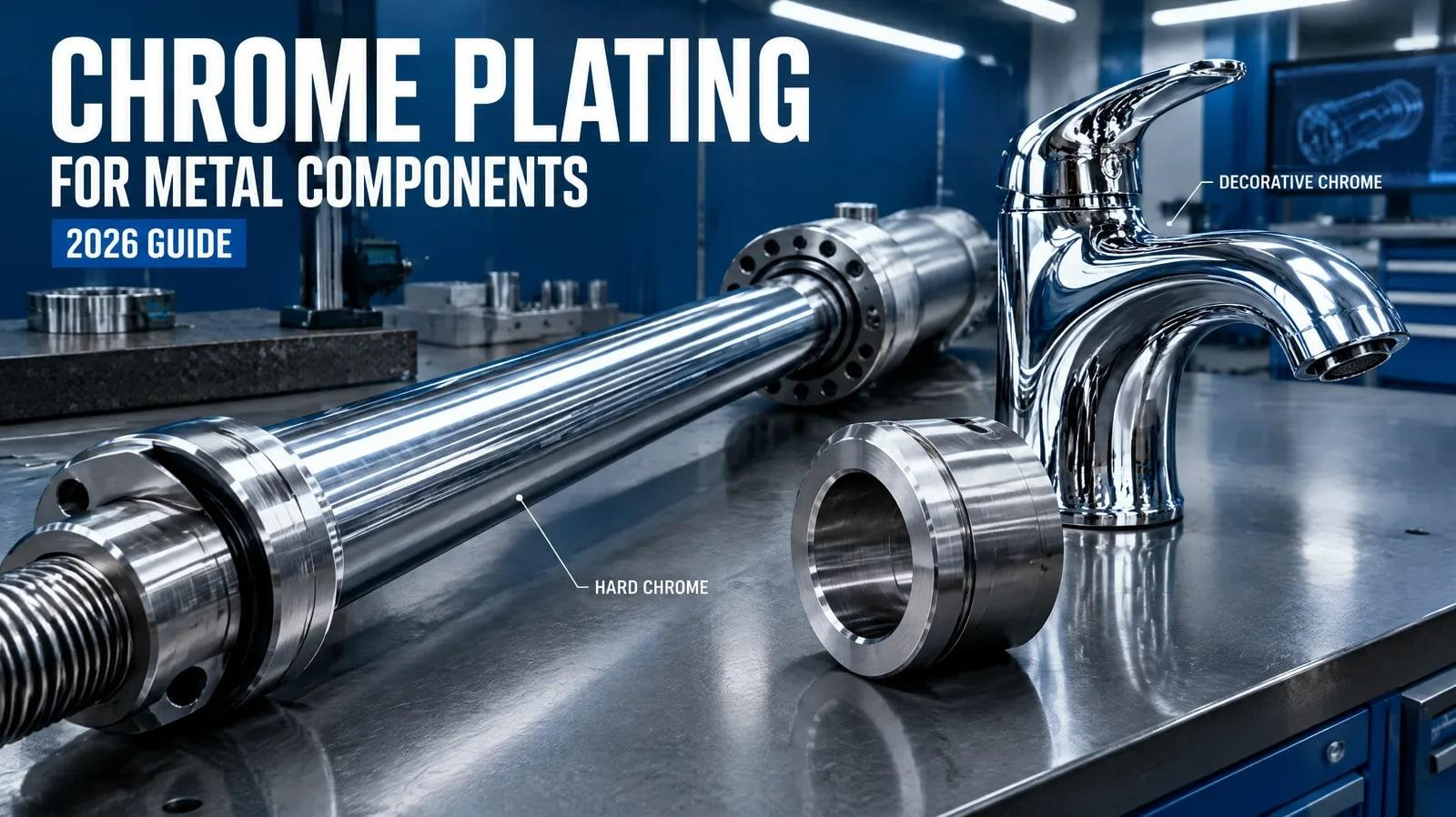
The process of chrome plating is carried out using electroplating. This process deposits a specific layer of chrome on the metal component. With this, the appearance becomes more appealing. Further, it also increases hardness, wear and corrosion resistance. There are two types of chrome plating the first one is decorative chrome – a bright, thin layer placed over nickel – and secondly hard chrome.
You likely recognize chrome as the shiny finish that adorns bumpers and faucets, and as the coating for hydraulic rods. Many guides omit how the base metal, the purpose, and regulations in 2026 should affect your chrome specification. This guide will take you through the types, materials, process, lifespan and the compliance questions to ask before you pick a plater.
Main Points.
● Chrome plating is a process of electroplating metals with chromium to form a thin coating for decoration and corrosion effects. It enhances looks, toughness, resiliency to wear, and rust guard.
● Hard chrome is a thick functional layer for wear and repair of parts, and decorative chrome is a thin bright layer over nickel. According to US Chrome, standard hard chrome thickness is 0.0002 to 0.020 inch.
● The type of plating method is influenced by the base metal. Steel can directly take hard chrome while stainless steel and aluminum require a nickel layer or have special pre-treatment that is usually zincate.
● The lifespan of chrome plating depends not on the finish name, but on the environment where it is used, plating thickness and most importantly maintenance. According to suppliers, severe industrial service may have an estimate range of 1-5 years and light duty for 10-20 years (Universal Grinding).
● Hexavalent chromium is a carcinogen which the OSHA limits worker exposure to 5 µg/m³ as an 8-hour average. Although trivalent chromium is less toxic, it is still being questioned if it is right for heavy dut functional chrome.
● The new wastewater regulation is caused by the use of PFAS-based fume suppressants used in Hex-Chrome baths. An EPA metal-finishing rule with targeted date February 2027 (Environment+Energy Leader, 2026) When purchasing foam, ask suppliers about their chemistry and PFAS-free suppression.
What’s chrome plating and how it actually works?
Chrome plating is an electrochemical technique that deposits a layer of metallic chromium on the surface of a prepared component appearing from a bath of chromic acid. This component serves as the negative electrode. Chromium is pulled from the solution and onto the part by electric current.
Chrome is a coating, not a metal that you make a part from. Terms such as chrome plated metal, chrome finish, chroming, Cr plated all refer to a base metal such as steel, aluminum or brass which has a chromium layer. Chromer metal is also a loose version of the same idea.
The object is first electroplated with nickel and sometimes copper in decorative plating before the chrome layer is applied (Finishing.com). According to PTSMAKE’s thickness data the chromium on top can be less than 1 micrometer (µm) thick. The corrosion blue is mostly borne by the nickel underneath. When assessing a decorative finish, inquire about nickel thickness before chrome thickness.
Hard chrome, decorative chrome and thin dense chrome.
There is a thick functional layer for wear and repairs called hard chrome, while there is a thin, bright layer over nickel called decorative chrome. There is also thin dense chrome that lies between the two. The contrasting factors are highlighted in the table.
Type | Typical thickness | Main purpose | Underlayer | Typical parts |
Hard chrome | 0.0002–0.020 in; adds 25–100 µm per side | Wear, low friction, part restoration | Usually none on steel | Hydraulic rods, rolls, shafts |
Thin dense chrome | 2–10 µm per side | Corrosion and wear with little size change | Varies by base metal | Close-tolerance components |
Decorative chrome | As thin as 50 millionths of an inch (under 1 µm) | Appearance, light corrosion protection | Nickel, sometimes copper | Bumpers, trim, grilles, faucets |
According to US Chrome and PTSMAKE, the two vendors slightly round decorative thickness differently. When comparing extreme values, on one hand, we have 0.020 inch and on the other hand, we have 0.00005 inch or a 400-fold spread in part thickness. Therefore, “chrome plated” alone tells you very little about the part.
The term hard chrome is defined as thick enough to be measured in hardness testing, not for being necessarily harder than other chrome. Mention a thickness, a function, not just the word “hard.”.
Materials Suitable for Chrome Plating
Of these, stainless steel, aluminum, copper alloy may all be chrome plated, but only steel has hard chrome direct. All the rest requires a preparation step first.
Base metal | Typical route | Watch for |
Carbon and alloy steel | Clean, then hard chrome directly; nickel first for decorative | Hydrogen embrittlement on high-strength parts |
Stainless steel | Acid activation, then a nickel layer, then chrome | Passive oxide film blocks adhesion |
Aluminum | Zincate process, then electroless nickel, then chrome | Natural oxide layer; adhesion failures |
Copper alloys | Adhesion layer such as nickel, then chrome | Surface cleanliness |
Paths taken follow PTSMAKE and Proleantech. The hydrogen embrittlement note is a general plating practice that you should check with your plater.
Can you chrome plate aluminum or stainless steel?
Certainly, however, neither of them extracts chrome directly from the bench. Aluminum requires the zinc plating process and electroless nickel, while stainless steel requires acid activation and nickel.
The pre-treatment steps are explained by two of the top five guides in the research, PTSMAKE and Proleantech. Third source, LEADRP, says that hard chrome is suitable to ferrous, and non-ferrous metals. Have faith in the pre-tech variant.
Step by Step Guide on Chrome Plating Process?
The chromium coating process uses five steps functions that include clean, activate, undercoat, plate and rinse. Every step gets the surface ready for the next one.
1. clean remove oil oxide and dirt from the part
2. In order for the coating to bond, etch or treat the surface. Stainless is activated with acid and zincate with aluminum.
3. For decorative work, copper, or nickel are applied. For aluminum, electroless nickel. When hard chrome is plated on steel, it often skips the step of pre-treatment.
4. Submerge the component in the chromium solution while current is applied until the target thickness builds.
5. Rinse off bath chemicals and then dry, bake or grind to suit the needs of the drawing.
The plating process usually uses only about 20 percent of the current applied during chrome plating which deposits chromium on the part. Basically, 80 percent of the electricity is used for the side reaction instead of coating. Gas is released from these reactions that carries chromium dust out of the bath. That’s why platers use fume suppressants. PFAS thus ended up in the picture.
How to Select a Chrome Finish for Your Component?
Shop based on function first: wear and repair point to hard chrome, while appearance points to decorative chrome. Tight tolerance points to thin dense chrome. The preparation route is then set by the base metal.
● Hard chrome, as found on hydraulic rods, is utilized for wear or sliding contact.
● Repairing an aged shaft: built up Hard chrome, then ground back to measurement.
● This is a Decorative nickel-chrome which is a standard for automotive chrome plating on bumpers, trim and grilles. Take a look at automotive metal parts.
● Coastal or wet service: Bright chrome with thick nickel.
● Achieve tight tolerances through either a thin layer of dense chrome or additional coating.
This is a worked example The layer of hard chrome adds 25-100 µm per side (PTSMAKE). On a shaft measuring 50 mm, the diameter which grows by 50 to 200 µm has a dimension of 50.05–50.20 mm before grind. Your plater should be told the final dimension; leave a grinding allowance on tight fits. For more plated hardware check out industrial tools and parts.
Chrome plating how long does it last?
The lifespan of chrome plating is 1-20 years dependent on environment, thickness and maintenance. These are supplier data, not controlled test data.
Finish and environment | Vendor estimate |
Hard chrome, light duty | 10–20 years |
Hard chrome, moderate industrial | 5–10 years |
Hard chrome, severe service | 1–5 years |
Decorative chrome on cars, regular cleaning | 10–20 years |
Decorative chrome near the coast, thin nickel | May pit in 3–5 years |
Hard chrome figures are supplied by a UK supplier. It originates from Baosheng Industry. The hard chrome finish that’s best case and worst case differs by 20 times (20 years versus 1 year). Therefore, the environment is more important than the finish name.
There are differing qualities. According to a contributor on Finishing.com, poor quality chrome job can hasten the corrosion of the underlying steel, and consumers can’t really tell the difference. This is the opinion of the industry, not a study. Request thickness and salt-spray records instead of judging by shine.
What changes will take place in 2026?
The classical hexavalent chromium (Cr(VI)) in chrome baths is carcinogenic while the trivalent chromium (Cr(III)) is less toxic. According to OSHA's fact sheet, trivalent hexavalent chromium is less toxic.
According to OSHA, the US body, the limit "should be set at the lowest level that is technologically. Occupational Safety and Health Administration (OSHA, 2006) The regulation can be found under 29 CFR 1910.1026.
Year | Milestone | Source |
2006 | OSHA cuts the Cr(VI) limit from 52 to 5 µg/m³ | |
2013 | NIOSH recommends 0.2 µg/m³ | |
2018 | ACGIH sets a 0.2 µg/m³ guideline | |
2023 | CARB amends its rule: decorative facilities stop using hex chrome by 2030, functional by 2039 | |
2027 | California decorative 2027 pathway ends hex use; EPA PFAS metal-finishing rule targeted | |
2039 | California functional chrome must stop using hex |
The 5µg/m³ limit is approximately 90 percent lower than 52, yet NIOSH's 0.2µg/m³ is 25 times lower again. Chrome finishing facilities discharge PFAS due to the use of PFAS-based mist suppressants. It should be noted, however, that the phase-out dates may change as a result of CARB’s technology assessments (see CARB), and federal wastewater standards (40 CFR Part 433) and the chromium electroplating NESHAP also apply.
Questions to ask your plater:
● Do you run hexavalent or trivalent chemistry for this part?
● Is your fume suppression PFAS-free?
● Can you share thickness and ASTM B368 (CASS) corrosion results?
● What are your lead times if you switch chemistry?
When Chrome Plating Is Not the Right Option?
Choosing chrome plating isn't ideal for aluminum when you need heat resistance, a thin layer, color or corrosion options. It is not something everybody will get.
● Chrome gets soft at high temperature. Source: HCS Plating. Let your plater know the operating temperature.
● Aluminum that is subject to color or corrosion schemes will often be better anodized. PTSMAKE itself compares these two.
● Trivalent works for decorative finishes, but patent filings from interested parties state it has struggled to match hexavalent consistency and is sensitive to metal impurities. Don't put too much trust in our work.
● Low-cost appearance parts like nickel or powder coating can fulfil your needs.
According to these sources, as a rule of thumb, if the base metal is aluminum and the aim is color, start with anodizing. Try a different coating if the part is running hot.
Commonly Asked Questions.
Is the Use of Hexavalent Chrome Plating Ending?
Indeed, yes California. Decorative finishes have a 2027 or 2030 pathway. Furthermore, functional chrome must cease use of hexavalent chromium by January 1, 2039. It is still permitted by federal rules with strict OSHA exposure limits.
Trivalent Chrome: A Valid Alternative for Plating Processors?
Not yet for each part. Trivalent chromium poses lower toxicity and applies well for decorative finish. Heavy-duty functional hard chrome supplier is still debating consistency. Check the samples on your side before switching.
What Influences the Cost of Chrome Plating, and Is It Worth It?
The expense is dictated by the size of the part, required thickness and batch size. I could not find any reliable public price figures, so you could request some price quotes. It is economical to repair something when it would otherwise get replaced due to wear.
Chrome Plating Process Duration – How Long Does It Take?
It is dependent on thickness. The time taken for plating increases with the layer required. Thus, a decorative thin coat will finish far sooner than a thick hard chrome build-up. Before the plating process begins, be aware there are more factors than just plating time.
Does Chrome Plating Make a Part Bigger?
Certainly. The thick- dense chrome adds 2-10 microns (μm), hard chrome adds 25-100 (μm) per side and a decorative chrome add under 1 (μm) (PTSMAKE). Make allowances for machining.
Conclusion.
Select the finish by function and then verify the path for your substrate. Alloys will need a pre-treatment, whereas hard chrome has a wear/repair function and decorative nickel-chrome solves any appeal. Before sending a drawing to your plater, ask one simple question: Is the bath hexavalent or trivalent, and is the fume suppression PFAS-free? As the rules for 2026 are still evolving, that answer will affect cost, lead time and end-of-supply.