en
 de
 jp
 kor
 fra
 spa
 ru
 pt
 it


Complete Non-Ferrous Metals List: Properties, Uses, and CNC Machining Tips
Non-ferrous metals have many significant applications in current manufacturing, engineering, construction, electronic, automotive, aerospace and medical industries. They are not based mainly on iron as are the ferrous metals. Many of them have a significant value for low weight, corrosion resistance, electrical properties, thermal resistance, and strength/weight.
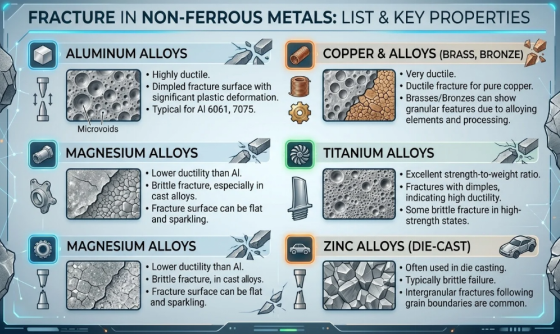
Some of the most common applications are made from aluminum, copper, brass, bronze, titanium, zinc, magnesium and nickel alloys. While the basic properties are an important consideration, selecting the appropriate material involves even more than those properties. It depends on the environment in which the components are used, the grade of alloy required, the toe that is needed for machining, size tolerance allowed and surface finish needed together with the production volumes. This Non-Ferrous Metals List provides details of the primary categories, specific characteristics, typical usage, and beneficial material considerations for CNC Machining.
What Are Non-Ferrous Metals?
Non-ferrous metals are the metals and alloys which do not contain iron as their primary constituents. May include small amount of iron as an alloying element, but not based on iron.
The above metals are used all over the world in which they can impart properties that serve certain engineering applications. For instance, copper is highly conductive, aluminum has low density and is also fairly machinable, and titanium has high strength and, on a mass-to-mass basis, is relatively light.
The non-ferrous metals are divided into two categories: common engineering metals and special metals. The performance may vary widely from alloy to alloy as well. Thus, it is always advisable for engineers to always verify the actual material specification rather than choosing a material by its general name.
Complete Non-Ferrous Metals List
This Non-Ferrous Metals List includes the key materials that are commonly used in manufacturing and precision engineering.
1. Aluminum
One of the most widely-used non-ferrous metals is aluminium. Low density, easy to be corrosion resistant, easy to be thermal conductive and relatively easy to be machined. Common grades include 6061, 7075, 2024, and 5052.
Aluminum 6061 is commonly used for general engineering and CNC parts, whereas 7075 is used for higher strength and performance parts, like parts used in the aerospace industry. Common applications for aluminum include automotive bodywork, electronics, aerospace structures, heat sinks, machine components and housings, to name a few.
Aluminum can typically be processed at a relatively high cutting speed with regard to CNC Machining. But some tool geometry and chip removal issues still remain to be addressed for a clean surface finish.
2. Copper
One of the main properties of Copper is its ability to conduct electricity and heat well. It is also relatively resistant to corrosion and can also be used in applications involving efficient heat transfer and/or electrical conductivity.
They are used in a variety of applications, such as electrical connectors, busbars, wiring components, heat exchangers, cooling systems, and thermal-management applications.
Copper is rarely as easy to machine as certain grades of aluminum or brass; unlike other materials it is soft and highly flexible. The use of acceptable tooling and cutting parameters minimize burr, material sticking and surface finish issues.
3. Brass
The main form of brass is a copper – zinc alloy. Its useful mechanical properties, appearance, corrosion resistance and good machinability makes it popular.
Brass is a popular choice for fittings, valves, connectors, fasteners, plumbing and hardware, or precision-machined parts. Some of the grades of brass are specially selected for automatic machining, high volume production.
Brass tends to be a relatively easy cutting material when using CNC machines. However, the grade should be taken into consideration, as the alloy composition may influence the hardness, strength and machinability of the grade.
4. Bronze
Bronze refers to any of a group of copper-based alloys that may also contain tin, aluminum and other alloys. Lots of bronze grades will give good load-bearing, corrosion resistance and wear resistance.
Common uses are bearings, bushings, gears, valves, marine components and parts that require friction or are subjected to harsh conditions.
The properties of bronze used for the manufacture of castings vary with the alloy. Some grades are easy to machine, others need careful control of cutting speed, the feed rate and the machine tooling.
5. Titanium
The property of titanium is high strength/weight properties and corrosion resistance. The Ti-6Al-4V alloys are the most widely accepted titanium alloys in applications like aerospace, medical, chemical processing etc. for its superior properties.
The toughness and rust-proof properties of titanium are beneficial in components where high performance is required in harsh environments. An oft-cited example is medical implants or aerospace parts.
Rather, titanium is more difficult to CNC machine than many metals that are used in manufacturing. It is relatively insulating with a tendency towards heat focusing around the cutting area. Thus, the selection of cutting tools, coolant, cutting parameters, and chip control are significant.
6. Nickel and Nickel Alloys
Nickel and nickel alloys are chosen to provide high corrosion capability, high temperatures resistance, and high performance or stability into elevated temperatures.
They find application in aerospace components, chemical-processing equipment, power-generation systems, heat-resistant components and other challenging industrial applications.
Nickel alloys are not ideal materials to machine due to their hardness, strength and ability to produce high cutting forces and heat. Wear of the tools can also be a problem. It is also critical to using stable machining conditions and the appropriate cutting tool to ensure dimensional accuracy and surface condition.
7. Zinc
Zinc is signficant due to its corrosion resistance, castability and low melting point. Widely used in die casting and protective applications.
Automotive parts, hardware, housing, fittings, and precision cast parts are some of the applications for zinc alloys. Zinc is also used to protect steel parts from corrosion by coating them.
In the manufacturing of zinc alloys using CNC, the selection of the alloy type, part geometry, work holding method, and surface requirements are all important factors to be taken into account. Good handling to prevent deformation and surface defects.
8. Magnesium
Magnesium is one of the lightest metal available for engineering use. It has a low density, which is beneficial in designs aimed at minimizing component weight.
Selected Applications: Automotive, Aerospace, electronics and lightweight equipment, etc. are using magnesium alloys. They will also have some benefit during the proper conditions of the machineability.
But, when it comes to CNC magnesium machining, there are safety precautions to take into account as this can create a fire hazard as very fine chips and dust. Housekeeping, tooling and machine set-up are critical.
9. Tin and Tin Alloys
Tin is a relatively low melting point, soft, corrosion resistant metal. It used to be made into structural material but has significant use of electronics usage, soldering and special alloys and coatings.
Tin alloys may be employed for protective coatings and for joinings. Due to the relative softness of tin, care should be taken that dimensionally important machining operations are controlled.
10. Lead and Lead Alloys
A heavy soft non-ferrous metal which has been given countless uses, including radiation protection, batteries, weights and special industrial applications.
Lead causes toxicity, though, and use of lead is limited and controlled in many products and industries. All lead work, whether it involves manufacturing or not, should adhere to all workplace, environmental, handling, waste disposal, etc. requirements.
Engineers are required to think about alternatives when they're designing a product today if it can perform the same function without the health and environmental risks that accompany the use of lead.
11. Other Specialized Non-Ferrous Metals
There are some less-common metals that are used for specialized engineering uses. These include metals such as cobalt, silver, gold, tungsten, zirconium, niobium and the platinum group metals.
Cobalt alloys offer excellent wear and high-temperature properties. Silver and gold has the use of providing electrical conductivity and is used in special electrical and electronic application. Tungsten has an extremely high density and good temperature resistance. Zirconium has been found to resist corrosion in some chemical environments, and niobium is utilized in specific alloys and for advanced uses.
Typically used in materials for certain performance needs rather than general application. They should be checked in terms of their cost, availability, channelling and application before production.
Key Properties of Non-Ferrous Metals
Each of the materials listed in a Non-Ferrous Metals List has a combination of different physical and mechanical properties. One of the most significant advantages for moisture, chemical, salt water or outdoor applications is corrosion resistance. Certain alloys, such as aluminum, titanium, copper alloys and nickel alloys, can offer environmentally beneficial corrosion protection as applicable.
Weight is another of the considerations. Aluminum and magnesium are good for lighter appearances, and titanium is a superior strength option than some steels, but is still lighter.
Other factors affecting material selection include electrical and thermal conductivity. The electrical use is particularly suitable for copper, whereas aluminum, which offers low weight combined with high conductivity, is used in various other electrical and electronic components.
Gears, bushings and bearings require hardness and wear resistance. Machinability is another feature to be considered as a material that is good in service may take longer to produce, involve more sophisticated processes or require more specialized tooling.
CNC Machining Tips for Non-Ferrous Metals
There are significant differences in the machining efficiency of various non-ferrous materials used for CNC. These factors as hardness of material, ductility, abrasiveness and ability of the material to form built-up edges are taken into account when choosing tools for a given job.
The start the speed, feed, spindle speed and depth of cut should also be customized on the particular alloy and machining operation. The same profile that works good for aluminum might not fit with titanium or nickel alloys.
It is important to ensure that a chip is ejected in case of soft metal turning. Can get captured, causing damage to the surface or to the cutting process. (When applicable) the use of coolants or appropriate lubricants may also be used to control heat as well as enhance the performance of the tools.
No one can overlook workholding. Excessive clamping forces will cause softer or thin walled pieces to deform. Following the machining process, further processes like deburring and threading, surface finishing and dimensional inspection may be required.
When the parts to be machined are difficult, such as titanium alloys or nickel alloys, controlling heat and tool wear play an important role in ensuring the accuracy and surface quality of the parts.
How to Choose the Right Non-Ferrous Metal for CNC Machining
The appropriate material must be used for the intended application of the final product. Strength, weight, Corrosion, operating temperature, electrical conductivity, thermal conductivity, hard index, wearing resistivity and machinability should be considerations given to engineers.
Also, the type of alloy grade is important. Caution should be used when considering mechanical and machining properties when considering different grades in the same metal family.
Volume of production also should be taken into account. For any product, the material cost is but a small fraction of manufacturing costs. The final cost can be influenced by various factors such as the machining time, tool life, nature of the finishing operations, availability of materials, inspection and scrap rates.
Very applicable for "precision components": selection of material and of process should be undertaken simultaneously. The most ideal material is the one which satisfies the application needs and is also can be manufactured easily.
Non-Ferrous Metals vs. Ferrous Metals for CNC Machining
Factor | Non-Ferrous Metals | Ferrous Metals |
Main composition | Not primarily iron-based | Primarily iron-based |
Weight | Not primarily iron-based | Many grades are heavier |
Corrosion resistance | Often good, depending on alloy | Varies by material |
Electrical conductivity | Often high | Generally lower |
Magnetic properties | Many are non-magnetic | Many can be magnetic |
Common uses | Electrical, aerospace, medical, precision parts | Structural and heavy-duty parts |
Machining behavior | Varies by alloy | Varies by grade |
Conclusion
The choice of right non-ferrous material is determined by the required characteristics of the obtained product, not the characteristic of the metal. Specialized metals, such as aluminum, copper, brass, bronze, titanium, nickel, zinc, magnesium, tin, lead, and a myriad of others all have different engineering applications.
Although this Non-Ferrous Metals List is certainly a good starting point to compare materials, you will need to consider the alloy grade, as well as its operating environment, tolerances, production volume, surface requirements, and the type of CNC machining process utilized prior to making a final selection. By carefully evaluating material and manufacturing, the performance of a component may be enhanced, while also managing production time and cost.