en
 de
 jp
 kor
 fra
 spa
 ru
 pt
 it


Does Brass Rust? Understanding Brass Corrosion and How to Prevent It
The strength, e.g. for fittings, connectors, valves, hardware, appearance, especially due to the process of embossing, and resistance to corrosion make brass a popular alloy for precision metal or near-net-shape parts and decorative parts. However, it can be altered over time by moisture, air, salt and chemicals. Does Brass Rust? The answer is No, not just like iron and steel. Brass is mostly made of copper and zinc, and does not rust, as iron does. Instead, brass may tarnish and darken, or have green deposits or other types of corrosion. The processes can be explained to both manufacturers and users of application machines so that they can choose suitable materials, finishes and maintenance methods to produce application machine components with increased service life.
What Is Brass?
Brass is an alloy of copper and zinc, the amount of which can be used to vary the properties of the metal. It can be used in a variety of applications including plumbing, electrical, automotive, decorative, industrial, consumer because its combination of strength, machinability, electrical conductivity, appearance and corrosion resistance. Brass compositions vary according to their operating conditions, and therefore choosing the right material to suit the environment that a component is to perform in. Geometry, surface finish, chemical environments, temperature and service life may also be considerations when selecting the material for precision metal parts. It is easier to understand the effect which moisture and oxygen have on brass, if one starts with an understanding of its basic composition.
Common Types of Brass
There are various types of brass alloys, each having a combination of strength, machinability, corrosion resistance and other properties. Examples are cartridge brass, free-machining brass, and naval brass. Cartridge Brass is ductile, and Free-machining grades of the material are made to be easier to cut and machine. It is sometimes necessary to add other alloying elements to naval brass to provide it with superior performance in harsh environments. The grade to use depends on the application, manufacturing process and on how much the material will be exposed to water, chemicals, salts and other corrosive conditions.
Does Brass Rust?
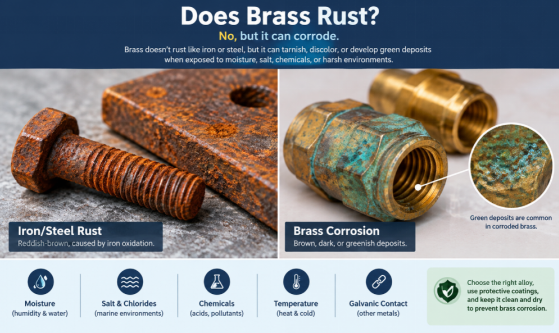
Brass is not rusted by iron, because it has not a lot of iron in it, but copper and zinc. It is surface reactive with nitrates, moisture, ions, pollutants, salts and chemicals, however. Reactions can cause the formation of tarnishing, discoloration and various kinds of corrosion. While the brass components may become dull, brown, dark or green over time, depending upon their environment and alloy composition. For this reason a brass product will normally be more corrosion resistant than many common iron-based products, but the surface may change or strip away instead of being fully protected against corrosion. It is important to realize that rust and corrosion are different when purchasing brass material for interior, exterior, marine, plumbing or industrial use.
Brass Rust vs. Brass Corrosion
Rust is a term used for the corrosion products that develop on iron and steel when iron oxidizes (reacts) in the presence of oxygen and water. Brass is a copper-based alloy and hence it reacts differently from chemical point of view. In addition to its surface becoming covered in reddish-brown iron oxide, it can develop oxide layers, tarnish or greenish copper-based compounds. When we compare these two, a simple comparison is helpful so the readers could know the difference at their glance: Rust, commonly observed on iron and steel, takes a red-brown color, while surface deposits are noticed on brass and take on a brown, dark blue-green, or green color. Not all changes are necessarily an indication that the brass part has become structurally unsound, but if performance or safety is involved, deep corrosion should be checked out.
What Causes Brass to Corrode?
There are some environmental conditions that can speed up the corrosion of brass. Chemical reactions can take place more easily, particularly when water is present for extended periods, under moisture and high humidity conditions. Sea salt and salt water exposure may be a specific concern in marine and coastal environments. Brass surfaces could also be corroded by acids, cleaning chemicals, industrial pollutants or other agents which are reactive. The rate of these reactions may be affected by temperature and exposure times. A second problem, related to the first, is galvanic corrosion that can happen when the brass comes into contact with another metal in the presence of moisture or some other electrolyte that will allow electrochemical reactions to occur. These are important parameters to consider when selecting proper alloys and protection measures for the engineers' design.
What Does Corroded Brass Look Like?
Rusted brass can exhibit various marker changes, depending on the environment and form of corrosion. The early symptoms can be dull or faded finish, brown or dark patches, spots, or surface discoloration. Product corrosion that is noticeable can cause green or blue-green deposits particularly if copper compounds have formed on the surface. Under more severe conditions, pitting or surface roughening can be seen. It should not be assumed that any of these conditions is a sign of failure of the components. In other areas, however, discernible corrosion must be checked to see if it has altered any properties such as dimensions, strength, sealing surfaces, etc., that are important for function and/or safety.
What Is Dezincification in Brass?
The corrosion process is called Dezincification and is a problem with certain types of brass. In the process, only the zinc of the alloy is removed, resulting in a structure of copper. This can compromise the integrity of the material and could become a serious issue in some applications and harsh settings. Colour changes or a porous surface are signs of dezincification, however it can not always be seen visually. This is significant for selecting an alloy when it will be exposed to situations that could result in dezincification. A number of factors should be evaluated to decide on the grade of brass for a specific engineering requirement, such as water composition, water temperature, type of alloy used, and service conditions.
How to Prevent Brass Corrosion
Brass corrosion problem can be avoided by selecting proper alloy for the environment in which it is to be used. Considerations for the manufacturer choosing a material include moisture, salt, chemicals, temperature, mechanical loads and anticipated service life. The surface of the brass can be treated to provide an extra resistance against the environment, using protective coatings, plating, polishing etc. Routine cleaning will eliminate dirt, salts, oils and chemical residues that can be conducive to corrosion. Correct storage is also necessary particularly in humid atmospheres. If brass is used together with other metals, the correct design of the joints/connection and proper electrical isolation may reduce galvanic corrosion. These are particularly beneficial when it is important that brass items remain their during long-term usage in terms of appearance, dimensions and efficiency.
Cleaning and Protective Maintenance
The cleaning should be appropriate for the type and condition of the brass part. Loose superficial surface dirt and deposits can generally be removed using a suitable non-corrosive method with a suitable cleaning compound for the brass surfaces being cleaned and then thoroughly rinsed and dried. 'Excessive abrasive cleaning' should not be done as it may damage the surface or peel off protective finishes. Household cleaning products may not be give to precision industrial components, special cleaning procedures may be adopted instead. Once it has been cleaned, it may be possible to use an appropriate protective finish to minimise the risk of further moisture and contamination. Routine checks also make it easier to detect early signs of pitting, colour change or other changes that indicate a potential problem before it is harder to cope with.
Brass Corrosion in Precision Metal Components
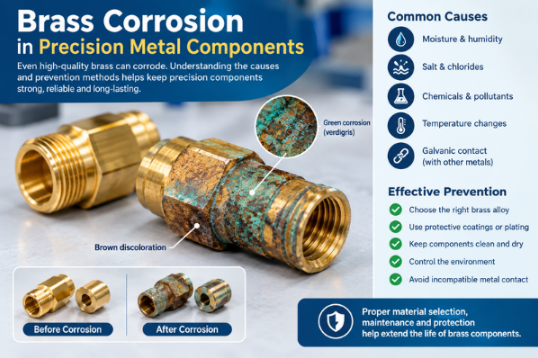
An important design parameter in precision metal parts for industrial and domestic uses include corrosion resistance. In the case of parts requiring more complex manufacturing, quantities of the material, component Geometry, surface features, environmental exposures, and finishing methods must be all accounted for. Metal Injection Molding (MIM) is an advanced technology that yields high volume of metal pieces in complex forms and tolerant tolerances. If copper-based materials or brass-related materials are considered for use, the required performance should be assessed based upon the specific use. The manufacturing plan could also include surface treatment, coating, inspection and finishing parameters. This can help provide the right material and manufacturing processes that will meet the requirements of the component under service conditions.
Brass Corrosion: Key Prevention Tips
If basic precautions are taken to preclude excessive corrosion and/or longevity, these properties can be enhanced with brass. When water, salt, chemicals or high humidity are likely to affect the part, have to use an alloy which has a resistance to these. Brass surfaces should be kept clean and dry, and shouldn't be left in contact with harsh chemicals for extended periods of time. To enhance surface protection apply a plate and suitable coating. Correct joining where necessary – brace joined with dissimilar materials to prevent Galvanic corrosion. Last but not least, check the condition of components for deposits and discoloration, pits and dezincification periodically. Surface variations that are very subtle and insignificant can be performance problems if not addressed early.
Conclusion
Brass exhibits practical advantages of being both strong and easily machined with an attractive, corrosion resistant surface but can cause surface changes and corrosion under special conditions. Does Brass Rust? Not the ones that people usually think of when they consider iron and steel. On the contrary, in the presence of corrosive environment and with different alloy compositions (combination of the metals used in its making), brass can tarnish, discolor and suffer from several kinds of corrosion. Appropriate alloy selection and surface protection, clean up, environment control, and periodic inspection will augment the service life of brass parts. In precision applications, assessing the material requirement and the surface treatment requirement during material design and manufacturing planning can further enhance material performance and durability.