en
 de
 jp
 kor
 fra
 spa
 ru
 pt
 it


Melting Point of Brass: Everything You Need to Know
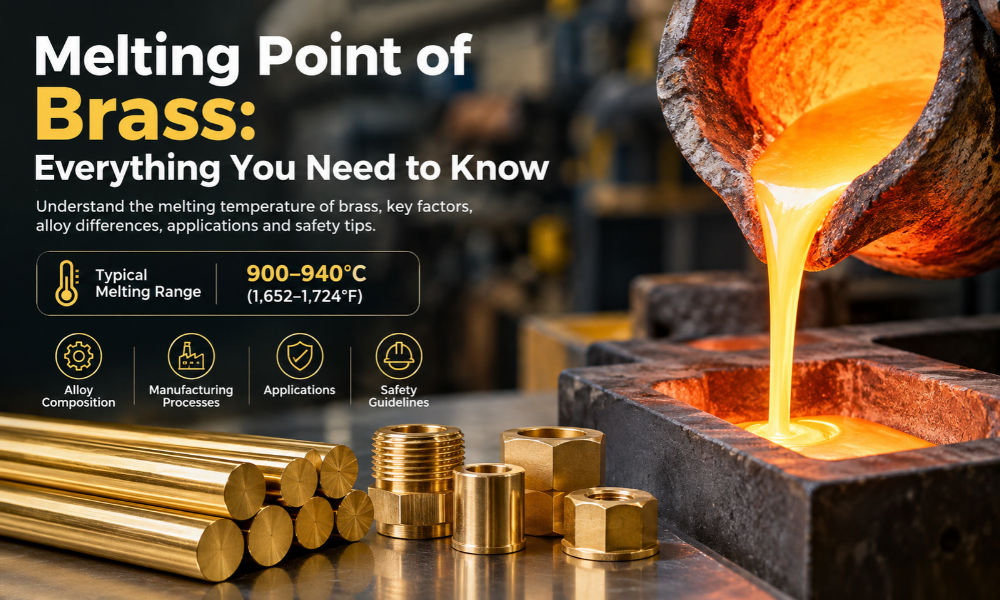
Brass is a alloy of copper and zinc, which is commonly used in a variety of applications, such as in the production of plumbing fixtures, electrical connectors, decorative objects, and precision metal parts. It is strong, resistant to corrosion and is easily machineable, all of which make it a useful product in many different sectors. The Melting Point of Brass varies with its chemical composition, thus allowing for a range of different melting temperatures for different grades. Most of the brass alloys have a melting range of 900°C to 940°C (1,652°F to 1,724°F); some alloys, however, do not. Knowing these differences in temperature is useful for engineers and manufacturers as well as metal workers, to determine the right type of materials and to plan for reliable manufacturing processes.
What Is the Melting Point of Brass?
To say that brass is not a pure metal, but is actually an alloy, so brass will not melt at a single temperature. The temperature at which the alloy starts melting is called solidus and the temperature at which the alloy is completely molten is called liquidus. The melting ranges for many brass grades fall in the range of about 900°C and 940°C for each type of brass and depend on the composition. Insert common queries, like "what is the melting point of brass," "what is the melting temperature of brass" and also "what is the melting temp of brass" normally within the explanation.
Brass Melting Temperature in Celsius, Fahrenheit, and Kelvin
Include a quick-reference table for readers to follow, to know the melting range for a variety of temperature units. State that these are only rough figures for the many common brass alloys and not guaranteed figures for all brass grades. When accurate temperature limits are required for manufacturing, manufacturers should refer to applicable material datasheet.
Temperature unit | Approximate range |
Celsius | 900–940°C |
Fahrenheit | 1,652–1,724°F |
Kelvin | 1,173–1,213 K |
What Temperature Does Brass Melt At?
To answer the question, many common brass alloys will start to melt at about 900°C, and finish melting at about 940°C (this depends on the grade of brass). Explain that there is no one fixed value known as brass melting temp; rather it is a range of temp. dependent on the type of brass. Answer any questions that are related to brass, including “what temperature does brass melt,” “what temp does brass melt at,” “at what temperature does brass melt,” and “at what temp does brass melt.” Explain that the temperature needed for a specific manufacturing process may be outside the melting range of the alloy and therefore the production process should be based on the material specification and process requirements.
Melting Temperature of Different Brass Alloys
Compare some of the common brass grades and demonstrate the reasons for the variation of the melting temperature of brass in different applications. The applications of various brass products are based on their composition: Cartridge brass is valued for its formability, Free cutting brass for its machineability, Naval brass for corrosion resistance and Aluminium brass for certain strength and corrosion related applications. Describe that these alloys are made from varying combinations of chemicals and so may react differently when heated. Provide a brief comparison table where grade specific values are available and encourage the reader to refer to supplier datasheets since not all brasses have a similar melting range.
Brass type | Main characteristic | Common applications |
Cartridge brass | Good formability | Tubes and formed components |
Free-cutting brass | Excellent machinability | Fittings and valve parts |
Naval brass | Corrosion resistance | Marine components |
Aluminum brass | Corrosion resistance in suitable environments | Heat exchangers and industrial equipment |
Brass Melting Temperature Compared With Other Metals
Compare the behaviour of brass and copper, zinc and aluminium with respect to their melting. Describe that many common brass alloys will melt over a temperature range, but pure metals will have a fixed temperature. This comparison assists engineers and product designers in realizing why different materials may need to be processed at different temperatures and why the melting characteristics of a material are significant for selecting a material for a specific application.
Material | Approximate melting point or range |
Brass | 900–940°C for many common grades |
Copper | 1,085°C |
Zinc | 420°C |
Aluminum | 660°C |
How Is Brass Melted in Industrial Manufacturing?
Explain the different ways brass is heated by manufacturers for casting and other appropriate metal working techniques. Describe how the process starts with the identification of the alloy, and preparation of the material. It is then heated in the appropriate equipment and the temperature and the state of the material are observed. The alloy is then transferred and/or poured by trained operators with proper equipment and procedures when it reaches the desired liquid temperature. The metal is then cooled and the components subjected to a surface check for defects, size and quality. Discuss the importance of temperature control and ventilation as zinc loss may be greater with the use of high heat and injurious fumes may be present.
Why Brass Melting Temperature Matters in Metal Injection Molding
Describe how the knowledge of the thermal properties of brass will help in the material selection and manufacturing. Explain about metal injection molding (MIM) which is a process of mixing fine metal powder with a binder, forming in a mold, and finally debinding and sintering to form metal parts. Explain that MIM is not a standard casting process since it is not a normal practice to pour a bulk charge of molten brass into a mold. The sintering temperature and the sintering conditions, on the contrary, are dependent on the powder used, the composition of the alloy and the desired properties of the components.
Explain why materials, dimensions and processing have to be compatible and consistent in the manufacture of small complex metal parts. Keeping a short promotional paragraph to show that before a manufacturer chooses a manufacturing method they need to check the geometry of the components, the amount of materials needed, the volume of the components to be made, and whether the manufacturing method is appropriate or not. Those who wish to know more about precision metal component manufacturing can check out Harber MIM for additional information about the technique, and the possibilities of industrial use.
Safety Considerations When Heating or Melting Brass
Describe the need for appropriate equipment, ventilation and trained personnel when using high temperatures to heat brass. Brass is a mixture with zinc which may produce toxic fumes when heated or melted under improper conditions. Molten metal may also result in serious burns and burning of other combustibles. Suggest proper industrial ventilation, appropriate protective equipment, dry and properly prepared tools and safety procedures in the workplace. Alert readers to not melt brass indoors or with homemade equipment which is not properly protected.
FAQ:
H3: What is the melting point of brass in Fahrenheit?
Most of the brass alloys have a melting range of about 1652°F to 1724°F. The temperature will vary according to the alloy and type.
Conclusion
Summarize Melting Point of Brass can be different depending on the composition and grade of the alloy. Most common brass alloys melt at around 900°C - 940°C, with other brass grades having different melting ranges. Emphasize the need for checking out material specifications, process temperatures and proper safety measures. Explain that a good grasp of the thermal properties of brass assists the brass manufacturers in making decisions regarding choice of material and method of production.