en
 de
 jp
 kor
 fra
 spa
 ru
 pt
 it


Copper Melting Point: 1,984°F / 1,085°C Explained (2026)
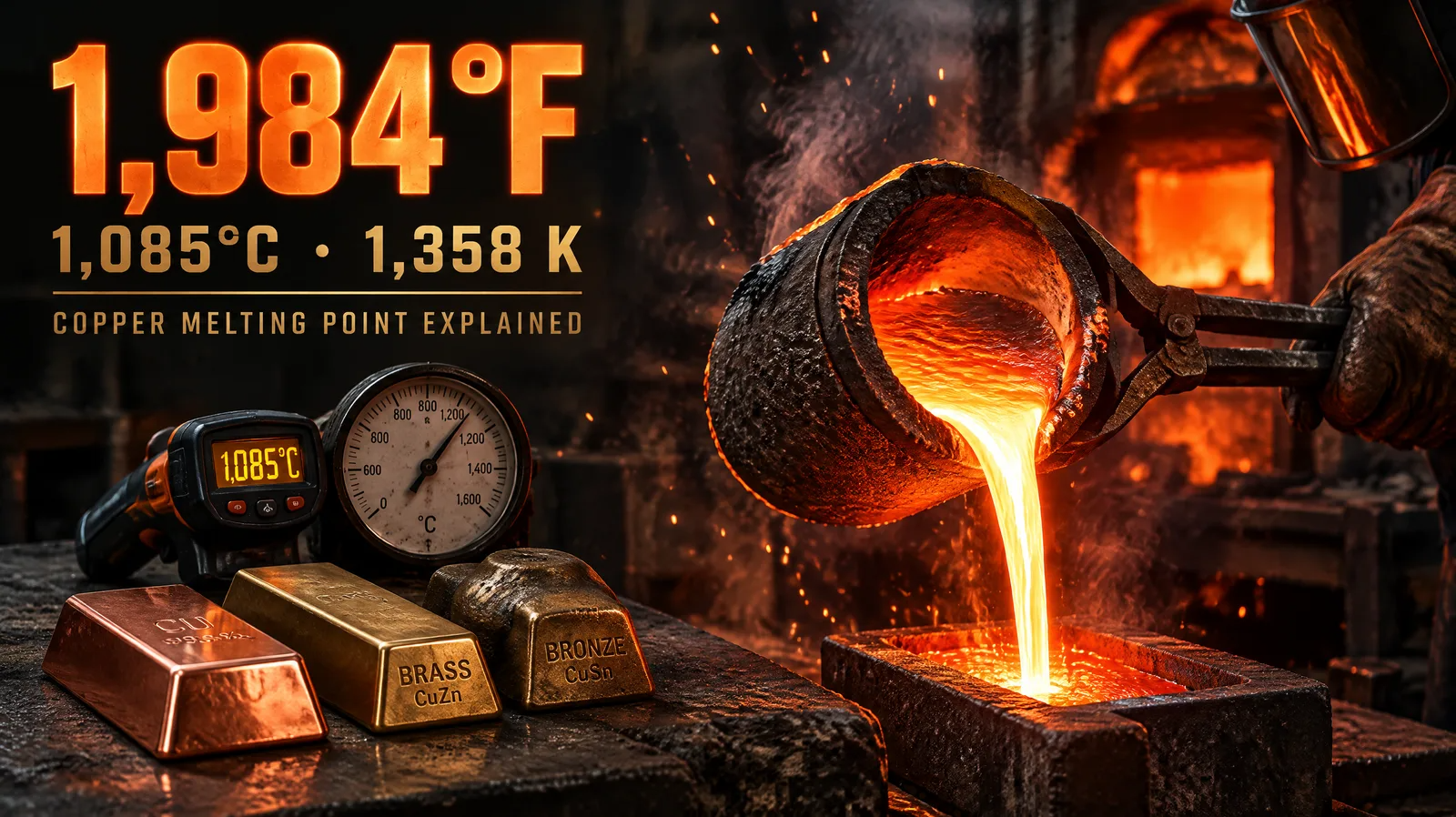
The melting point of pure copper is 1,084.62 °C or 1,984.32 °F. The melting point of copper is often rounded to 1 085 °C (1 984 °F) in many references and older sources list 1 083 °C. Copper alloys, including brass and bronze, have a lower melting point of around 900–1,050 °C due to added elements changing their melting range.
You might have encountered 1,083°C, 1,084°C and 1,085°C mentioned as though they are one and the same. Pages fail to clarify which “copper” they refer to, why the numbers diverge, or the value’s real crucible significance. This guide provides the temperature in °F, °C and K, and then looks at the alloys, purity, and source of heat.
Key Takeaways
● Copper has a melting point of about 1,085 °C or 1,984 °F. A melting point at air pressure is an important feature of metals.
● Due to rounding, older reference values and slight differences in purity, the US Trauma Values published values were 1083 and 1085 °C.
● Copper alloys have a melting point that is lower than pure copper. Brass will melt when heated to around 900–940 °C. Bronzes and phosphor bronzes melt at around 913 to 1,050 °C depending on composition (Wikipedia, 2026; Fractory, 2026).
● Copper melts at a higher temperature than aluminium (660 °C) and lower than iron (1,538 °C), which means it requires more heat than can be provided for aluminium casting but less than that steel (ArcCaptain, 2026).
● Copper oxides melt at different temperature than the metal: Cu₂O melts at 1,244 °C, and CuO at 1,326 °C (Wikipedia, 2026; Wikipedia, 2026).
● To melt copper at home, you will need your own heat source which can be something like a propane forge, oxy-acetylene torch or induction furnace, plus a graphite or ceramic crucible. Kitchen stoves and utensils are unsuitable.
● The melting process requires equipment rated in excess of approximately 2000 °F, correct crucibles and protection.
What Is the Melting Point of Copper in °C, °F and Kelvin?
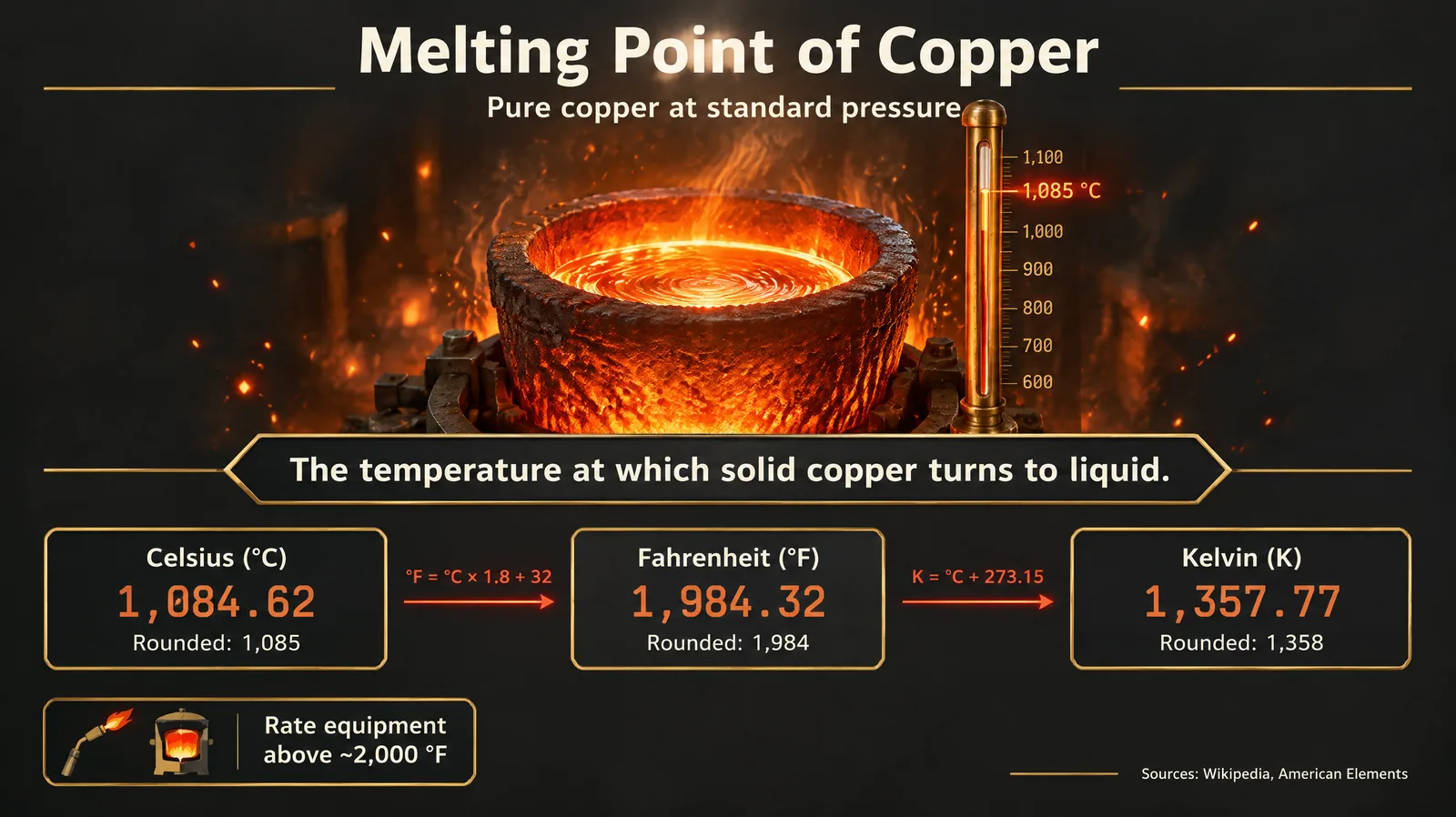
Copper which is 66% copper and 33% zinc melts at 890 °C, while bronze which is 90% copper and 10% tin melts at 900 °C. American Elements (2026) provides a melting point table compiled of melting points for the element in Celsius and Fahrenheit values. In short, copper melts at a temperature just under 2,000 °F (or 1,900 °F to be more precise).
Unit | Exact value | Common rounded value |
Celsius (°C) | 1,084.62 | 1,085 |
Fahrenheit (°F) | 1,984.32 | 1,984 |
Kelvin (K) | 1,357.77 | 1,358 |
You can verify the conversions yourself. The result is 1357.77 K. To get Fahrenheit we multiply Celsius with 1.8 and 32 is added to it.
Here’s how to use the number practically. You should use any furnace or torch setup rated above approximately 2,000 °F, since copper requires 1,984.32 °F to start melting. A forge that reaches 1,800 °F is 184 °F too cold, and no amount of waiting is going to fix that.
Why Do Sources List Different Melting Points for Copper?
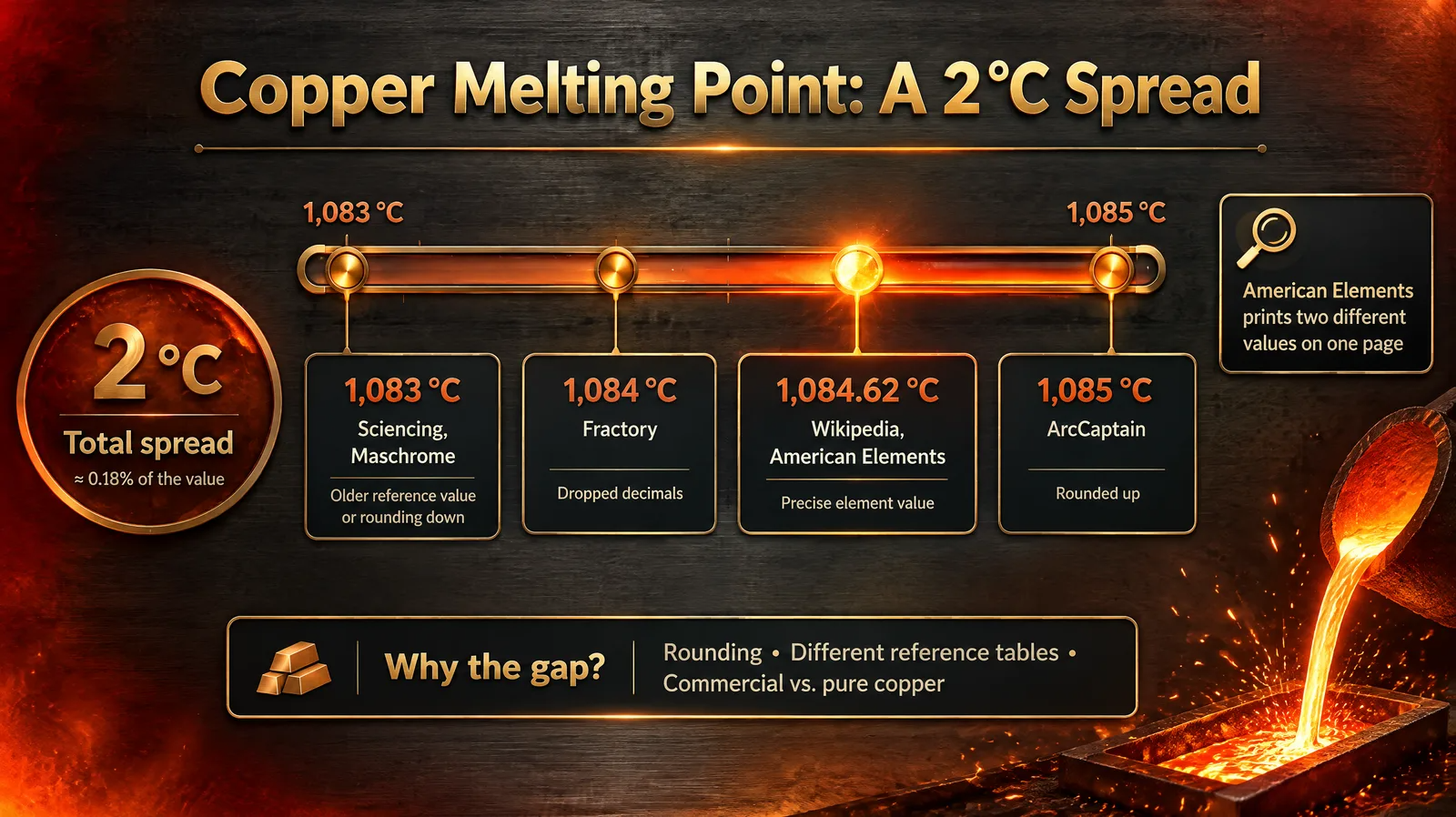
Different reference sources will state different melting points for copper as they will round off the value differently, rely on different reference tables, or describe commercial copper which is different from the pure element. The difference between the 1,083 °C and 1,085 °C is only 2 °C, which is also about 0.18%. The five pages shown here for our sample search are not very helpful in explaining the gap. In fact, American Elements prints two values on a page.
Value (°C) | Where you'll see it | Likely cause |
1,083 | Sciencing, Maschrome (Source: Sciencing, Maschrome) | Older reference value or rounding down |
1,084 | Dropped decimals | |
1,084.62 | Precise element value | |
1,085 | Rounded to a whole number |
The original sources add a new twist. A second site MetalStudy says 1,084.62 °C for NIST Chemistry WebBook (MetalStudy, 2025). Yet the phase change entry lists 1,357.95 K as a nominal catalog value from 1988. This equates to 1,084.80 °C, or 0.18 °C above the conventional figure.
The value of 1,357.77 K is found in the CRC Handbook of Chemistry and Physics, where it is designated an ITS-90 fixed point, freezing point. In any practical job, the differences aren’t large enough to count.
What Changes the Melting Point of Copper?
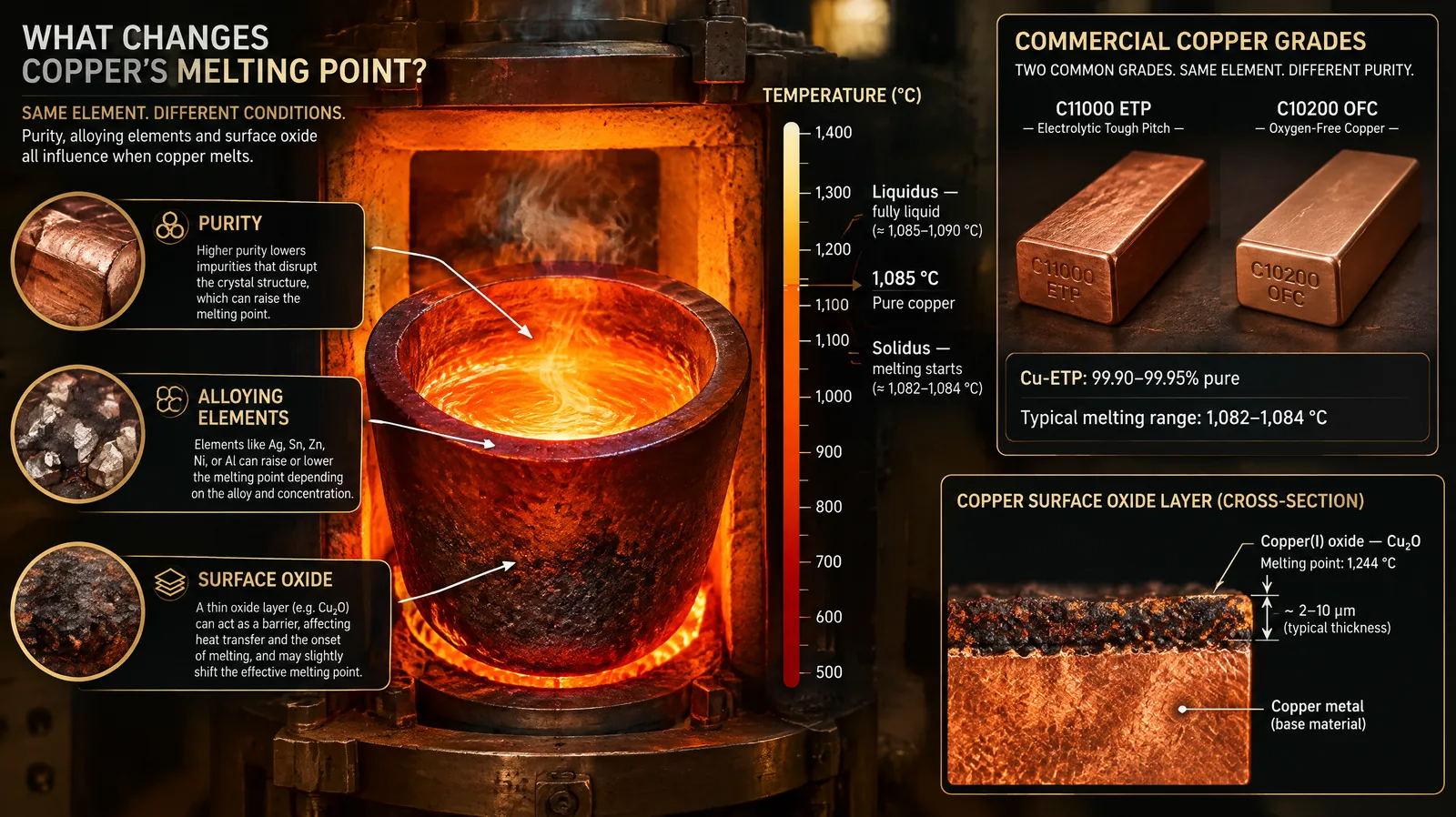
The melting point of copper is altered by its purity, alloying elements and surface oxide. The melting point of pure copper is at one temperature, while alloys have melting points over a range (solidus, where melting starts, and liquidus, the fully liquid metal).
Commercial copper grades
The "copper" you buy is usually not pure. According to LangHe Industry, the total impurity of industrial copper can be up to 0.1%. This can lower its melting point to 1082-1084 °C. You're most likely to encounter two grades of copper: C11000 Electrolytic Tough Pitch (ETP) copper and C10200 Oxygen-Free Copper (OFC). The UNS code consists of numeric identifiers that indicate the various grades.
Copper oxides
Copper oxide has a melting point higher than that of pure copper. According to the source cited copper(I) oxide (Cu₂O) has a melting point of 1,244 °C and copper(II) oxide (CuO) has a melting point of 1,326 °C. An opposing page has Cu₂O melting at around 1,232 °C, so take this exact figure as a little uncertain.
Here is what that signifies in a crucible. The melting point of Cu₂O is roughly 159 °C higher than that of copper. That is, at roughly 1084 °C, CuO melts. Thus, the dark coating that forms on copper when it is old or heated can remain solid while the underlying metal becomes liquid. That's the reason why melters remove "dross" from the surface.
What Is the Melting Point of Brass and Bronze Compared With Pure Copper?
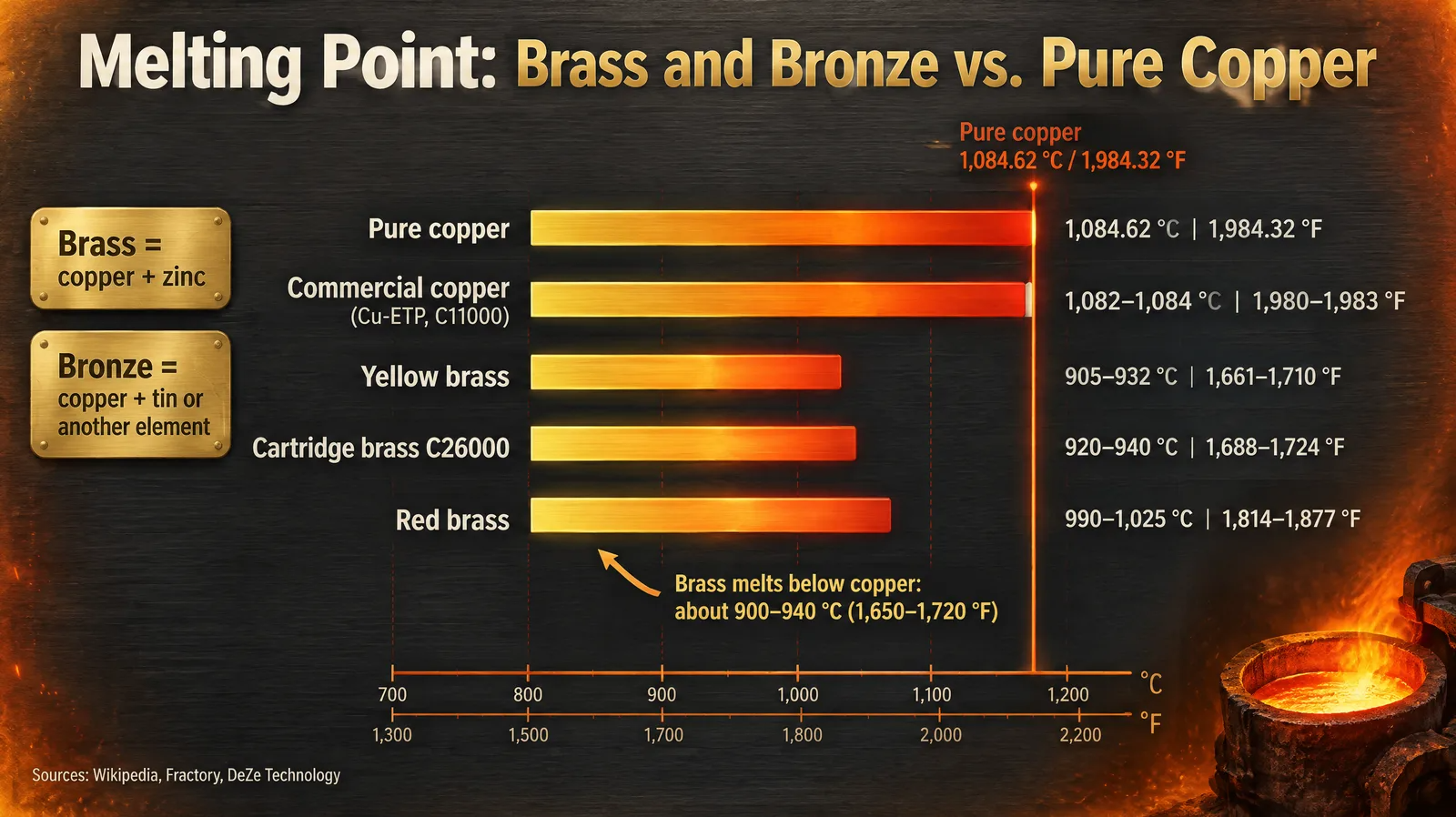
Brass and bronze easily melts below the melting point of pure copper. The melting point of brass is about 900-940 degrees Celsius. This is about 1,650-1,720 degrees Fahrenheit, depending on brass composition (Wikipedia, 2026). Brass results from copper combining with zinc. Bronze infers copper combining with tin, or another element. The table below lists the figures by UNS grade where there is a grade.
Material | Melting range (°C) | Melting range (°F) | Source |
Pure copper | 1,084.62 | 1,984.32 | |
Commercial copper (Cu-ETP, C11000) | 1,082–1,084 | 1,980–1,983 | LangHe Industry |
Yellow brass | 905–932 | 1,661–1,710 | |
Cartridge brass C26000 | 920–940 | 1,688–1,724 | |
Red brass | 990–1,025 | 1,814–1,877 | |
Phosphor bronze C51000 | 1,000–1,050 | 1,832–1,922 | |
Aluminum bronze C61400 | 1,015–1,035 | 1,859–1,895 | |
Bronze (general, low figure) | 913 | 1,675 | |
Bronze (general, range) | 950–1,050 | 1,742–1,922 |
The sources disagree on “bronze” (913 °C vs. 950-1,050 °C). This is probably because “bronze” is a family of metals, not just one. While the addition of tin lowers decomposition, a single number can’t cover all aluminum or phosphor bronze mixes.
It is simple to size the gap from pure copper. Brass melts at roughly 145 to 185 degrees Celsius lower than pure copper at temperatures of 900 to 940 degrees Celsius (1,084.62 degrees Celsius minus 900 and 940). The DeZe figures are taken from the manufacturer’s site, so check any important grade against a CDA datasheet. Beryllium copper isn't included in the sources collected below, so consult that place as well.
How Does Copper's Melting Point Compare to Aluminum and Iron?
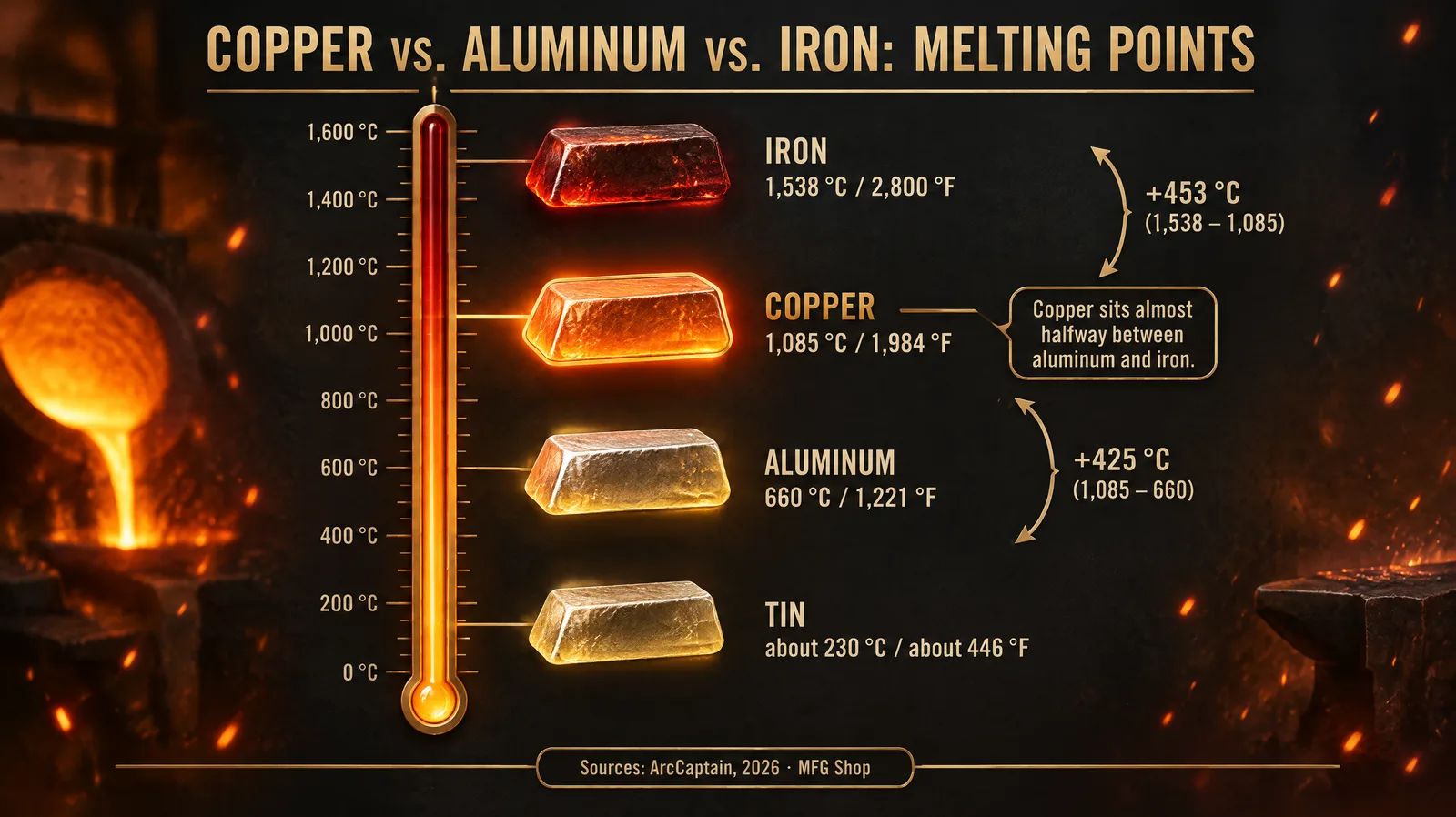
Copper can melt at a higher temperature compared to aluminum and tin but lower than iron. Aluminum liquefies at 1,221 °F (660 °C), iron at 2,800 °F (1,538 °C), and copper at 1,984 °F (1,085 °C) (ArcCaptain, 2026).
Metal | Melting point (°C) | Melting point (°F) | Source |
Tin | about 230 | about 446 | (Source: MFG Shop) |
Aluminum | 660 | 1,221 | |
Copper | 1,085 | 1,984 | |
Iron | 1,538 | 2,800 |
Copper is almost halfway between aluminum and iron. It melts at 425 °C higher than the melting temperature of aluminum (1,085 − 660) and 453 °C lower than iron (1,538 − 1,085). Check the alloy as steel varies by grade.
The gaps are important inside a shop. According to MFG Shop, an aluminum crucible will melt long before copper, and tin-lined cookware fails even faster. When working with copper, use graphite or ceramic.
Can You Melt Copper at Home? Equipment and Safety
It is indeed possible to melt small amounts of copper at home, provided you use proper equipment and protective gear. The reviewed sources disagree. A blowtorch or a stove top can do tiny amounts. A kitchen stove cannot reach the proper temperature. Propane torches may not be adequate for larger batches.
Heat source | Reaches about 1,985 °F? | Verdict |
Kitchen stove or cookware | No | Not suitable |
Handheld propane torch | Borderline | Small pieces at best; sources conflict |
Propane forge | Yes | Common hobby choice |
Oxy-acetylene torch | Yes | Works; needs training and care |
Induction furnace | Yes | Fast and controlled; costs more |
This matrix provides a reconciliation of those conflicting claims, so treat the torch row as the least certain. A torch melts a little scrap piece. So, the stove and any household pan are out.
Reaching the melting point is not the same as pouring
Many demonstrations recommend keeping metal below the temperature of melting it. The casting process is impacted with this misrepresentation, after all molten metal is heated marginally above its melting point so it remains liquid long enough to be poured. The data gathered here do not give pouring temperatures but follow a target from a foundry or metallurgy guide for your alloy.
Basic safety
It is dangerous to melt copper. Wear safety glasses, gloves and stable footwear with a ventilation mask. Keep crucibles and molds completely dry, because trapped moisture can quickly vaporize into steam and cast molten metal wildly about. Before starting the metalcasting work, compare these points they against OSHA or a foundry safety guide.
At What Temperature Does Copper Wire Melt?
Copper wire consists of the same material as the copper itself, at about 1,084.62 °C. Another competing page claims a temp of 1085 °C (1984 °F) for wire, without context. But the amount applies solely to the metal.
Insulation, solder and brazing fail much sooner
The plastic insulation used in actual wiring fails at a significantly lower temperature than the conductor. Copper pipe joints can be made without melting the copper due to the fact that soft solder and brazing filler metals flow far below copper's melting point. Confirm limit on a specific wire with an electrical code or manufacturer source, as overloaded wire can heat up and fail from current.
Boiling point and thermal properties
Copper, which has a thermal conductivity of 401 W/(m·K), boils at 2,562 °C (4,643 °F) (Wikipedia, 2026). A melting to boiling range of the liquid is about 1,477 °C (which is 2,562 − 1,084.62). Copper's high conductivity means it draws heat from the very spot you are heating. It requires more power to get a chunk up to temperature than its melting point suggests.
Frequently Asked Questions
Is copper easier to melt than steel?
Indeed. The melting temperature of copper is approximately 1,085 °C, whereas that of iron, the chief ingredient of steel, is 1,538 °C (ArcCaptain, 2026). Popular works explain that steels are divided into families too. They vary in temperature the closer the steel is to the melting range of copper the more troublesome a hobby forge has. Copper still requires significantly more heat than aluminum.
Prev Page : What Is Aluminum’s Symbol? Chemical Symbol Al Explained
Next Page : Melting Point of Brass: Everything You Need to Know
RETURN
Prev Page : What Is Aluminum’s Symbol? Chemical Symbol Al Explained
Next Page : Melting Point of Brass: Everything You Need to Know