en
 de
 jp
 kor
 fra
 spa
 ru
 pt
 it


Gear Manufacturing: An In-depth Guide
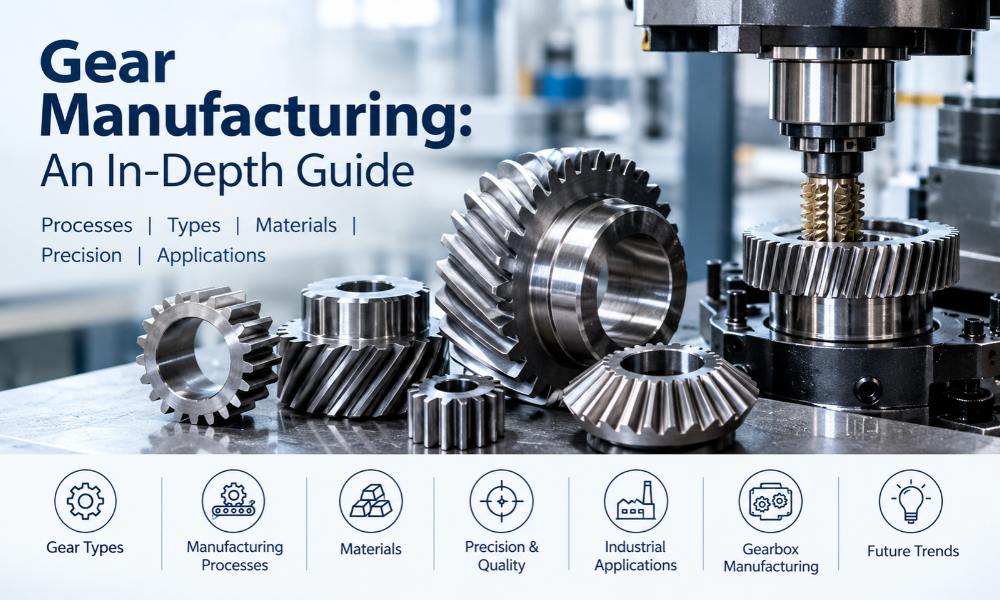
Gear manufacturing is a significant part of manufacturing mechanical parts that transmit motion and torque between the different mechanical components. In a wide range of applications such as automotive systems, industrial machinery, robotics and so on, gears are employed to control speed, direction and power. The design, material, tooth profile, manufacturing and finishing process are the main factors determining the quality of a gear. This guide covers the various types of gears, the process for manufacturing them, some of the most popular methods, quality standards, and what companies need to consider when choosing a manufacturer.
What Is Gear Manufacturing?
The gear manufacturing involves the design and the manufacture of the gears having certain shapes, tooth profiles, dimensions and mechanical properties. These components can be used to transmit power from one rotating shaft to another, to regulate the speed, torque, and direction of motion. Depending on the design of the gear and its application, the process may include cutting, forming and molding, also heat treating, grinding and inspecting. Knowing the basic stages helps the engineers to select right materials and manufacturing methods, and control cost, durability and performance.
Different Types of Gears Used in Manufacturing
There are various designs of gears that have different mechanical functions. Spur gears have straight teeth and are typically used in parallel shafts, while in helical gears teeth are set at an angle, which means they're able to get in touch smoother. Bevel gears are used to transmit motion between intersecting shafts and are useful where it is necessary to change the direction of motion. Worm gears are used for high speed reductions in a relatively small package, and planetary gears are a combination of gears that will distribute the load within a small area. Hypoid gears also have offset shafts and are generally employed in the differentials of vehicles. Tooth geometry, materials, lubrication and manufacturing accuracy requirements vary for each design.
Bevel Gears, Planetary Gears, and Hypoid Gear Applications
In the manufacture of bevel gears, the geometry of the teeth is important to make sure of smooth contact between the shafts which intersect. In planetary gear systems, it is important that the sun gear, planet gears, and ring gear are properly aligned. Due to the offset design of the hypoid gear sets, the tooth surfaces have considerable sliding contact, which means that proper lubrication is required. Those looking for hypoid gear oil must know that it is a lubricant designed for hypoid gears. The proper grade and performance characteristics of the oil will vary according to the equipment manufacturer's recommendations.
How Are Gears Made? A Step-by-Step Manufacturing Process
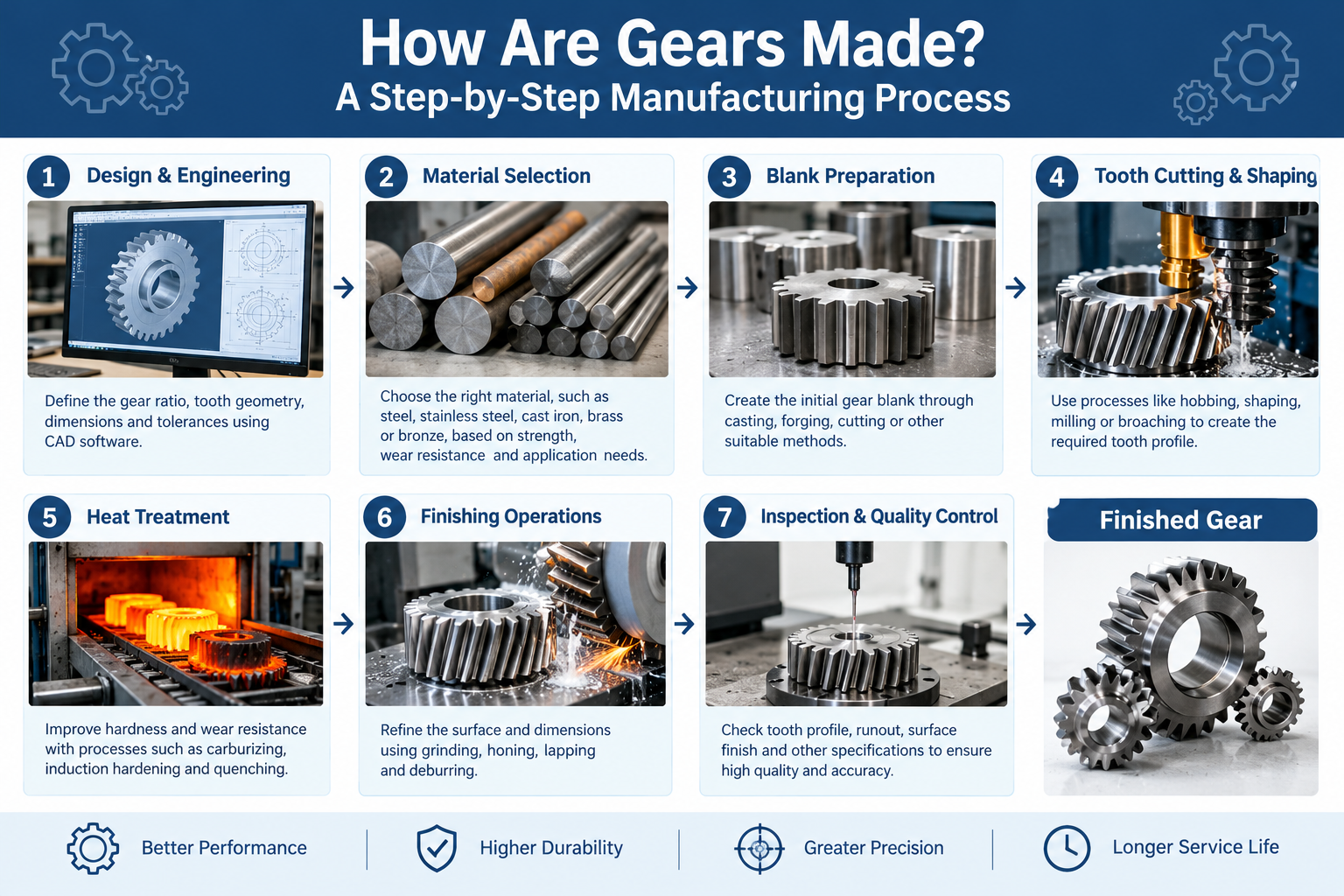
The knowledge of manufacturing of the gears provides the engineering and purchasing team an insight into the production quality, lead time and costs. Typically, the process starts with engineering design, as specialists determine the gear ratio, the shape of the gears, the dimensions of the gears, tolerances and predicted loads. Then, the manufacturer chooses a material, and cuts or casts, or forges, or uses another suitable method to form the gear blank. They then use an appropriate machining or forming method to form the teeth. Downstream processes such as heat treatment can be integrated to enhance the hardness and wear resistance of the teeth and finishing processes polish the surface and size of the teeth. Finally, the inspection checks for accuracy of the tooth, runout, surface quality and other requirements before the gears are sent off for assembly or delivery.
Common Gear Manufacturing Techniques
There are a number of gear manufacturing techniques and the selection of the technique depends on the geometry of the gear, the material, the number of gears required, the accuracy desired and the cost. Gear Hobbing is a rotary type process that can be used for the efficient production of a large number of external gear types. Gear shaping is employed for the internal gears and external gears to form a tooth profile through coordinating the movement of gear cutter and the work piece. Gear milling is a process in which material is removed using a cutter designed or set up to form the desired gear teeth and broaching can be used to form internal profiles which are repeatable. Gear grinding and honing process improve surface finish and dimensional precision after the initial cutting process. Some small, complex metal gears can also be manufactured in medium or high volumes by a metal injection molding (MIM). Sometimes, additive manufacturing may be used to make prototypes and certain special applications, however, depending on the strength, surface finish and accuracy required.
Difference Between Gear Forming and Gear Generating
The gear teeth are formed by two methods – gear forming and gear generating and they differ in functioning. The tooth space or tooth profile required by the product can be directly formed by the shape or cutting trajectory of the cutting tool in the gear forming process. This can be done by forming, such as in milling and broaching. Tooth profile is built up in gear generating process by controlling the relationship between the tool and the rotating workpiece. Examples are gear hobbing and gear shaping. Forming can be beneficial in some special profiles and production requirements but generating is extensively used for efficient and repeatable production of gear standard profiles. The selection of the best choice will depend upon the design of the gear, costs of tools, tolerances and quantity to be produced.
Materials Used in Industrial Gear Manufacturing
The material used will influence the strength, weight, wear resistance, corrosion resistance and service life of a gear. There are a number of applications for which either carbon steel or alloy steel may be used, depending on the strength and durability requirements, and in cases where corrosion resistance is a key factor, stainless steel might be employed. Selected heavy duty systems use cast iron and for applications with specific friction and wear requirements, brass or bronze might be appropriate. In appropriate low load applications engineering plastics provide lighter and more silent operation. For complex shapes and repeatable production, another solution may be in the sintered metal parts. Before choosing a material, manufacturers must take into consideration factors such as operating loads, temperature, lubrication, environmental exposure, heat treatment and cost. All these factors can help us to select which process of production can provide the required mechanical performance.
High-Precision Gear Manufacturing and Quality Control
When dimensional errors of small equipment can impact on the efficiency, noise, vibration or reliability of the equipment, high precision gear manufacturing becomes important. To ensure that engineering requirements are met, manufacturers have to control tooth profile, tooth spacing, runout, concentricity and surface finish. This also must be considered with heat treatment as dimensional changes and distortion can occur if uneven heating or cooling occurs. Some quality control processes may involve checking the condition of the surface defects, hardness testing, and gear measurement system. Noise, vibration and gear meshing performance may also be compared by the manufacturers, depending on the application. The use of appropriate machine tools, proper processes and regular inspection can help ensure precision gear manufacturing is produced to meet the desired specifications.
Industrial Gear Manufacturing Applications
The gear industry is a wide-spread supplier of a number of industries which rely upon controlled motion and power transmission. Gears are used in transmissions, differentials and other parts of an automobile. They are employed in industrial machines such as conveyors, pumps, compressors and production machinery. Gear systems are used for the movement and power transmission of agricultural machinery, and in robotics and automation, for precisely manufactured compact gears that are required for controlled positioning. Special designs and quality controls might be needed for aerospace and energy applications. Small precision gears can also be applied to medical and scientific devices, where precise and dependable motion is critical. The variety of these applications is evidence that the design of the gears, choice of materials, manufacturing processes, and inspection specifications are key factors in ensuring that the equipment performs its intended function.
Gear Manufacturing vs. Gear Fabrication and Gear Machining
While these are similar terms, they don't always refer to the same action. Gear manufacturing is the general term used to describe the entire process used to manufacture gears from material preparation, finishing and inspection. Fabrication/assemblage of gears is a general term in industry to refer to the making or assembly of metal gears. Gear machining is the material removal processes that are used to cut, shape or finish gear parts. For instance, a manufacturer can cut teeth in a gear blank that has been prepared and then finish the surfaces to the desired finish. The knowledge of these differences can assist buyers to effectively communicate their needs and to compare suppliers according to the processes the suppliers actually provide.
How to Choose the Right Gear Manufacturing Partner
There are more factors than just cost involved in selecting an appropriate manufacturing partner. The supplier's experience (on the type of gear required, the machines available, materials available, finishing processes available and inspection facilities available) should be studied by the buyer. Also the supplier's ability to comply with engineering drawings, tolerances, production volumes and delivery dates are important to confirm. Inquire about prototype development, technical communication, quality documentation and support in the product design. Metal injection molding (MIM) can be an appropriate alternative to traditional metal machining for some complex, small metal parts, depending on the geometry, material and quantity of the products.
Firms that are interested in precision metal part manufacturing may check out Harber MIM, which provides metal injection molding, tooling, machining, finishing and other production services. Among them, powder metallurgy gear parts and other metal parts are its products. MIM can be quite helpful in discerning some of the more complex designs and repeat manufacturing, but the buyer should check the supplier's experience in designing and manufacturing their particular type of machinery, load requirement, tolerances and application before using it.
FAQ:
What are the most common gear manufacturing techniques?
Gear hobbing, gear shaping, and milling, grinding and honing are the common methods. Metal injection molding also is an appropriate process for some small, complex metal gears manufactured in appropriate volumes.
What is the difference between gear forming and gear generating?
Tooth space is formed directly by the shape of the tool or cutting path of gear forming. The tooth profile is formed by coordinating the motion of the cutting tool and work piece during gear generating.
Which materials are commonly used for gears?
There are many different materials available, such as carbon steel, alloy steel, stainless steel, cast iron, brass, bronze, engineering plastics and certain sintered metals. The selection will depend on the load, environment, wear and price of the gear.
What is high-precision gear manufacturing?
It is the manufacturing of gears which have a high requirement to dimension, tooth form, surface quality and the performance of gears in operation. It is based on controllable processes and the appropriate inspection techniques.
Can metal injection molding be used to produce gears?
Yes. There are some small, complex metal gears that can be made using metal injection molding, especially when repeatability and production volume are paramount and the cost of the tooling is not a concern. There are various factors which influence the suitability: geometry, material, strength and precision requirement for the gear.
Conclusion
Gear Manufacturing of reliable gears involves a careful planning at each stage of the manufacturing process including gear design, material selection, tooth forming, finishing and quality checking. Various types of gears are designed to meet various mechanical requirements and different methods of production are used for manufacturing different types of gears, therefore, the operating loads, accuracy, durability and production costs must be considered prior to selecting a type of gear. Knowing these factors will help in the selection of materials and manufacturing partners. This helps companies ensure that the parts they produce are compatible with the equipment design and use, thereby improving the reliability and performance of the equipment.