en
 de
 jp
 kor
 fra
 spa
 ru
 pt
 it


Is Stainless Steel Magnetic? Grades and Tests (2026)
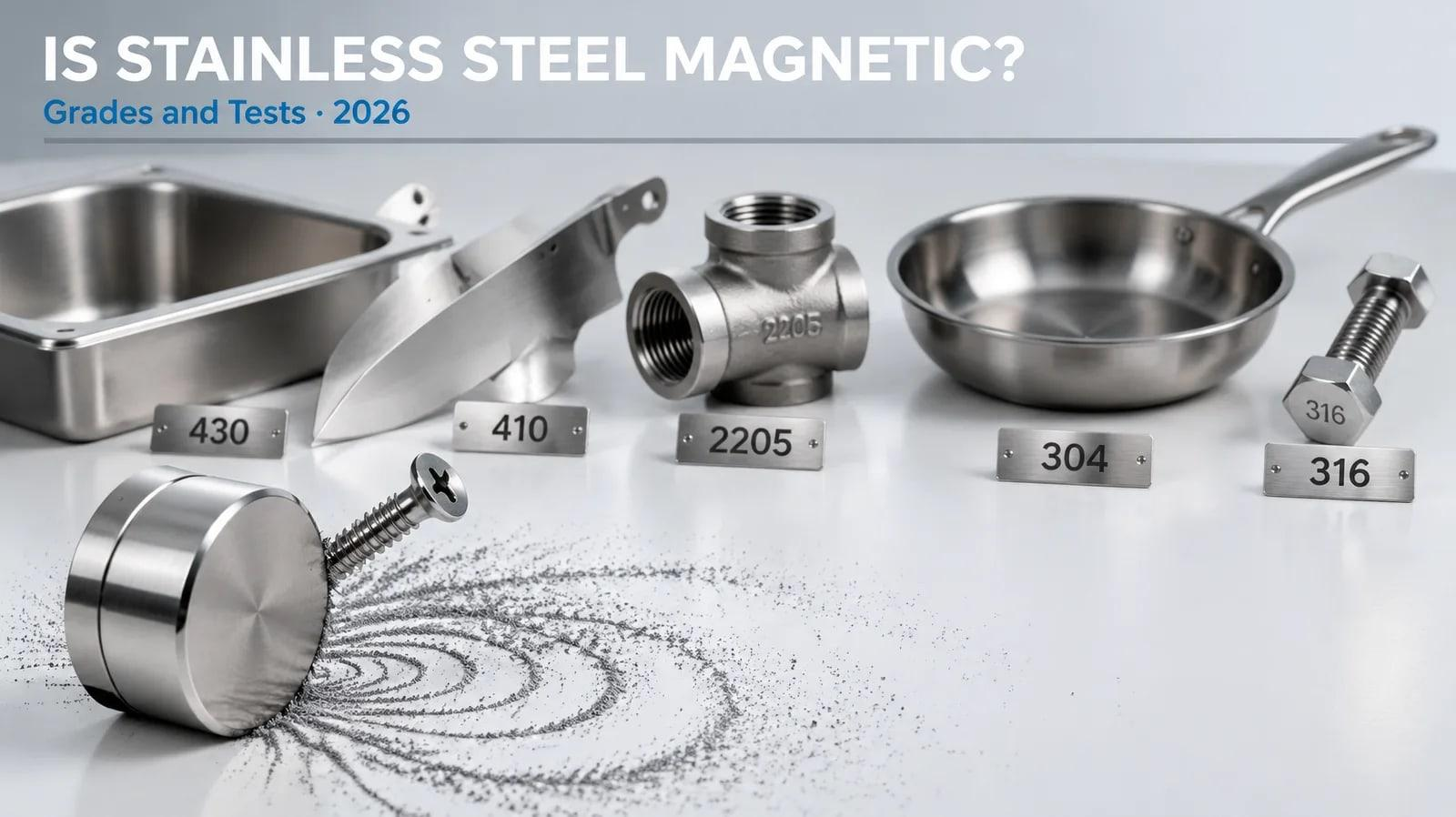
Many people wonder if stainless steel is magnetic. This post will cover everything you need to know.
Stainless steel is a type of metal that is not magnetic under normal conditions. But stainless steel can be attracted to a magnet under certain conditions. For example, austenitic stainless steel is usually not attracted to a magnet. When the steel is deformed, it becomes weakly attracted to a magnet.
Most guides will give a one-line grade rule and skip the exceptions that confuse you when a magnet clings to a screw, sink or pan. This chart tells you which grades will behave just like 2026, and remember that two pieces of the same grade of steel may behave differently. Reading the chart: 304 and 316 are grades of stainless steel that are not magnetic, so it may confuse someone who receives a mixed bag when they take one piece off the shelf and find that it clings nicely to the magnet.
Key Takeaways
● Stainless steel grades are classified into five groups, of which only one group is magnetic. These are referred to as the 400 series grades, which have a tensile strength of about 400 MPa.
● Magnetism is determined by the crystal structure rather than the amount of iron present. Ferrite and martensite are ferromagnetic, whereas austenite shows little attraction to a hand-held magnet.
● Some magnetism may be present in annealed 304 and 316 stainless steel. Cold working and welding can make them more magnetic.
● The probability of stainless steel is determined using a magnet test. However, the exact steel family cannot be identified through magnet testing.
● The word “magnetism” certainly does not mean the stainless steel item is unreal. Common magnetic grades, such as 409 and 430, are less resistant to corrosion than 316 and 304 grades.
● Stainless steel cookware needs a magnetic base to work on an induction cooktop. A pan made entirely of 18/10 stainless steel might not work unless it’s clad with a magnetic layer.
Which Types of Stainless Steel Are Magnetic?
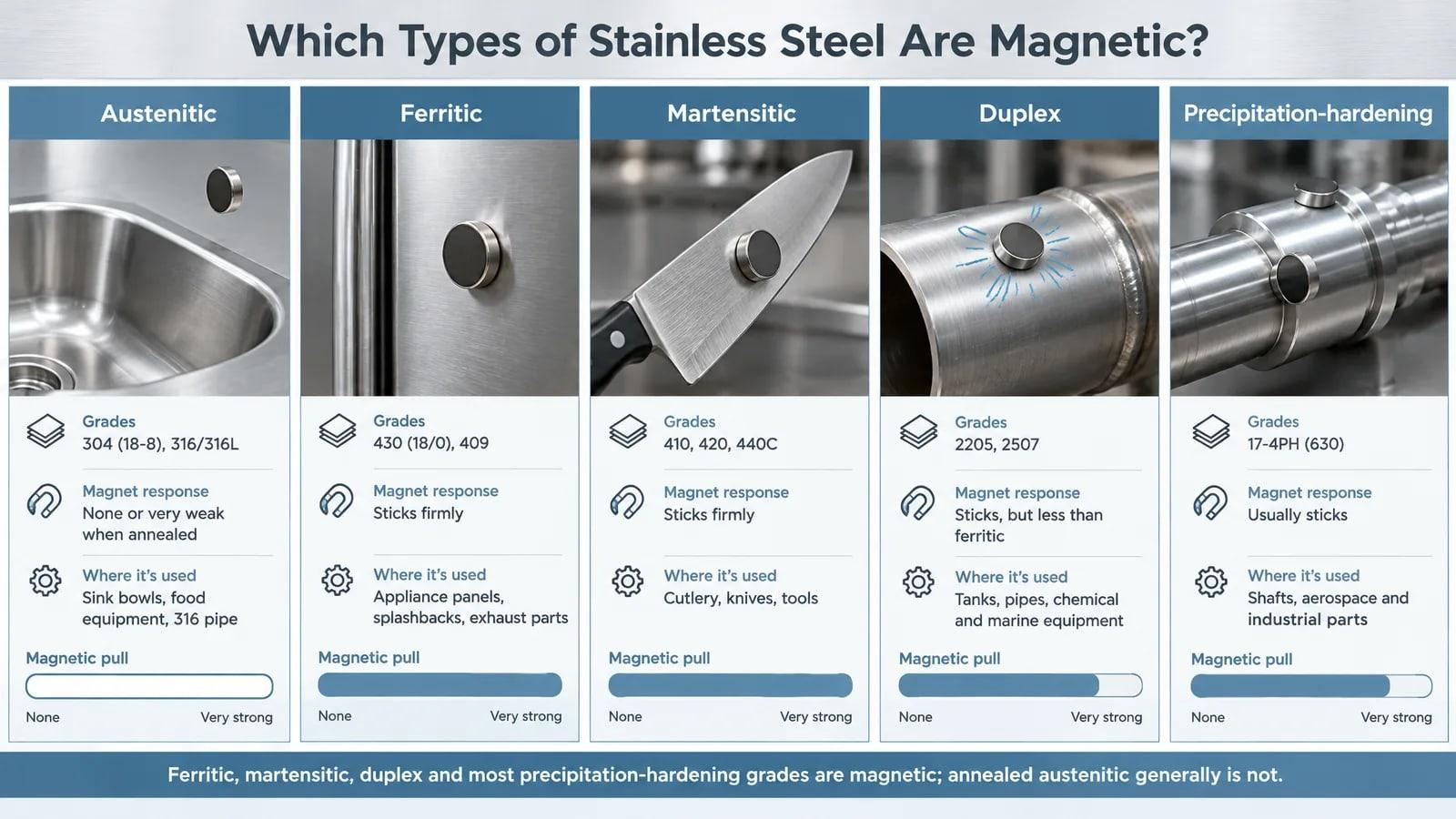
Stainless steels made of ferritic, precipitation-hardened, and martensitic metals are magnetic. In contrast, the austenitic ones are generally not. The following table sorts each group of stainless steel by how likely it is to be magnetic and shows how it responds to a magnetic field.
Family | Example grades | Magnet response | Where you'll meet it |
Austenitic | 304 (18-8), 316/316L | None or very weak when annealed | Sink bowls, food equipment, 316 pipe |
Ferritic | 430 (18/0), 409 | Sticks firmly | Appliance panels, splashbacks, exhaust parts |
Martensitic | 410, 420, 440C | Sticks firmly | Cutlery, knives, tools |
Duplex | 2205, 2507 | Sticks, but less than ferritic | Tanks, pipes, chemical and marine equipment |
Precipitation-hardening | 17-4PH (630) | Usually sticks | Shafts, aerospace and industrial parts |
Day-to-day articles are no exception. Midway Metals says that a magnet grips a 430 splashback very strongly, a 304 sink corner weakly if it is cold-worked, and not at all if it is annealed.
According to sources, duplex is a term used for steel with partial magnetism. Ferritic grades have strong magnetic properties, making them completely magnetic. When a person feels a pull from a magnet, they can test the pull with their hands. In this case, duplex steel is likely to be a duplex alloy with a two-phase structure. By contrast, the fully magnetic steel the person refers to is likely a ferritic grade of steel (Atlas Steels, 2021).
Why Does Crystal Structure Decide Magnetism, Not Iron Content?
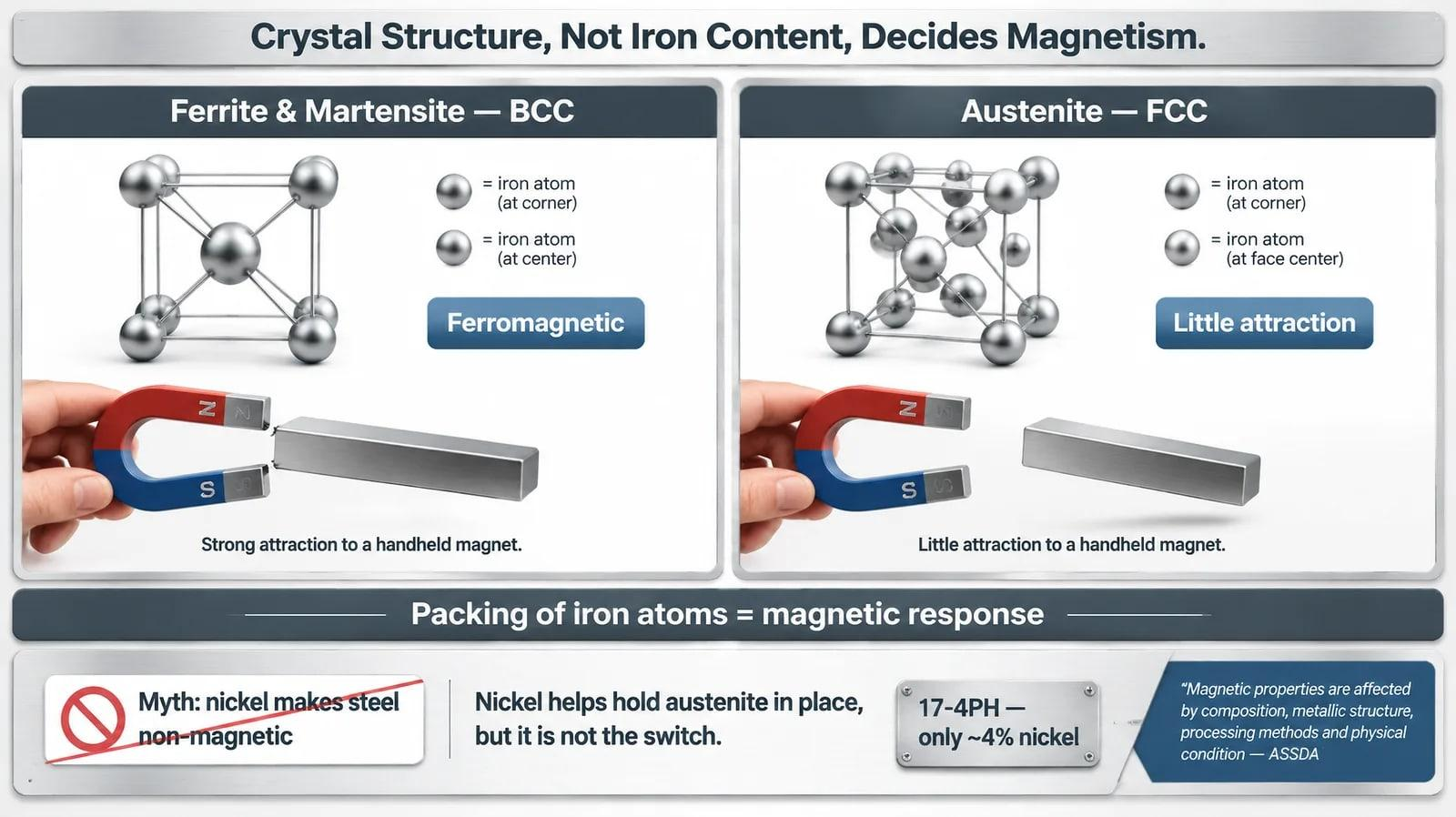
The magnetism of iron is determined by its crystal structure. Ferrite is ferromagnetic and has a body-centred cubic (BCC) structure. Martensite, which is closely related to ferrite, is also ferromagnetic. Austenite does not attract a handheld magnet, but it is closely related to ferrite and has a face-centred cubic (FCC) structure.
According to ASSDA’s technical FAQ, “The metallic structure, processing and physical condition of the material also significantly influence the magnetic properties of steel. Therefore, the structure and condition of steel are more important than its composition.”
A guide says, “Nickel makes steel non-magnetic,” but many people have misunderstood it. Nickel helps hold the austenite structure in place, but it isn’t what makes it magnetic. According to Geometrics, 17-4 PH contains about 4% nickel, but because of its other alloying elements, it’s magnetic. However, 304 can become magnetic after handling because of its structure, not its composition.
Every stainless steel grade mainly consists of iron. However, iron content cannot be the defining factor between 304 and 430, because both contain about 18% chromium, while only 304 contains about 8% nickel. What distinguishes them is that 304 has more nickel and is nitrogen-based.
Different types of stainless steel have different magnetic properties, but, as a general rule, only a few common grades are strongly magnetic, while others are nonmagnetic. The magnetic permeability of 430 stainless steel is 600–1,800 times that of iron in air.
Why Is 304 Stainless Steel Sometimes Magnetic?
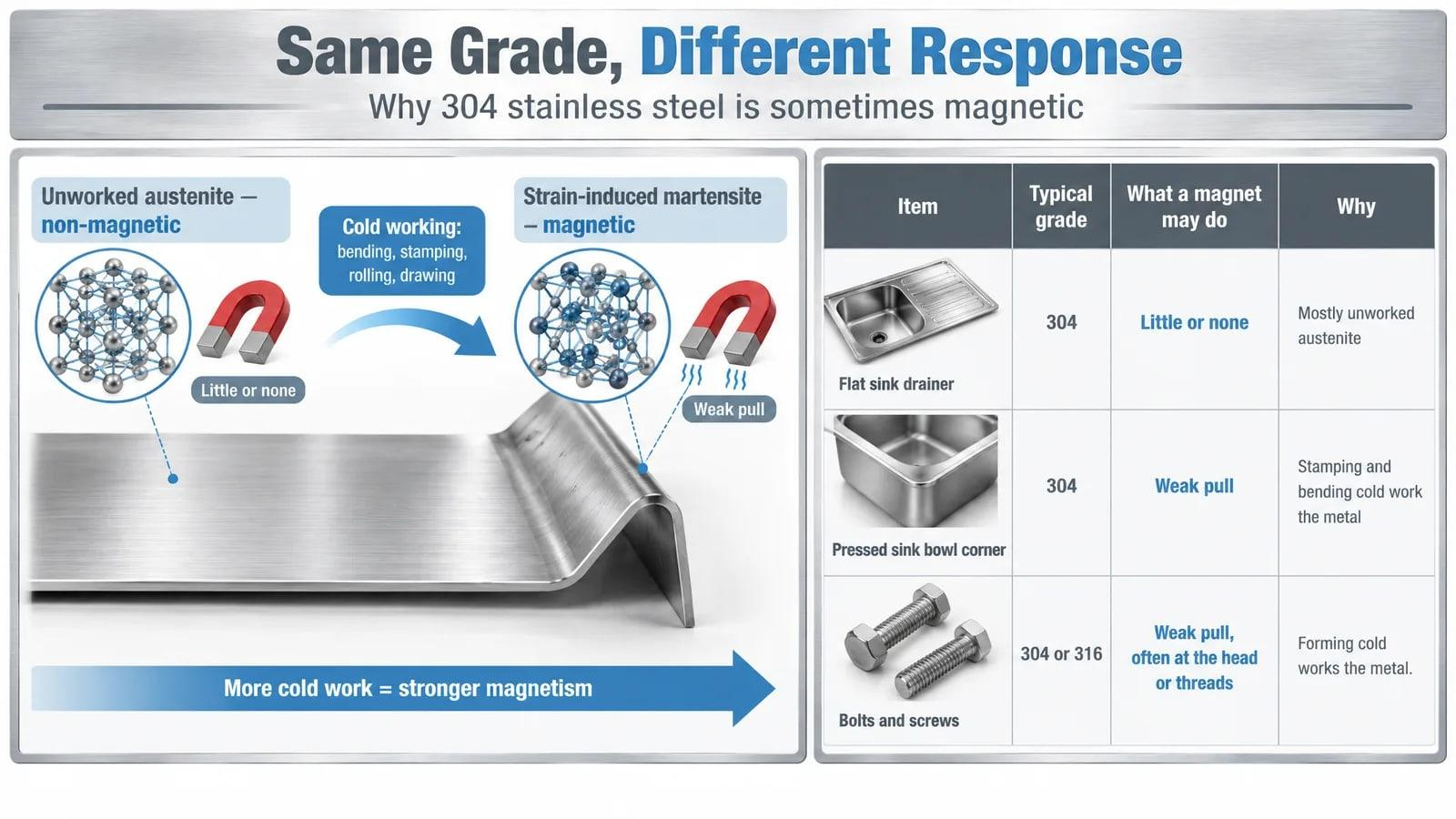
Mechanical deformation can transform stable austenite into unstable martensite. It is durable stainless steel, but it is less stable, so it is not surprising that it becomes magnetic. Compared with 316, 304 contains four-tenths more austenite (SS 304 vs. SS 316).
Answers of the same grade can differ from each other by a few inches. The following table summarizes the most common cases of “same grade, different response.”
Item | Typical grade | What a magnet may do | Why |
Flat sink drainer | 304 | Little or none | Mostly unworked austenite |
Pressed sink bowl corner | 304 | Weak pull | Stamping and bending cold work the metal |
Bolts and screws | 304 or 316 | Weak pull, often at the head or threads | Cold heading and thread rolling |
Cast parts | 304/316-type | Often magnetic unless heat treated | Cast structure can hold ferrite |
Weld bead | 304 | Weak pull | Weld metal can contain local ferrite |
Annealed pipe | 316 | None | No deformation |
Is 316 Stainless Steel Magnetic?
316 in the annealed condition is nonmagnetic, but at 1765–2101°F (967–1154°C), with an HRC of 21 or lower, it does become magnetizable. The magnetism in the new grade is almost indistinguishable using regular sieve inspection.
Why Do Some Stainless Steel Screws and Bolts Stick to a Magnet?
When fasteners are shaped at room temperature, the metal can form some martensite in their heads and threads. Thus, a magnetic 304 bolt is standard and not a fake. To guarantee a non-magnetic part, buyers need to specify this requirement and request testing when placing the order.
Can Stainless Steel Become Non-Magnetic Again After Cold Working?
Yes, several treatments can restore it to an austenitic structure. Annealing is the most common treatment for restoring the austenitic structure. It is not a home remedy but an industrial process.
Does a Magnet Stick to Stainless Steel, and How Do You Test It?
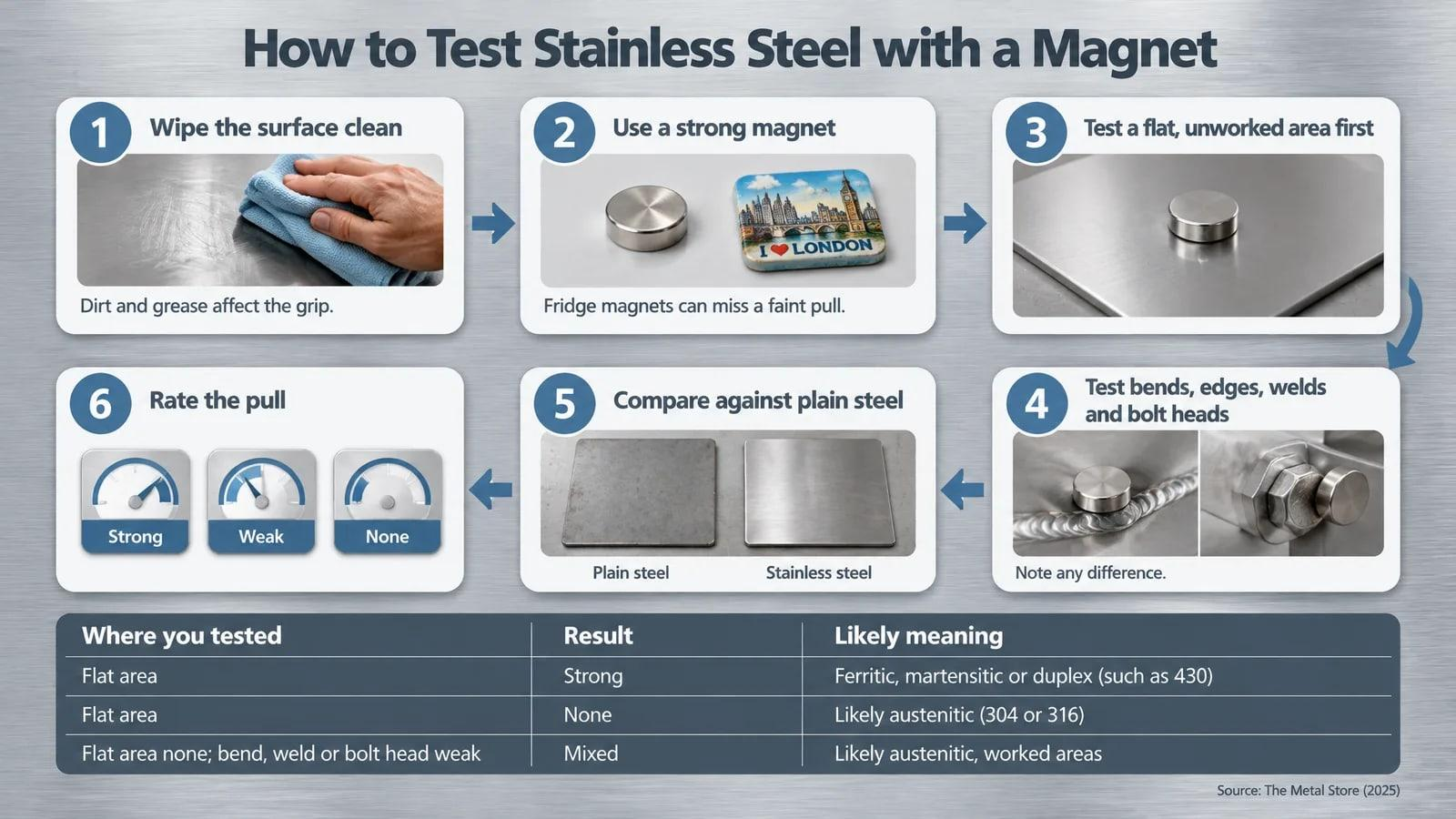
A strong magnet is held against a flat area of the item. If there is a strong attraction, the steel is likely ferritic, martensitic or duplex. If there is a weak attraction or no attraction, the steel is likely austenitic.
1. Wipe the dirt and grease off the surface to ensure a better grip.
2. A neodymium magnet should be used. They are much stronger than fridge magnets and do not lose their magnetism.
3. Test a flat, unworked area first.
4. Conduct the second test on the test pieces to note any differences.
5. Compare it to an uncoated coil, if available. Can you compare them?
6. Rate the pull as strong, weak or none.
Where you tested | Result | Likely meaning |
Flat area | Strong | Ferritic, martensitic or duplex (such as 430) |
Flat area | None | Likely austenitic (304 or 316) |
Flat area none; bend, weld or bolt head weak | Weak at worked spots | Austenitic with cold work or weld ferrite |
Flat area | Weak | Unclear: duplex, or heavily worked austenitic |
There are arguments about which is “stronger” or “weaker,” but the concepts are relative. A piece of grade 430 stainless steel fell off the scale when K&J tested its pull. The pull was 82% to 99% of the pull on regular steel, though a force 5–20% weaker can be expected instead (K&J Magnetics, 2024). So if a magnet pulled 10 pounds on mild steel, it might pull roughly 8.2 to 9.9 pounds on grade 430 stainless steel. A strongly magnetic stainless steel piece can feel about like mild steel.
This needle won't tell us the exact grade. A wise customer would be right to assume it's fake.
● Duplex and ferrite. The difference between duplex and ferrite is unlikely to be felt by hand.
● Use a mill test certificate or an alloy analysis, such as XRF or positive material identification (PMI).
Does Magnetic Stainless Steel Mean It Is Fake or Rust-Prone?
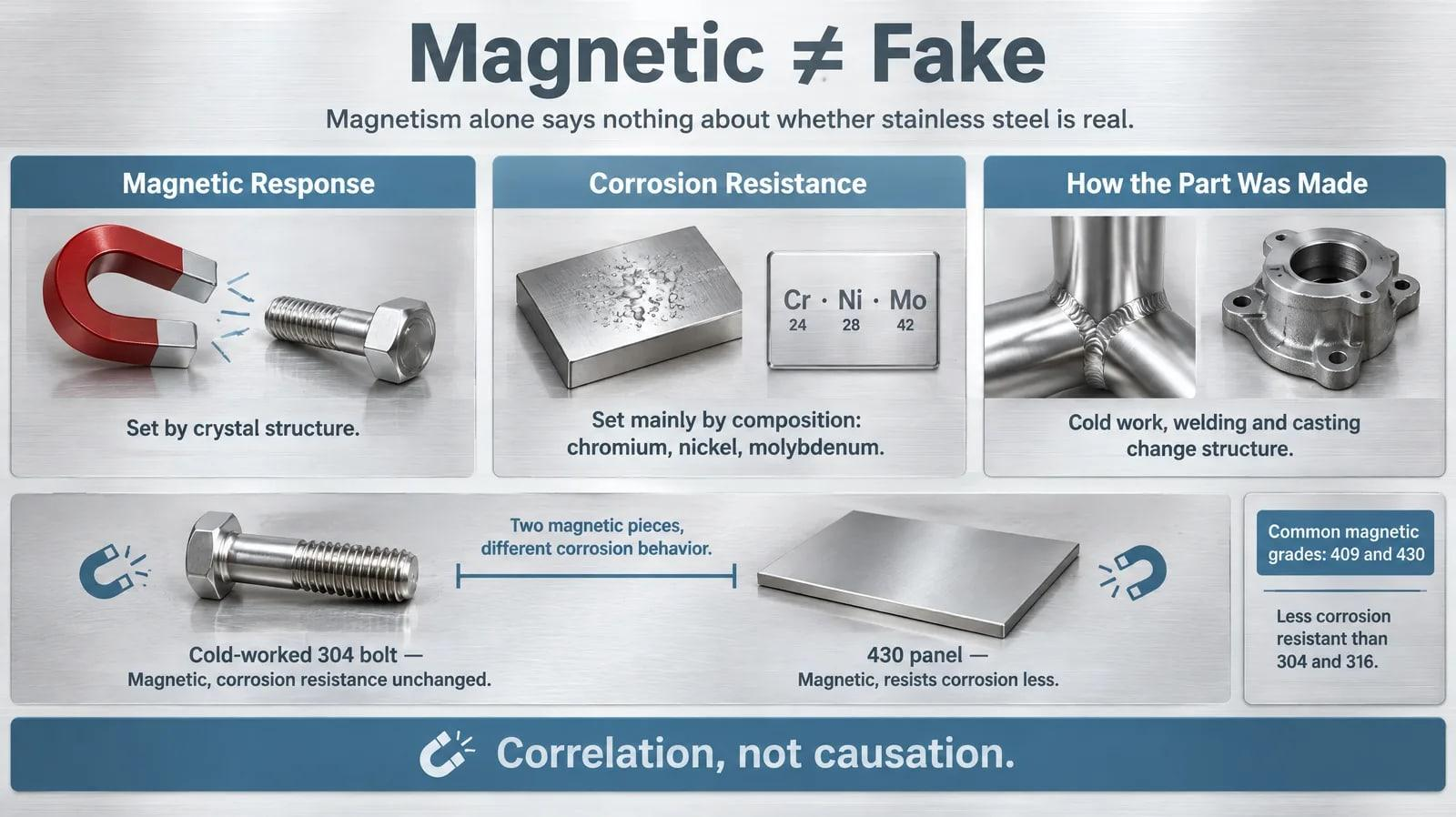
Magnetic stainless steel is not counterfeit because magnetism has no bearing on whether stainless steel is real. Monster Bolts supports this fact and points out that its magnetic stainless steel fasteners are genuine. The myth remains because commonly used magnetic stainless steels—409 and 430—do not resist corrosion as well as 304 or 316, according to Austral Wright.
This shows a relationship, not results. People mix up three distinct things.
● Magnetic response: set by crystal structure.
● The core’s corrosion resistance can be altered by controlling its chemical composition, such as its chromium content.
● The structure was changed by the cold working, welding and casting techniques used to make this product.
It represents or implies a specification for the length of the stainless steel bolt. A cold-worked 304 stainless steel bolt (and a 430 stainless steel panel; see data below) wouldn’t hold a magnet. This shows how cold work changes the structure of the steel. Consequently, the magnetic strength of the two listed items isn’t the same, which could explain why the 304 bolt isn’t attracted to the magnet.
Does Magnetic Stainless Steel Rust?
It could, especially in wet or salty conditions, where 430 and 409 have less of a margin than 316. 430 often makes the most sense for largely dry indoor use, such as appliance panels or exhaust parts.
Does Stainless Steel Cookware Work on Induction Cooktops?
KitchenAid says stainless steel cookware will work on induction only if its base contains a layer of magnetic steel. If a magnet sticks well to the base of the cookware, then the cookware is induction-compatible. Whirlpool and Made In also suggest this magnet check.
The assertion that an induction pan should be made of “18/10” stainless steel (meaning 18% chromium and 10% nickel) is wrong. A common non-magnetic grade of stainless steel contains about 15% chromium and 7–9% nickel. Test 18/10 stainless steel with a magnet.
Factories can’t ignore magnetism. Magnetism is so important in factories that Eclipse Magnetics noted that once bits of stainless steel are work-hardened, they become slightly magnetic, allowing the food plant’s magnetic separator to catch them.
How Do You Choose Between Magnetic and Non-Magnetic Stainless Steel?
You should first select the stainless steel grade based on the environmental and load criteria. Only if it meets both criteria and has the required magnetic response can it be considered suitable for use.
Your need | Typical choice | Trade-off |
Magnet attraction (appliance panels, induction base) | 430 | Less corrosion resistance than 304 or 316 |
Non-magnetic behavior | Annealed 304 or 316 | Cold work adds weak magnetism, so verify |
Marine or salt exposure | 316 | Mostly non-magnetic; costs more than 430 |
Hardness for blades | 420 or 440C | Magnetic; less corrosion resistant than 304 |
Magnetism comes with the structure you select for other reasons. You hardly select it directly, except for sensitive instruments. Choose a low-permeability material and test it. A manufacturer of stainless steel sintered parts can verify the grade and magnetic behavior of a custom component in writing for you.
Frequently Asked Questions
Is Duplex Stainless Steel Magnetic?
(Author's name) Answer: Yes, duplex stainless steels are magnetic. Are they as magnetic as ferritic stainless steels? Yes, in the sense that both have a magnetic response due to their metal structure. Grades such as 2205 and 2507 have about half the ferrite of grade 430. A simple but slightly more intense test is to use a handheld magnet.
Is 430 Stainless Steel Magnetic?
I am a ferritic grade of steel, so a magnet will easily stick to me. I have less corrosion resistance than 304 or 316, so you’ll find my product is best used indoors.
Is 18/10 Stainless Steel Magnetic?
Typically, no. The 18/10 name refers to around 18% chromium and 10% nickel, and is a descriptive name for an austenitic grade like 304. This grade is nonmagnetic when annealed, and even though a pan is labeled 18/10, it will stick to a magnet if it has a magnetic base layer.
Is 17-4PH Stainless Steel Magnetic?
To begin with, 17-4 PH can be magnetic. Almost all martensitic precipitation-hardening grades, including 17-4 PH (630), are magnetic. Since it contains approximately 4% nickel, along with other alloying elements, 17-4 PH is very rarely nonmagnetic. Therefore, it is frequently used for metal shafts and other standard industrial components.
Can a Magnet Damage Stainless Steel?
A magnetic attraction to stainless steel does not affect or change its corrosion resistance. Attraction to a magnet does not mean that the metal is composed of silver. It only makes clear that the steel is not pure.
Conclusion
On a flat, unworked surface, use a strong magnet to run the magnet test. Test bends, welds and bolt heads separately. Don’t use this result as proof of grade; use it only to screen for the stainless steel family. To confirm the grade, check the grade stamp or datasheet. When buying, ask the maker to provide the grade in writing. A magnetic test alone is not proof of grade.