en
 de
 jp
 kor
 fra
 spa
 ru
 pt
 it

What Is Aluminum’s Symbol? Chemical Symbol Al Explained
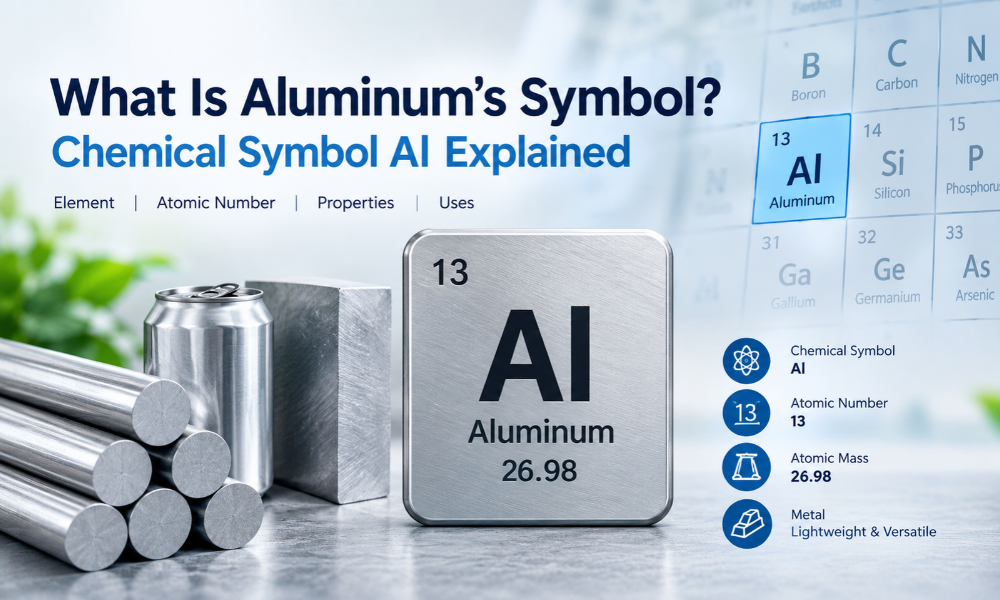
Use foil to explain how the aluminum chemical symbol is a common metal in many appliances including electronic devices, products for packaging and storage, industry and transportation. Answer the most important question verbatim, saying the name of the chemical symbol and the atomic number: So the answer to the main question is the chemical symbol of aluminium is Al and its atomic number is 13. Strike up a general discussion about the word and how the two spellings are associated with different Englishes – aluminum is predominantly used in American English, versus the much more common aluminium usage in British English and in many other countries. Tell students that the two names of compounds are being used to describe the same chemical element. Here use the main keyword one time to make your reader believe you will be talking about its chemical symbol, where it fits on the periodic table, some of its atomic properties and applications to science.
What Is the Chemical Symbol for Aluminum?
Describe that the electronic symbol of Aluminium in Chemistry, documents, chemical equations and in the periodic table is Al. Explain the use of chemical symbols to represent an element which is short and consistent throughout languages. Include related search phrase like mentioning Al is uppercase and a is lowercase, which is correct, and Al is not correct, or al is not correct etc. and include the symbols in the terms mentioned above, like chemical symbol for aluminum, symbol for aluminium, chemical symbol aluminium. Make sure to stress that the symbol is not to indicate a specific product made of aluminum, but the aluminum itself.
Aluminum Element Symbol and Periodic Table Facts
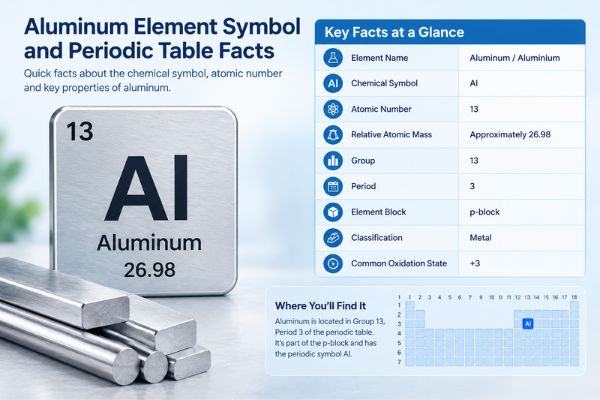
Display the fundamental properties of Al in simple table. State the Group, Period and p-block which the element belongs to. Give its chemical symbol, atomic number, relative atomic mass, classification (as a metal) and the most common oxidation state (+3). Explain that the aluminium in equation in the periodic table is the same ‘aluminium' in the spelling, as it is the same element. Explain that the rel. atomic mass is about 26.98 and that these properties can help students, engineers and manufacturers to identify this material. Use naturally the symbol and aluminum periodic symbol of the element as a primary word, but not overused.
Property | Details |
Element name | Aluminum / Aluminium |
Chemical symbol | Al |
Atomic number | 13 |
Relative atomic mass | Approximately 26.98 |
Group | 13 |
Period | 3 |
Element block | p-block |
Classification | Metal |
Common oxidation state | +3 |
Why Is Aluminum’s Chemical Symbol Al?
Give the reasons for the two-letter symbol Al for aluminum. Make a point that the symbol is a conventional, shortened form of the word; other countries' symbols for the element may be different. The first letter is capitalized, the second letter (if present) is in lower case. Explain that symbols not only provide an abbreviated form of the chemical formula but also help to make the chemical formula more comprehensible. For instance, the element's symbol is spelled out when the element is identified by its name as in Al, and other numbers, or charge designation, give more information about kinds of compounds and ions. Add the associated words to a natural description of how people look up the notation of the standard element: aluminium chemical sign and aluminums symbol. Explain that Al is not an informal symbol, but the chemical symbol.
Aluminum vs. Aluminium: Are the Symbols Different?
Give an explanation so that students come to understand that there are two acceptable spellings of the same chemical element, aluminium and aluminum. The word aluminium is used for American English, aluminium in British English and most international education materials. Although the names are different the atoms both have the same number of protons, which is known as the atomic number, Al is 13 whose name is aluminium. Explain how readers can find both terms in texts they read and see in websites and manufacturing and product specifications. An answer to the now common question “What is the symbol for aluminium?” is straightforward, the spelling change results in no change of the chemical identity of the element. Use aluminum symbol and what is the symbol for aluminium to answer the questions related to the same.
What Is Aluminum’s Atomic Number?
Explain that there are 13 protons in the nucleus of each aluminum atom, that occurs in nature, and why. There are 13 electrons in a neutral atom of aluminium. Explain the concept of atomic number and relative atomic mass, make clear that the difference of the two is the naturally occurring isotopes of the atoms of a particular element. Add the diagram of the electron configuration of Al (1s2 2s2 2p6 3s2 3p11s^2\,2s^2\,2p^6\,3s^2\,3p^11s2) and explain briefly that the electrons of Al are in different energy levels surrounding the nucleus. Use a "search term" term number and explain that the number is that of the element on the periodic table, not 26.98.
Common Uses and Properties of Aluminum
Give an account of the essential properties of aluminum which makes it useful for everyday use and in industry. Describe its lightweight properties, malleability, its resistance against corrosion due to the protective oxide layer that it forms, as well as its excellent conducting properties for heat and electricity. Relate them to common examples such as window frames and roofing for buildings, aircraft parts and vehicle parts, can and foil (packaging), conductors (electrical use) and manufactured parts (in manufacture). Explain that aluminium alloys can be engineered to have various strength, weight and performance characteristics. Avoid speculating or adding opinions, just as to keep the essay strictly factual, convey the same message that, by identifying an element, a reader can gain information about the element's practical applications.
Aluminum’s Symbol Used in Chemical Formulas
Notation | Meaning |
AI | Aluminum element symbol |
Al₂O₃ | Aluminum oxide |
AlCl₃ | Aluminum chloride |
Al³⁺ | Aluminum ion with a +3 charge |
Is Aluminum Symbolism the Same as Its Chemical Symbol?
Define the scientific use of a chemical symbol and understand that a chemical symbol is used for a more general purpose of symbol. Discuss the possibility of using aluminum symbolism in non-scientific, informal or cultural contexts as opposed to the precise and standardized scientific one for Al. Recognizes the element in the periodic table, formulas and in scientific communication. Don't imply that the type of strength, durability or other abstract meaning that aluminum has to do with that. Remind the students that chemical symbols are used as per conventions and not according to their own thoughts or general ideas.
Why Is Aluminum Important in Modern Manufacturing?
Describe the role of these properties – density, corrosion resistance, formability and thermal conductivity – are useful to aluminium's use in the production of a variety of materials. Explain its uses in manufactured products such as parts for machining, formed metal products, electrical components, transportation products, etc. Explain the criteria for choosing the appropriate grade/alloy for aluminum products, depending on the properties needed, such as strength, operating environment, size and production process. Introduce briefly the common production processes of making aluminium parts, such as machining, casting and metal forming. Specify Harber MIM if applicable in a broader way, precision manufacturing and material selection and not without substantiated claims of capabilities or aluminum processes.
FAQ:
What is the element symbol for aluminum?
Its symbol for the periodic table and formula of chemistry is Al.
What is the aluminium symbol on the periodic table?
The atomic number of aluminium is 13 and symbol is Al.
Why is aluminum written as Al instead of A?
The standardized symbol is Al. Chemical symbols are assigned to distinguish elements clearly and consistently.
Conclusion
Aluminum chemical symbol is Al, its atomic number of 13, and a mass of about 26.98. Aluminium (also spelled aluminium) remains a go-to material for both everyday items and industrial manufacturing thanks to its versatility, low weight, and corrosion resistance. Recognizing simple properties like these makes mastering chemical formulas and reading the periodic table far less confusing.