en
 de
 jp
 kor
 fra
 spa
 ru
 pt
 it


What Is Annealing? A Complete Guide to the Metal Annealing
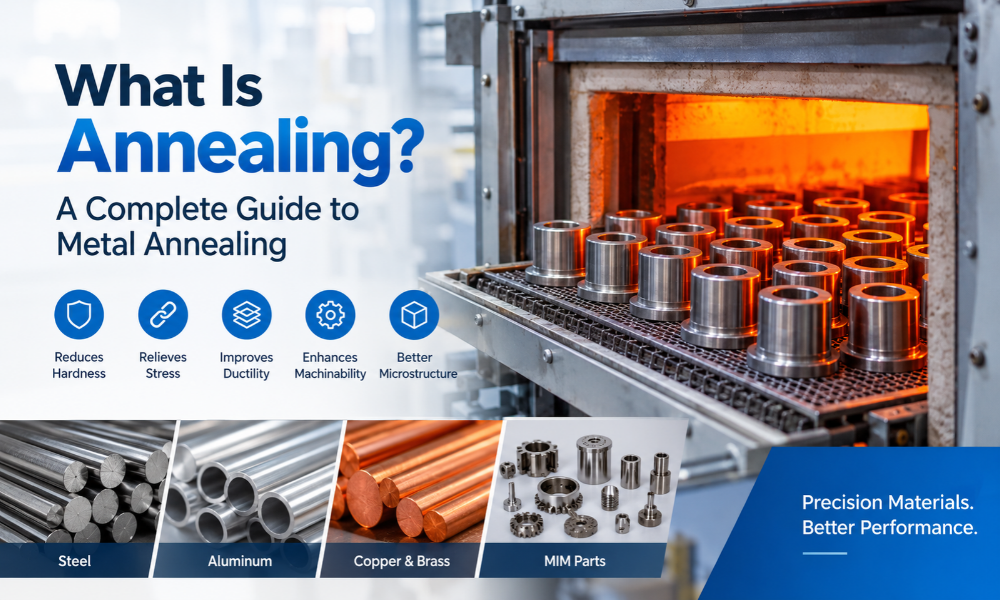
The metals in a manufacturing process can be hard, strained or difficult to form. These characteristics can be modified by heat treatment to produce materials with desired characteristics for further processing. Metal Annealing is a heat treatment process that is applied to increase a metal's resistance to fracture and stress. This can decrease the hardness of the material, increase ductility, eliminate internal stresses, and make it easier to machine or form. The actual outcome will vary with choice of metal and treatment. We will discuss the working, main types and advantages of annealing, and its application in steel, aluminum and precision metal manufacturing.
What Is Annealing? Definition and Meaning
A method of changing the properties and internal structure of metals by heat treatment is called annealing. One of its primary uses is to soften a material, give it the ability to bend or stretch and make it more suitable for subsequent operations. Also it can be used to minimize residual stress and enhance the machinability. However, the time of results and the cooling method will differ depending on the alloy, temperature, holding and cooling time.
Annealing Definition and Meaning
In metallurgy, when a material is heated and cooled in a controlled manner, in order to alter certain of its properties, the process of heating and cooling is known as anneal. The term annealing is used in metalworking to describe this heat treatment and anneal is the noun used when referring to the action of heat treating. The term "annealed" when used to describe a material indicates that the material has been subjected to an annealing treatment. The treatment does not work on all metals and the process needs to be appropriate for the purpose to which the metal is to be put.
What Is Annealed Metal?
Metal which has been heated and cooled through a desired annealing cycle is called annealed metal. It might be softer, more ductile or less stressed than in its previous state. For instance, annealed steel is more easily machined, while annealed aluminum is likely to be more easily shaped after cold working. Just because it is annealed, does not necessarily make it stronger or better it means it has been treated to get certain qualities.
How Does Annealing Work?
It operates by altering the internal structure of the metal by carefully heating and cooling. Recovery and recrystallization can decrease the effects of previous deformations in appropriate materials, and heat can cause the atoms of the metal to rearrange. These alterations will reduce hardness and increase ductility. The treatment also alters the grain structure and/or distribution of phases in some metals. The final properties are determined by the alloy, its prior processing, the heating temperature, the time the alloy was held at the heating temperature and the cooling rate.
What Is the Annealing Process? Step-by-Step Guide
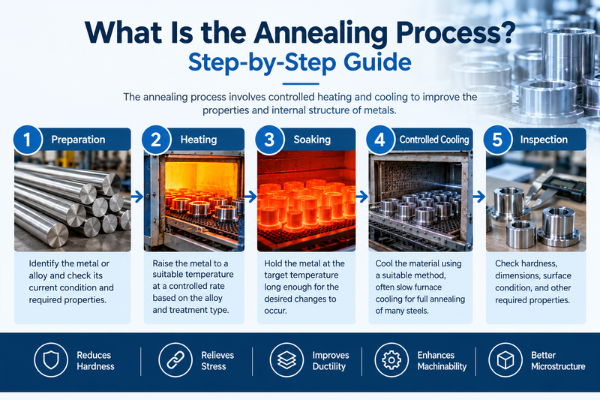
The annealing process has a few stages and each stage is to help attain the desired material properties. The choice of the cycle depends on the type of metal, the size of parts to be produced, and the production needs.
1. Preparation: Determine the properties of the treated alloy, the condition of the alloy and its identification.
2. Heating: Raise the temperature of the metal at a controlled rate to a proper temperature. The desired temperature is dependent upon the alloy and kind of annealing operation.
3. Soaking: Maintain the metal at the desired temperature for the desired time to bring about the desired changes in the component.
4. Controlled cooling: Cool the material with appropriate cooling process. Many steels are fully annealed by furnace cooling at slow rates, and other metals and/or annealing processes may require other cooling rates.
5. Inspection: Test to check the hardness, dimensions, surface condition or other requirements set out in the product specification.
The process of temperature control and cooling is critical and if the temperature is not controlled and the cooling is not suited, the hardness, grain growth, oxidation and distortion may be unwanted.
Types of Metal Annealing
The various annealing processes have various functions for the manufacturing process. The selection of the appropriate method allows the engineers to control the hardness, ductility, stress and microstructure.
● Full annealing: cools slowly to produce a softer more workable structure when the metal to be annealed is heated to a specified temperature.
● Process annealing: Re-gains some ductility in a cold worked metal which gives it the ability to go through further forming operations.
● Stress relief annealing: Relieves the stresses that may be present from the process of manufacturing such as forming, welding, casting or machining, without necessarily causing significant microstructural changes.
● Recrystallization annealing: Recrystallizes the material to restore ductility and to reduce the work hardening.
● Spheroidizing annealing: Heat the material to a suitable temperature for a certain period, so as to change the carbide morphology of the steel to improve the performance of the steel in machining and forming.
These methods cannot be substituted for each other. When designing the alloy for a specific component, an engineer has to take into account the alloy and its previous manufacturing process and the required properties of the finished component.
Why Is Metal Annealing Important in Manufacturing?
Metal Annealing is crucial in that it enables manufacturers to prepare the materials for subsequent production operations such as machining, forming, stamping, etc. A proper treatment can soften, re-ductilize, un-stress and increase the ability of the material to be machined. It can also be used to produce a more desirable microstructure that can be utilized at a later stage in processing.
These benefits can lead to more predictable manufacturing for precision components, and help to minimize issues with following operations. But, in not all cases, annealing produces better performance. An undesirable softening or an inappropriate grain size is not desirable in a component if high strength or wear resistance is required. The treatment needs to therefore be tailored to the requirements of the final product.
Annealing Different Metals: Steel, Aluminum, and Other Alloys
Heat treatment of each metal is different, depending on the composition of the metal and the application.
What's Annealing Steel?
Describe the annealing process of steel and its effect on the steel's characteristics of machinability, ductility and stress relief. Explain Annealing of Steel, Anneal steel and what it is called when the steel is annealed.
What Is Annealed Aluminum?
Explain why the ductility of aluminum can be returned by annealing after the cold working step and why some forming processes are facilitated. Include annealed Aluminum and discuss the need for treatment specific temperature control for Aluminum alloys.
Other Metals and Alloys
Explain briefly about copper alloys, brass and other appropriate alloys, giving a brief note about the response of all these materials to heat treatment.
Annealing in Metal Injection Molding (MIM)
Metal Injection Molding (MIM) is a manufacturing technique which involves mixing together a fine metal powder and a binder to form a feedstock. The feedstock is formed in a desired shape, the binder is removed and the component is sintered into a solid metal component. These parts are generally employed when intricate designs and tolerances are necessary.
MIM parts meaning is the parts manufactured using the metal injection molding process. The annealing step can be part of certain production routes or performed after the manufacturing process, but is not considered sintering. Sintering is one of the most critical processes in MIM which is responsible for the development of properties and bonding of metal particles. If further annealing is required, it is dependent on the type of material, production process, and requirements.
The differences between thermal processes, for manufacturers like Harber MIM, allow engineers to select the most appropriate manufacturing steps for the precision metal parts they are working with.
Factors That Affect the Annealing Process
There are some factors that will help or hinder whether an annealing cycle will result in the desired outcome. Several factors when designing such a component include the composition of the metal, the temperature to which it is heated, the time it is allowed to soak, the rate of cooling, the thickness of the component itself and the previous manufacturing processes. Other factors, such as the required hardness, ductility, microstructure and dimensional stability, also affect the selection of treatment.
With stamping and other high volume manufacturing processes, the proper cycle can help return the workability between the forming processes. Take stamping and annealing cycle as an example, in China and other countries, manufacturers need to choose the cycle according to the requirements of the material grade and production requirements, and cannot use a single cycle. It can be ensured that the treated material has the desired specifications through proper testing.
Annealing vs. Other Heat Treatment Processes
The various heat treatment processes may be compared in terms of the difference between annealing and other processes.
Process | Main purpose | Typical cooling method |
Annealing | Re-work material to make it more ductile, soft or relieve stress | Typically time consuming furnace cool to full anneal of steel |
Normalizing | To further develop the structure of good steels | Usually cooled by still air cooling. |
Quenching | Create a more compact texture within appropriate material(s) | Rapid Cooling in a Given Medium. |
Tempering | Temper steel to change its hardness and toughness in the hardened condition | A reheating process that is followed by a controlled cooling operation. |
The proper process will vary according to the material and its uses. Annealing, for instance may be used to prepare steel for machining, quenching and tempering may be chosen for a component that requires a certain combination of hardness and toughness.
Conclusion
Metal Annealing can be used to modify the properties of appropriate metals to make them harder, more ductile, less stressed and more microstructural. When the heating, soaking or cooling of materials is controlled, the material can be prepared for the subsequent machining, forming, stamping and other production processes. Depending on the alloy, its former condition and the desired properties of the finished product, the right method has to be used. It is important to understand these factors to enable manufacturers to choose appropriate heat treatment processes and to control the product quality.
In the case of precision components (including MIM parts), it is important to follow the material specification and manufacturing requirements in the heat treatment process.