en
 de
 jp
 kor
 fra
 spa
 ru
 pt
 it


Tungsten Magnetic Properties: A Comprehensive Guide (2026)
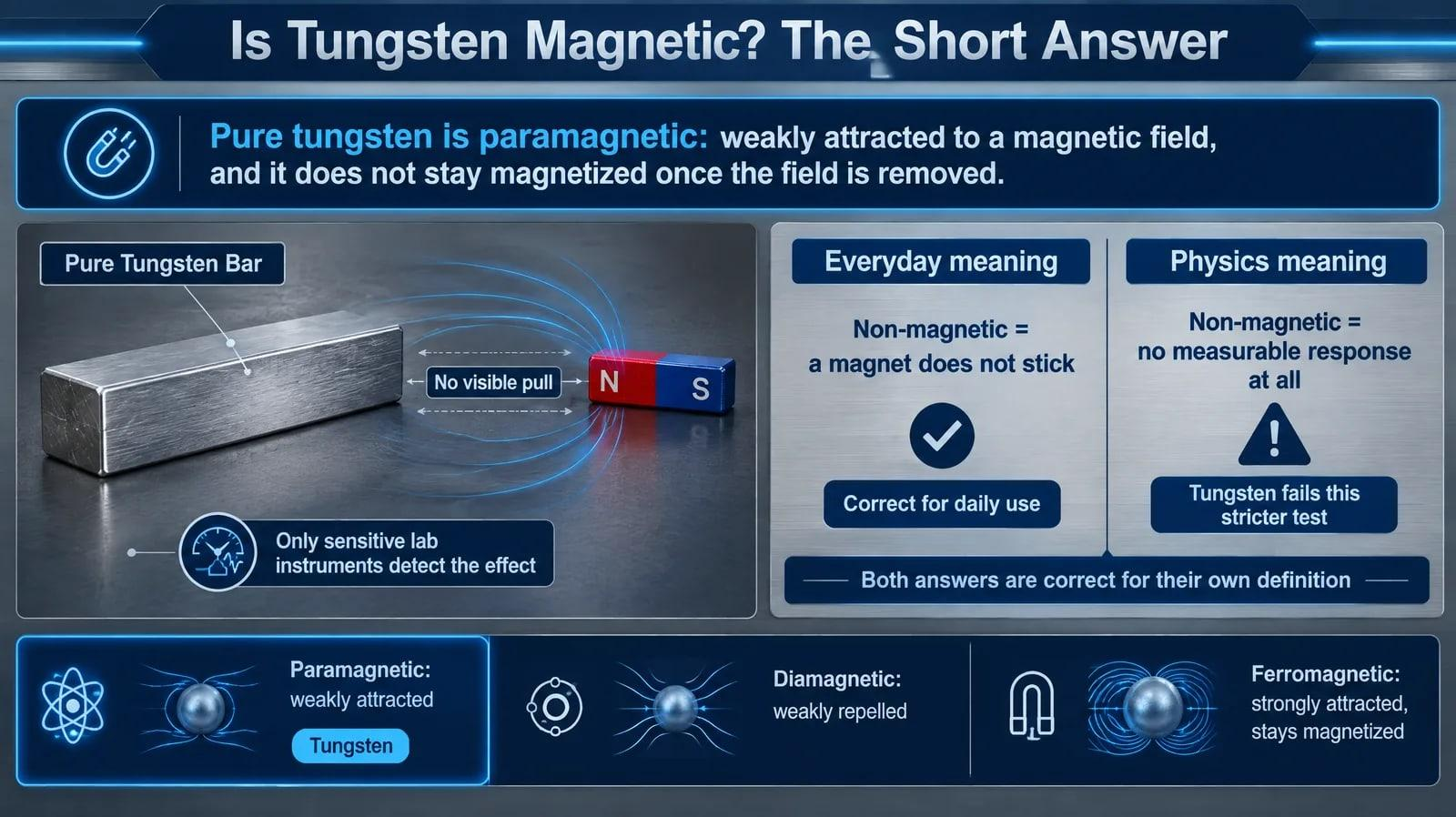
Pure tungsten is not magnetic in any practical way. It has a weak type of paramagnetism which means a strong magnetic field that gets formed in it makes it weakly attracted. Tungsten products can be attracted by magnets when they have cobalt, nickel or iron binders, such as tungsten carbide and heavy alloys.
As you probably already know, tungsten is heavy (actually very very heavy) and withstands a huge amount of heat. However, you may have also noticed that tungsten rings or carbide tools will stick to a magnet, and if you go looking online for susceptibility numbers you will notice they differ. The guide of 2026 describes how the binder metal of a material as well as ASTM B777 grades and measured permeability decide whether a given product is magnetic or not.
Key Takeaways
● Tungsten is paramagnetic. More specifically, pure tungsten is a weak magnetic. Consequently, in the presence of a magnetic field, it tends to be slightly attracted. However, once removed, it will not keep any magnetization.
● Tungsten products, tungsten carbide with cobalt binder, magnetic grade heavy alloys, tungsten steel etc. can be attracted to a magnet if they contain cobalt, nickel or iron.
● The binder's nature determines tungsten carbide's magnetism. WC-Co carbide is ferromagnetic at room temperature but tends to have low magnetic permeability.
● All tungsten heavy alloys compliant with ASTM B777 are magnetic or non-magnetic in nature. Copper and nickel binders are used in non-magnetic grades.
● Because a binder can cause a genuine product to stick to a magnet, a hand-magnet test cannot reliably show an item is real tungsten.
● The reported susceptibility values for tungsten differ significantly across websites. Examine the units of a number before using it.
● Being non-magnetic doesn’t imply that it will not cause any trouble in MRIs or metal detectors.
Is Tungsten Magnetic? The Short Answer
Tungsten being paramagnetic means it is only attracted to a magnetic field weakly. Once the magnetic field is removed, tungsten loses magnetism. A bar of pure tungsten will not be easily pulled near a fridge magnet. The effect can only be detected by sensitive lab instruments.
Sources are torn between “not magnetic” and “weakly magnetic” because they have two definitions. “non-magnetic” means that something does not sticks to a magnet in everyday use In physics, no measureable response at all means tungsten fails that stricter test. Both answers fit for their respective definitions.
The division also results in poor writing. Out of the five competitive pages reviewed for this guide, two contradict themselves on the physics. BOYI refers to tungsten as paramagnetic but also states the primary diamagnetic behaviour. According to HSMAG, in one instance diamagnetism seems to overcome the paramagnetism, and in another, they call the diamagnetic response negligible (HSMAG, 2025). Diamagnetism refers to a weak repulsion from the magnetic field, opposite to paramagnetism.
"Non-magnetic" is an active label, not a material fact: practical lesson. When creating a component for a sensitive instrument, request quantified data rather than accepting what someone claims.
Why Is Pure Tungsten Only Weakly Paramagnetic?
Due to its unpaired d-electrons weakly responding to a field, pure tungsten is known to be a paramagnet, but they do not lock into domains like iron does. Without domains, there is no structure to help with alignment. Tungsten’s body-centered cubic (bcc) crystal structure won’t change this.
The degree to which it magnetises in an applied magnetic field is called magnetic susceptibility. The tungsten atom has a small positive charge. A peer-reviewed paper gives 3.2 × 10⁻⁷ emu/g at 298 K and 2800 Oe, and it rises with temperature (ScienceDirect, 2017). This value is listed as +59.0 × 10⁻⁶ cm³/mol at 298 K by Wikipedia. E-magnetica gives 4.0 × 10⁻⁹ m³/kg in SI and 53 × 10⁻⁶ cm³/mol in CGS (E-magnetica, 2024).
They appear to be different but are not. The table uses tungsten with an atomic mass of about 183.84 g/mole to convert each to emu/g. (equal to cm³/g in CGS). The arithmetic has been performed on original values.
Source | Reported value | Converted to emu/g | Versus the 2017 paper |
3.2 × 10⁻⁷ emu/g | 3.2 × 10⁻⁷ | Baseline | |
+59.0 × 10⁻⁶ cm³/mol | 3.2 × 10⁻⁷ | Matches | |
4.0 × 10⁻⁹ m³/kg | 3.2 × 10⁻⁷ | Matches | |
53 × 10⁻⁶ cm³/mol | 2.9 × 10⁻⁷ | About 10% lower | |
7.8 × 10⁻⁵ cm³/mol | 4.2 × 10⁻⁷ | About 1.3× higher | |
1.3–1.8 × 10⁻⁵ cm³/mol | 0.7–1.0 × 10⁻⁷ | 3–4.5× lower | |
6.8 × 10⁻⁶ emu/g | 6.8 × 10⁻⁶ | About 21× higher |
All three competitor values fall more than 30% away from the primary figure, while BOYI's value is about 21 times too high. Confusion arises because quantities often involve more than one unit; we must be clear. Always refer to the unit before comparing the two numbers.
The temperature is important too. The 2017 study also notes a transition from paramagnetic to diamagnetic behavior at distinctive locations on the inverse susceptibility curve.
Magnetic Behavior by Tungsten Form
The magnetism of a tungsten product depends not on the tungsten itself but on what is mixed with tungsten. The table sorts common forms by binder, the metal that holds the tungsten particles together.
Tungsten form | Binder or added metal | Does a magnet stick? | What to check |
Pure tungsten | None | No visible attraction; weakly paramagnetic | Purity certificate |
WC-Co carbide | Cobalt | Often yes; ferromagnetic at room temperature (Hyperion) | Cobalt content, permeability |
WC-Ni carbide | Nickel | Feebly magnetic (HSMAG, 2025) | Nickel content |
W-Ni-Fe heavy alloy | Nickel and iron | Magnetic grades exist | ASTM B777 class |
W-Ni-Cu heavy alloy | Nickel and copper | Non-magnetic grades | Permeability of 1.05 or lower |
Tungsten steel | Iron | Yes | Steel grade |
"Tungsten" ring | Usually carbide with Co or Ni | Depends on the binder | Ask the seller |
If you take a peak at the second column then you will see that the answer in every case has came from the second ingredient. The clearest case is tungsten steel. Due to this iron content, it is said to be magnetic. Furthermore, tungsten used to be a major alloying element in magnet steels but AlNiCo alloys replaced it.
Rings and implements typically cause the most problems. Tungsten carbide is most of what is sold, so the binder is the variable that matters.
Is Tungsten Carbide Magnetic?
The magnetic behavior of tungsten carbide depends on the binder. A cobalt or nickel binder will cause ferromagnetic behavior at room temperature. But the effect is modest. According to the manufacturer, “Although WC-Co cemented carbides have a ferromagnetic binder phase, they usually have low magnetic permeability,” notes Hyperion Materials & Technologies.
Relative permeability, a measure of the extent to which a material concentrates a magnetic field compared with vacuum (which equals 1), generally runs 2 to 12; cobalt content increases this number considerably. The cobalt binder undergoes a transition from ferromagnetic to paramagnetic between 950-1050 oC.
Magnetism as a Quality-Control Measurement
Manufacturers magnetism is used for all products check. The tungsten and carbon dissolved in the cobalt binder are read through magnetic saturation. Carbide is considered high quality when it reaches from 80% to 100% saturation, and the 80% mark indicates where brittle eta phases start to form (US Patent 10,456,889). The saturation of pure cobalt is 201.9 μT·m³/kg.
For example, a cobalt grade of 6% at 100% saturation reads 12.1 μT·m³/kg (0.06 × 201.9). At the 80% floor it would record about 9.7. This is a worked-out example, not a spec.
Are Tungsten Rings Magnetic, and Does a Magnet Test Prove They Are Fake?
A tungsten ring may stick to a magnet, or it may not stick to a magnet. In either case, the ringing of a magnet proves nothing one way or the other. Most "tungsten" rings are carbide in nature and the resulting binder metal determines the outcome. If a ring containing cobalt is attracted to a magnet, it is still possible that it is a genuine carbide.
Tungsten Heavy Alloys: Magnetic vs. Non-Magnetic Grades
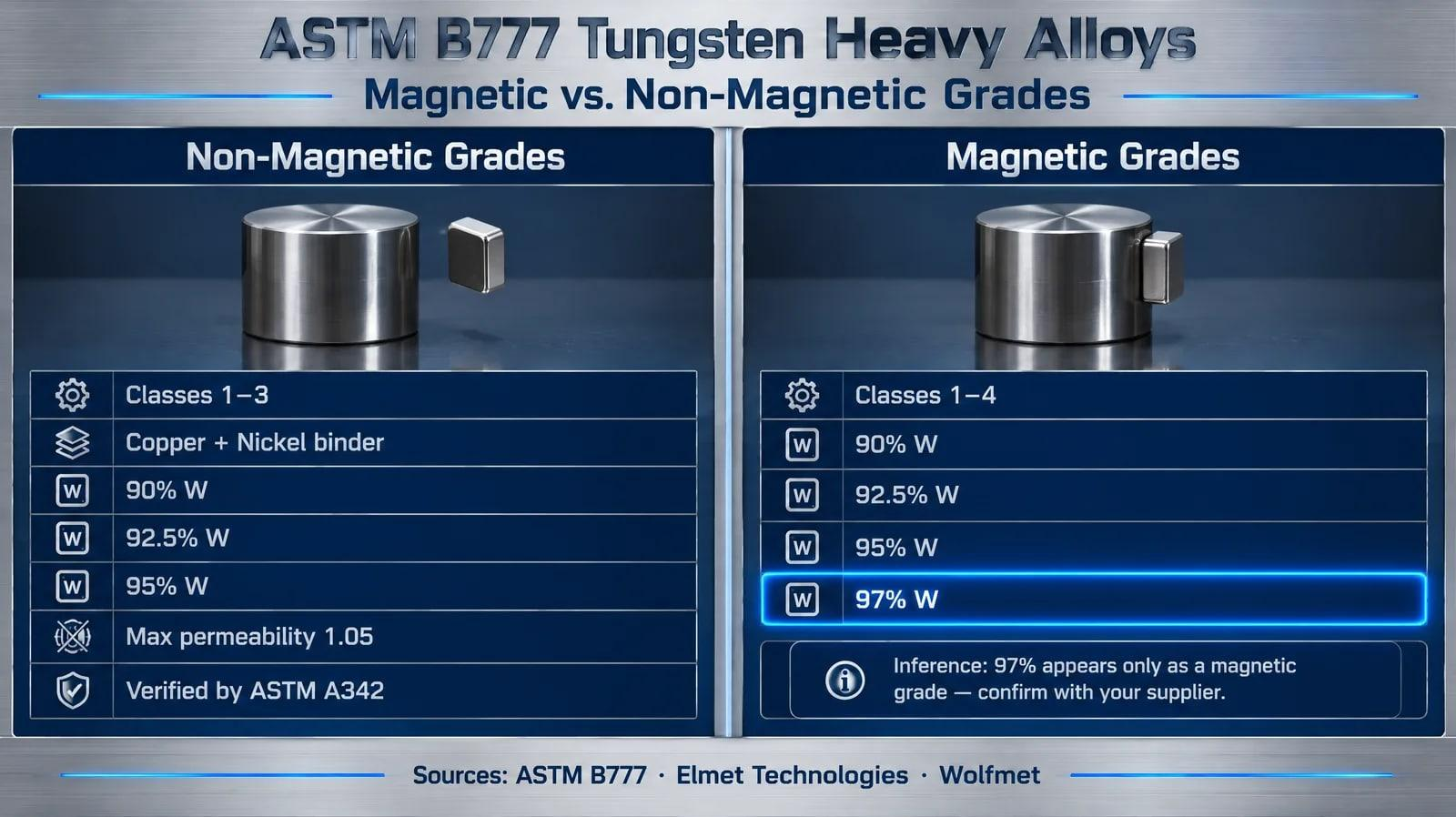
The tungsten heavy alloys are tungsten-rich dense composites and ASTM B777 covers magnetic and non-magnetic grades. Generally, non-magnetic materials have a maximum permeability of 1.05, as established by ASTM A342 (Elmet Technologies).
According to Golden Sunbird Metals, the standard has four classes i.e. 90%, 92.5%, 95%, and 97% tungsten. Wolfmet uses copper and nickel binders with 90-95% tungsten for its non-magnetic alloys. Its grade table covers non-magnetic Classes 1-3 and magnetic Classes 1-4 to ASTM B777-15(Source: Wolfmet).
When read together, the two listings suggest the 97% class essentially exists as a magnetic grade. Inferred, confirm with your supplier.
How to Read a Spec Sheet
1. Determine the tungsten percentage by finding the ASTM B777 class.
2. See if the grade is identified as magnetic or non-magnetic.
3. Find a permeability value and test method (e.g. ASTM A342) after checks above.
A non-magnetic grade still only passes against its threshold, not against zero. The reasons for the threshold are revealed. To avoid magnetic field disturbance, a tungsten alloy with a nickel-copper binder was tested on the ITER reactor for having low permeability (Source: arXiv, 2025). This documentation can be provided by suppliers like Harber Metal.
How Can You Test Whether a Tungsten Product Is Magnetic?
A hand magnet is the quickest test available. However, relying on a hand magnet for confirming if a product is real tungsten cannot be trusted(Source: Great Magtech, 2026) Make use of a three-tier path and stop at the breakdown that you need for your goal.
1. Magnet for hand. Put a magnet near the item. When sticking occurs, it indicates the presence of a magnetic binder or iron. When not sticking, little can be concluded.
2. Permeability test. If the value is important, request a test per ASTM A342.
3. Certificate from supplier. Ask in writing for the alloy class, binder and permeability.
The 1.05 threshold is a mere 5% off vacuum and therefore too small for a pocket magnet to settle by feel. That's why tier one can't certufy a "non-magnetic" claim.
Choose the tier that suits your objectives.
● Inquire what the binder is. Magnet attraction is no proof that the lock is fake.
● Level one is enough for machinist, as it will flag magnetic swarf or chips, but do check the grade before cutting parts for the sensitive equipment. If you require a magnetic function for your precision metal parts, include it on the drawing.
● Ask for tier two and tier three version those engineer near sensors or MRI
Beyond Bulk Metal: Where Tungsten Magnetism Gets Unusual
The magnetic narrative of tungsten is not merely attraction because the term “magnetic properties” can also refer to a material’s resistance to electrical flow in a field. Tungsten ditelluride (WTe2) showed a resistance increase of about 13 million percent in a 60 tesla field at 0.5 K, in 2014. This means a 130,000-fold rise in resistance (13 million/100), a magnetoresistance effect that has nothing to do with a magnet sticking.
Tungsten is also found in physics. Using tungsten as a neutron source, researchers developed bismuth and tungsten powder that cancels fidgety responses to magnetic field (Source: arXiv, 2015). The same idea corroborates that pure tungsten gives a small but real response.
Frequently Asked Questions
Does temperature change tungsten's magnetic behavior?
Certainly. The susceptibility of pure tungsten is paramagnetic and increases with temperature. About 950-1050 °C, the cobalt binder in carbide is ferromagnetic and will become paramagnetic. A carbide part doesn’t get magnetized at very high temperatures.
Is tungsten safe near an MRI scanner?
To say that a tungsten ring is “not magnetic” is not a safety claim. A tungsten ring can still heat up in the MRI, distort images, or include a magnetic binder. For this reason, Redwood Rings recommends removing rings for an MRI regardless (Source: Redwood Rings, 2026). As always, treat everything here as general advice, not a medical clearance. Ask the MRI facility before scanning.
Will tungsten set off a metal detector?
It certainly can. Just because a metal is non-magnetic does not mean metal detectors will not respond to it, they also respond to conductivity. Redwood Rings states that even a ring can set off airport security (Source: Redwood Rings, 2026).
Can tungsten be magnetized?
Tungsten that is pure can’t be magnetized in any lasting way because it won’t keep any magnetization once the field is removed. Due to its iron content, tungsten steel can be magnetised. Moreover, tungsten was an important alloying element in magnet steels. Cobalt-bound carbide can also carry a little magnetism.
Which metals are magnetic, and how does tungsten compare?
Iron, nickel, and cobalt are the common ferromagnetic metals, meaning they are strongly attracted to magnets and can stay magnetized. Tungsten exhibits paramagnetic properties offering a susceptibility that is equal to 3.2 × 10⁻⁷ emu/g (ScienceDirect, 2017). It is much too weak a feel with a hand magnet.
Conclusion
Ask this first question to judge any tungsten product: what is the binder? While pure tungsten is essentially non-magnetic, cobalt, nickel and iron change the answer. Then check the evidence which is to your risk. A hand-held magnet should be sufficient for a casual ring check. If you require ASTM Class with measured permeability and a certificate from supplier in writing for sensors, shielding or medical environments, let’s talk!