en
 de
 jp
 kor
 fra
 spa
 ru
 pt
 it

Inconel Alloy 718: A Comprehensive Guide to Know (2026)
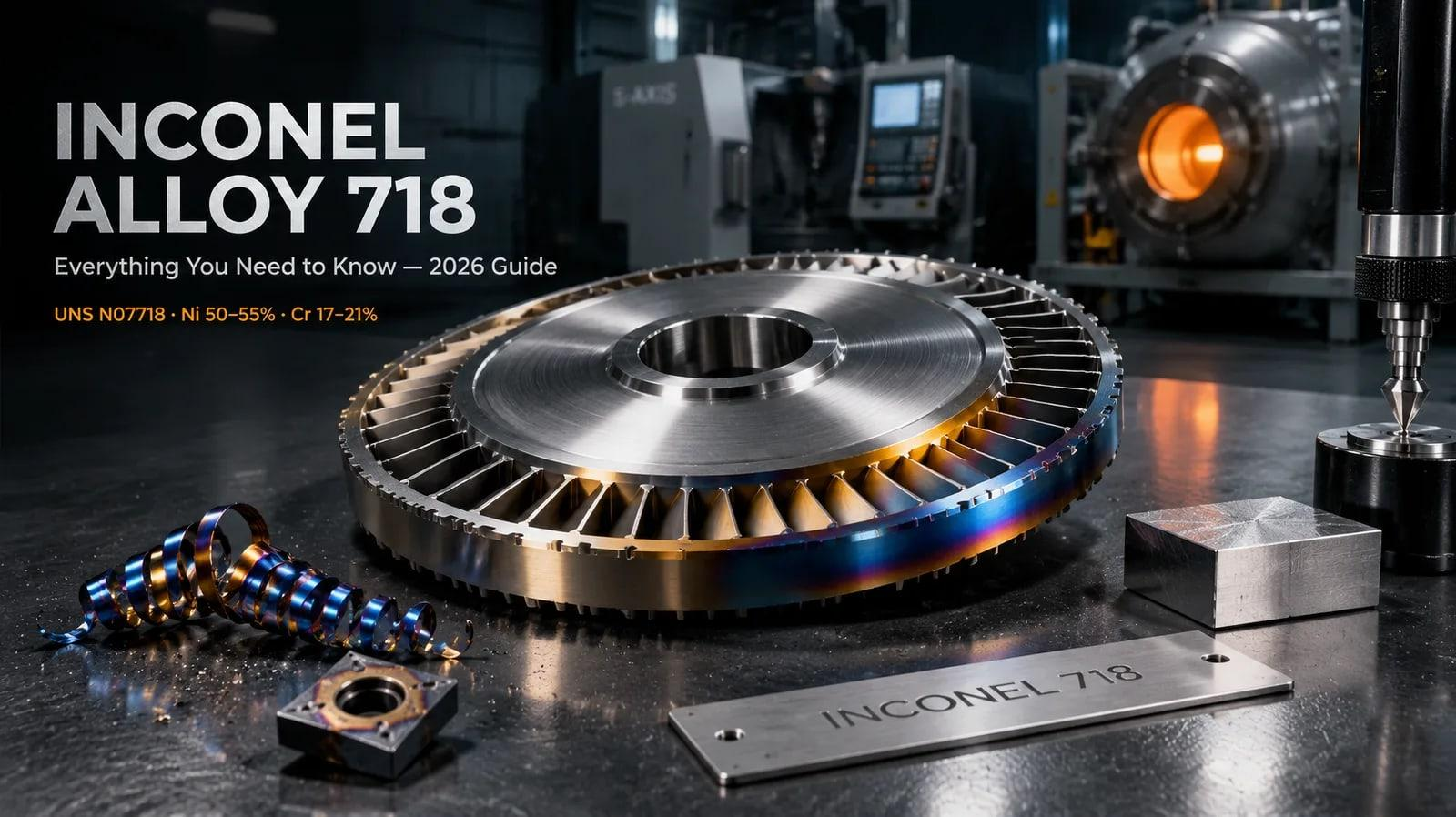
Inconel 718, which is a nickel-chromium superalloy, is precipitation-hardened (UNS N07718). It comprises 50-55% nickel and 17-21% chromium and strengthened by niobium. It maintains strength, creep resistance and corrosion resistance from cryogenic temperatures up to about 1,200-1,300 °F. The aerospace, oil and gas, and power generation industries heavily use it because it’s hard to machine it.
718 is the aerospace superalloy you know probably already saw the numbers on its datasheet. Most guides overlook the differences in those figures among suppliers, the variations due to heat-treat condition, and the instances when 718 isn’t a good choice. This guide (2026) composition, properties, machining & 3D printing and how to read the specs correctly.
Essential Insights
● Inconel 718 is a superalloy that precipitates, form a mixture of nickel and chromium minerals. Inconel718 is made with the base 50-55% nickel and 17-21% chromium. Addition of iron as the balance and additional measure niobium, molybdenum, titanium and aluminum. [source](Xometry 2026)
● The strength of 718 is the result of niobium and other components driving an age-hardening response. The properties of the alloy are very dependent on whether it is supplied annealed or solution-treated and aged.
● The alloy has excellent creep-rupture strength up to 1300°F (700°C). Some suppliers will quote lower or higher limits so always check the datasheet and condition. Goldman and Warnock.
● Incoloy 718 finds application in gas turbines, jet engines, oilfield equipment, subsea hardware, and cryogenic tanks, where strength must be retained at temperature or in corrosive service.
● The machining of Inconel 718 is difficult because it work-hardens, traps heat at the tool tip and abrasively wears cutting tools.. The conventional measures include use of rigid setups, coated carbide, no dwell and high-pressure coolant.
● Inconel 718 is the most popular alloy in nickel-based powder metallurgy. However, the heat treatments suggested by the manufacturer differ from wrought practice.
● Inconel 718 isn’t always ideal for every single high-temperature job. Use 625, X-750 or a γ’ strengthened alloy, for instance, Haynes 282 when the application’s temperature, corrosion or machining needs dictate otherwise.
What Is Inconel 718 - What Is It Made Of?
Inconel 718 is a nickel-based alloy which is able to withstand high pressures and temperatures. This material has a high resistance to oxidation. It is weldable up to 1300 °F (700 °C). It is able to resist cracking from stress corrosion. It can easily be fabricated. The ability of metal to deform or stretch permanently under constant load and temperature is creep. As per Wikipedia, the company Inco developed the alloy Inconel 625 during the 1960s for projects related to the Inconel alloy. The Inconel trademark is now owned by Special Metals Corporation. The German designation for Inconel is Werkstoff 2.4668.
The following table adds a label to each value with its condition because a bare datasheet number might mislead.
Property | Value | Condition |
Nickel / chromium | 50–55% / 17–21% (Xometry, 2026) | Composition range |
Density | 8.19 g/cm³ (MatWeb) | Typical |
Thermal conductivity | 11.4 W/m·K (MatWeb) | Typical |
Melting range | 1260–1336°C (2300–2437°F) (MatWeb) | Typical |
Ultimate tensile strength, 23°C | 1375 MPa (MatWeb) | Aged, typical |
Tensile / yield, aged bar | 180–185 ksi / 150 ksi (High Performance Alloys) | AMS 5662/5663, nominal |
Tensile / yield, annealed | 135 ksi / 70 ksi (Source: Rolled Alloys) | Annealed at 1800°F |
Hardness | 36–40 HRC aged; about 25 HRC annealed (Xometry, 2026) | By condition |
This alloy is quoted two different ways. Langley Alloys’ bar listing indicates a minimum of 1034 N/mm², so MatWeb’s 1375 MPa at 23°C is about 33% higher (1375 ÷ 1034) Both are correct: one is a regular outcome and the other one is the floor guaranteed by a supplier. (Source: Langley Alloys).
What Are the Chemicals Found in Inconel 718?
Inconel 718 is an alloy mostly made up of Nickel and chromium with iron as a balancer and smaller additions of niobium, molybdenum, titanium & aluminium (Xometry, 2026). Various other ranges displayed beneath match every top page reviewed.
Element | Typical range | What it does |
Nickel | 50–55% | Forms the matrix and resists corrosion |
Chromium | 17–21% | Protects against oxidation and corrosion |
Niobium + tantalum | 4.75–5.5% | Builds the strengthening phase during aging |
Molybdenum | 2.8–3.3% | Adds solid-solution strength |
Titanium, aluminum | Small amounts | Support precipitation hardening |
Iron | Balance | Makes up the remainder |
Niobium is most deserving. When aging, it helps develop nanoscale γ′ and γ″ particles, the phases it is stated are the key strengtheners. One bar can therefore be soft or very strong depending on its heat treatment only.
Make sure you always check the UNS N07718 or Special Metals chemistry. Typos are present, for example, one of the supplier pages (FW Metals) shows molybdenum at “2.80 - 1.15” that is a clear typo for 2.80–3.30%.
Why is there a disagreement on Inconel 718 Datasheet Numbers?
The discrepancy of Inconel 718 datasheet numbers is a result of dissimilarity in heat-treat conditions, test types and specifications levels. It takes three checks to read them correctly.
Normal, Minimum, and Conditioning.
The material that is aged is considerably stronger than that which is annealed. According to Rolled Alloys, after an anneal at 1800°F, this material has a tensile strength of 135 ksi and a yield strength of 70 ksi. The aged bar and forgings under AMS 5662 and 5663 have a tensile strength of 180 − 185 ksi (High Performance Alloys). This results in an aged tensile strength which is 33–37% higher, and aged yield (150 ksi) 2.1 times annealed yield.
Heat is important as well. According to MatWeb, the 23°C yield strength is 1375 MPa after precipitation hardening. According to our calculations, there is approximately 80% retention of strength at room temperature at 650°C.
What is the highest Inconel 718 maximum service temperature?
The highest service temperature depends on the limiting factor, namely strength, creep-rupture or oxidation. Reputable sources report multiple torch temperatures, including 1200°F, 1300°F and 1400°F.
Claim | Source | Likely meaning |
1200°F long-term service | Rolled Alloys | Conservative load-bearing limit |
1300°F (700°C) | ESPI Metals | Creep-rupture strength |
1400°F | United Performance Metals | Looser, possibly shorter-term |
1800°F | One datasheet | Oxidation resistance only |
A reasonable reading is to treat about 1300°F (700°C) as the ceiling for load-bearing parts; anything above or in the 1000°F (540°C) dashboard area can be read as short-term, or oxidation only.
Where is Inconel 718 used?
Inconel 718 is used wherever strength must withstand high temperatures, corrosion or extreme cold. It is more helpful to group uses by the property that drives the choice than industries.
● Temperature creep is one of the many gas turbine components listed in Wikipedia’s jet engine page.
● According to Xometry, subsea hardware that withstands pressures exceeding 15,000 psi, and oil and gas completion equipment. Langley Alloys has a NACE MR0175/ISO 15156 listing for sour service. Wellhead tools also fall under this category.
● Tough cryogenics: cryogenic tanks and high-strength bolting.
A thick, stable, passivating oxide layer that protects against further attack (Source: Heat Treat Today, 2026) is also formed by Heated 718.
This system gives you a shortcut: name one property of value that will cease to work first. If there is creep present, use the temperature limits above. NACE listing and supplier's certs are required if it is sour-gas cracking. Take a look at Harber Metal’s industrial tools and parts.
What Makes Inconel 718 Challenging to Machine?
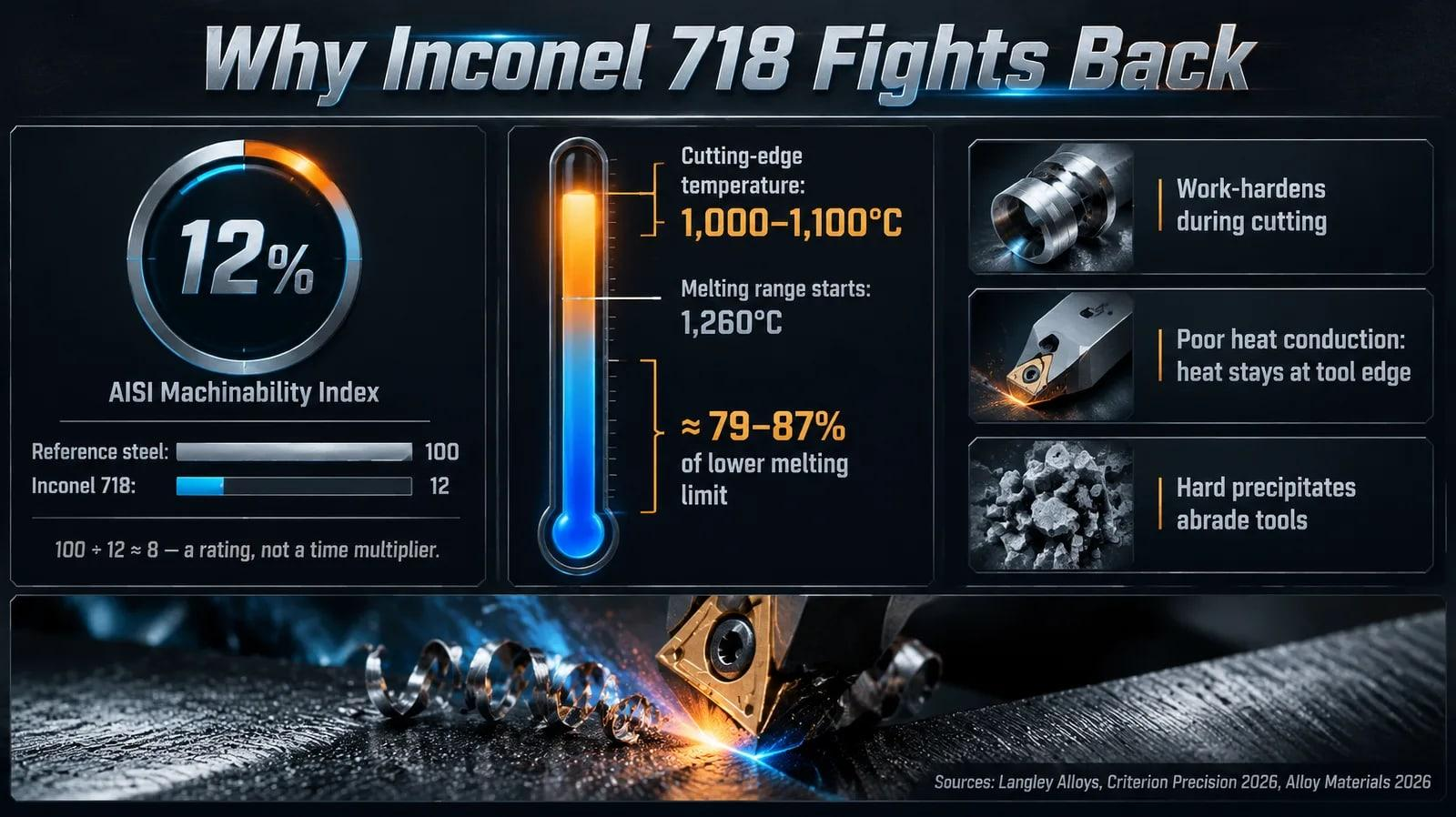
Inconel 718 is challenging to cut as it work-hardens, has poor heat conductivity so heat builds up at the tool edge, and has hard precipitates which cause tool wear (Source: Langley Alloys). It has a score of approximately 12% according AISI Machinability Index. Advanced temperatures can reach 1,000-1,100°C (Alloy Materials, 2026)
This would become concrete through two calculations. If you divide 100 by 12, you’ll get roughly 8, giving you a rough indication that the reference steel cuts approximately eight times easier (as the index is a rating, not a time multiplier). That melting range begins at 1260°C so edge temperatures of 1,000–1,100°C are at about 79–87% of the lower melting limit.
How would you achieve machining Inconel 718 without tool breakage?
The reviewed machining pages agree on the same four causes above and the same fixes. They disagreed on specifics, like dry ceramic tools versus flood-cooled carbide. Mutual agreement.
● Use a fixed setup and sharp positive-rake-coated carbide tools.
● Abstain from utilizing TiN and TiCN coatings but TiAlN (Source: Starting Point Precision and Sinbo).
● Don't allow the tool to sit idle; rubbing it will harden it.
● Use important coolant pressure.
● Use a thread mill instead of a tap.
● This steel should be rough in the annealed state (around 25 HRC). Where the drawing allows, age it afterwards. Check with your heat-treat vendor for dimensions changes.
Use vendor specifications as starting points, not guarantees.
Is it possible to weld Inconel 718, and can you 3D print it?
Inconel 718, although weldable and 3D printable. However, each process alters the heat treatment in a different way. The best performing pages claim 718 has excellent weldability, particularly that it as resistant to cracking post-weld.
Can this nickel-chromium alloy be manufactured via additive manufacturing, and how should it be heat treated?
Due to its suitable processability, Inconel 718 is the most used nickel-based alloy in additive manufacturing ([MDPI Materials, 2025]). Nothing can exceed this heat treatment As of 2023, a study tested the AMS 5662 schedule (980 °C solution, double age at 720 °C and 620 °C) and found that printed 718 gave lower creep strength than a forged reference due to high Laves- and δ-phase content (MDPI Materials, 2023 ).
Heat treatment is still helping in other ways. A chapter in Springer in the year 2026 has reported the porosity in the selective laser melted 718 falling by 67% (0.056% to 0.018%) perpendicular to the building plane, and it was 76% in parallel sections (Springer, 2026).
Aaron Stebner of ADAPT relates work on a cooler heat treatment for laser powder bed fusion parts. “We can do it, and we get better strength and ductility than both AM and forged parts,” comments the Executive Director of the ADAPT consortium at Colorado School of Mines.
In the real world, if they say for printed parts, “heat treat it like wrought” you can’t assume that the default will be OK anymore. When planning for qualification testing, consider whether hot isostatic pressing (HIP) would be part of your process.
What distinguishes inconel 718 from inconel 625?
Inconel 718 is age-hardened for maximum strength while Inconel 625 is solid-solution strengthened and not age-hardened (Unionfab). According to Xometry, 718 has the highest tensile strength of all significant Inconel alloys and in the aged condition. However, strength is just one selection criterion.
Alloy | Strengthening | Pick it when | Limit |
718 | Age-hardened (γ″) | You need peak strength up to about 700°C | Hard to machine; weaker above ~700°C |
625 | Solid-solution | Corrosion resistance matters more than peak strength | Lower strength than aged 718 |
X-750 | Age-hardened | You need age-hardened strength for springs or similar parts | Lower aged tensile strength than 718 |
600 | Solid-solution | You need corrosion and oxidation resistance at moderate strength | Cannot be age-hardened |
Haynes 282 | γ′ | Service runs above ~700°C | Unionfab lists over 800 MPa at 870°C |
Based on our look at the table, we see that the choice often boils down to whether you’re good with an aging step and the machining penalty associated with higher hardness. Comparing the 870°C number of 282 with the 650°C number of 718 directly is inaccurate given the different test points.
When should you not use inconel 718?
Do not use Inconel 718 if your service temperature, production volume or part geometry suggests a better alloy or process. Researchers point out that the high-temperature performance of 718 is not applicable in highly demanding aerospace applications.
Review this checklist before specifying.
1. Once the temperature is above ~ 700 °C, Haynes 282 or another γ ′-strengthened alloy may be the best choice.
2. Cycle time & tooling costs go up fast at 12% machinability rating. Very high machining volume.
3. Due to the heat-treated caveats above, it may be more suitable for additive manufacturing.
4. The requirements for specifications regarding certification need to be named. AMS 5662 and AMS 5663 for bar, forgings and rings. AMS 5596 for sheet, strip and plate. AMS 5383 for castings. AMS 2770 for heat treatment of wrought parts.
As long as we have “yes” once per any number of tests, it's time to quote. If you need to source finished parts, Harber Metal has an entire category of automotive metal parts to compare.
Commonly Asked Queries.
Is inconel 718 magnetic
In its standard condition, Inconel 718 is normally non-magnetic at room temperature. A standard bar's permeability is so low that a magnet cannot stick to it. Whenever there is an essential sensitive instrument nearby, you should ask the vendor to give you certified permeability data instead of assuming that the permeability value you have is adequate.
What impacts the price of Inconel 718?
There is no one price. Products costs are affected by markets for nickel and niobium, product form, heat-treat condition, quantity and certification level. Machining is an additional expense, because slow cuts and tool wear raise finished part costs. Quotes requested by form/AMS spec (for example, bar under AMS 5662), not price per pound comparisons.
What is the density and melting point of Inconel 718?
A density of 8.19 g/cm³, melting range of 1260–1336 °C (2300–2437 °F), thermal conductivity of 11.4 W/m·K (MatWeb).
The low conductivity makes heat to remain concentrated at the cutting edge during machining.
I don't know that, but I'm sure it means something.
UNS N07718 is the designation given to alloy 718, while it is commonly denoted in specifications and on purchase orders. Material 2.4668 is the German name. Any reference to “Inconel 718” or “Alloy 718” refers to the same chemistry. Inconel is the Special Metals trademark.
Will Inconel 718 tarnish or oxidize?
Inconel 718 is resistant to rust as well as most corrosion though no alloys are immune. According to Heat Treat Today, 2026, h