en
 de
 jp
 kor
 fra
 spa
 ru
 pt
 it


Sheet Metal Gauge Thickness Chart (MM and Inches Conversion Guide)
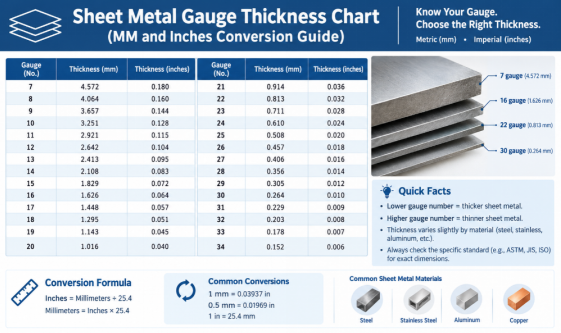
A Sheet Metal Gauge Thickness Chart will assist engineers, designers, fabricators and buyers to understand the correlation between sheet metal gauge numbers and the thickness in both millimeters and inches. The traditional method of measuring the thickness of a metal is called gauge, but the same gauge is not necessarily the same thickness for each metal. This guide will cover the definition of sheet metal gauge, and provide a comparison of common gauge thicknesses in mm and inches, as well as discussing the difference in proper gauge selection based on material type, manufacturing requirements, and thickness tolerance. These differences can be crucial to avoiding ordering and design mistakes for custom metal parts.
What Is Sheet Metal Gauge?
There will be a numbering system that is used to designate the thickness or thinness of metal sheets and plates. This is called sheet metal gauge. Basically, the higher the gauge number the thinner the material; the lower the gauge number the thicker the material. Note that, however, gauge is not a universal measurement as it can be different for various metals such as steel, stainless steel, aluminum, galvanized steel and others. Therefore, engineers need to make an initial determination of the material's identity prior to any gauge number to thickness conversion performed. If accuracy is important, the actual thickness should be stated in technical drawings and purchasing specifications as either millimeters or inches.
Sheet Metal Gauge Thickness Chart: MM and Inches
The primary use of a Sheet Metal Gauge Thickness Chart is to use it as a reference between the gauge-number and its thickness. The commonly used thickness should be expressed in both inches and millimeters in a clear table as indicated in the article. The table needs to be designed so it is obvious that the values are dependent on the material being measured. The comments appearing below the tabular section should warn the reader that he should check the material specification or the supplier specification before making.
Standard Steel Gauge Thickness Chart
List the common steel gage numbers and their corresponding thicknesses (in inches and millimetres). The table should be limited to some gauges used most often and note selected applications like brackets, panels, cabinets, enclosures, structural elements, etc. and general fabrication applications. Explain that these are reference values and that a possible tolerance on the thickness of commercially available material may have been approved.
Aluminum Gauge Thickness Chart
Explain the difference between the gauge values of aluminium, steel and SS due to their Material Dependency. Outline some typical applications of aluminum gages (like brazing, pressing, and extruding) and discuss how its characteristics may differ due to these factors (strength, density, etc.) and impact material selection. If the exact type of alloy or thickness of the alloy to be used for the fabrication, encourage the reader to check.
How to Convert Sheet Metal Gauge to MM and Inches
Since one formula for converting gages is not necessarily applicable to all types of metal, the gauge conversion for each type of metal should be based on its own reference standard. To make direct unit conversions, explain that 1 inch = 25.4 mm and 1 mm = ~0.03937 inch. Provide examples of simple conversions from one system of thickness to the other, all for given values. This section should also clarify how the width of the gum has to be checked with the correct definition of materials, and is then converted into specification / gauge units, particularly when creating engineering drawings / manufacturing specifications.
Sheet Metal Gauge VS Actual Thickness
Gauge | Actual Thickness |
Number used to describe metal thickness | Actual thickness of the sheet |
Higher gauge = thinner metal | Higher mm/inch = thicker metal |
Can vary by material | Direct measurement |
Good for quick reference | Better for precise specifications |
Example: 18 gauge | Example: about 1.2 mm steel |
Should be checked with a material-specific chart | Should include tolerance when needed |
Why Gauge Numbers Can Be Confusing
Please note that the numbers listed above on the gauge can be different numbers depending on the gauge thickness of metal. For instance, a 3/8" steel gauge is not necessarily the same thickness as a 3/8" aluminum or stainless steel gauge. The section should emphasize the fact that it is a good practice to work through the material before ordering or making a production drawing plan based on the appropriate reference table.
Gauge and Thickness Tolerance
Discuss between nominal thickness versus actual measured thickness. Explain the need for tolerance where bending, forming, welding, cutting and fabricating parts to be assembled with other parts. If high precision applications are required, then thickness tolerance needs to be specified within the engineering tolerances for the material to allow the manufacturer to choose and control the material accurately.
How to Choose the Right Sheet Metal Thickness
The selection of thickness isn't so simple as consulting a gauge table. Explain the major factors such as material type and grade, strength, dimensions and shape of parts, stiffness requirements, and bending and forming requirements, weight, corrosion resistance, manufacturing process, tolerances, production volume, and cost. Set out that sometimes a thicker sheet is not the better choice as it may require more weight, material cost, forming difficulty and machining/required cuts. The final selection should be a combination of performance, manufacturability and costs.
Sheet Metal Gauge Selection for Manufacturing
Thicknesses specifically chosen will influence the ease of part cutting, easy bending, forming, welding, machining and finishing. During the early design phase a Sheet Metal Gauge Thickness Chart can be beneficial; however, the actual style of manufacturing must also be taken into account when making a material selection.
Gauge and Fabrication Processes
Describe effect of thickness on laser cutting & punching process, bending, welding, forming etc. operations. Some thin materials should be handled with great care as they can become distorted, while other thickness materials may need heavier cutting power, higher forming speeds or specialized tooling. When designing a custom thickness, this section should inspire the designer to think before the part is manufactured about any limitations of the fabricated part.
Gauge VS. Manufacturing Method
Thickness | Manufacturing Method | Common Use |
Thin | Laser cutting, punching | Panels, covers |
MediumThick | Cutting, bending, welding | Brackets, enclosures |
Thick | Heavy cutting, bending, welding | Structural parts |
Very thick | Heavy fabrication, machining | Heavy-duty components |
Sheet Metal Gauge Chart vs. Other Thickness Specifications
Specification | Meaning | Used For |
Gauge | Thickness number | General fabrication |
MM | Exact thickness in millimeters | Engineering and manufacturing |
Inches | Exact thickness in inches | Imperial measurements |
Micrometer | Very small thickness measurement | Thin and precision materials |
Gauge + MM | Gauge with exact thickness | Clear supplier communication |
Sheet Metal Gauge Thickness: Quick Reference Table
Gauge | Thickness (Inches) | Thickness (MM) |
10 | 0.1345 | 3.416 |
12 | 0.1046 | 2.656 |
14 | 0.0747 | 1.897 |
16 | 0.0598 | 1.518 |
18 | 0.0478 | 1.214 |
20 | 0.0359 | 0.912 |
22 | 0.0299 | 0.759 |
24 | 0.0239 | 0.607 |
26 | 0.0179 | 0.455 |
When to Specify Gauge and When to Specify MM
Discuss the use of gauge and when is it helpful to use exact thickness. Although it may be useful when discussing general fabrication, it is more useful to use millimeters or inches when performing engineering drawings, CNC, precision assemblies and purchasing documents. Recommend indicating material number + material thickness + tolerance, when appropriate add to the reference of the gauge.
Sheet Metal Thickness and Custom Metal Parts
Thickness is one of the most important characteristics of metal materials that affects the strength, weight, dimensional stability, manufacturability and cost of custom metal parts. Discuss why the designer should study the entire drawing, material specification, tolerances and the manufacturing process prior to the manufacturing process. Of course, this section will provide something to link with your manufacturing partner, Harber MIM and custom metal fabrication services, and it will be relevant without being in too salesy of a vein. An emphasis needs to be given to the choice of an appropriate material and thickness for the application.
FAQ:
Is sheet metal gauge the same for steel and aluminum?
Discuss that it does not have to be the same and that material specific gauge charts should be used.
How do I convert sheet metal gauge to mm?
Point out that the proper gauge must be selected that matches with the "thickness" of the material; then inches and mm can be converted using 25.4 mm/in.
What is the difference between gauge and thickness?
Explain that thickness is a straight measurement in units (mm, in) but gauge is a numbering system.
Should I specify gauge or mm on an engineering drawing?
For engineering drawings specify the exact numerical thickness and grade of material and tolerance that is to be used, adding gauge as an assist if necessary.
Conclusion
There are several factors that need to be taken into account, and they are the Gauge number, Metal Difference, Dimensional Tolerance and Manufacturing Requirement to select the right thickness of the metal. A Sheet Metal Gauge Thickness Chart allows very quick comparison between some common gauge values and in mm and in inch measurements but should always be referenced to the appropriate material specification. For custom components: the proper combination of thickness to the correct material, tolerance, and manufacturing process can enhance the performance of parts, consistency, and efficiency.