304 (predominantly low‑carbon 304L variant) is the most widely‑used austenitic stainless‑steel grade for Metal Injection Molding (MIM). Many engineers directly reference wrought 304 stainless‑steel datasheets for MIM projects, without realizing that sintered MIM 304 components have unique characteristics driven by powder quality, atomization method, sintered residual porosity and vacuum‑sintering workflowsASM Intern.... Blindly adopting wrought‑steel specifications can result in unexpected corrosion failure, insufficient ductility, magnetism deviation and poor dimensional stability for finished MIM parts.
This guide systematically covers mechanical, physical, chemical‑corrosion and thermal properties of MIM 304 / 304L stainless steel, highlights critical distinctions from wrought 304, analyzes powder‑type influences, lists typical real‑world applications, shares Harbermetal’s typical MIM 304 engineering‑review scenarios, and delivers actionable sourcing advice for design and procurement teams.
Brief Introduction to MIM 304 / 304L Stainless Steel
MIM 304L is the practical mainstream grade for MIM manufacturing, low‑carbon austenitic stainless‑steel with nominal composition: Cr 18‑20 %, Ni 8‑12 %, max carbon 0.03 % to avoid carbide precipitation during high‑temperature sintering. It is produced by compounding fine stainless‑steel powder (water‑atomized or gas‑atomized) with polymer‑wax binder into MIM feedstock, followed by injection molding, debinding and high‑temperature vacuum / protective‑atmosphere sintering.
Sintered MIM 304L normally reaches 96‑99 % of theoretical density, leaving minor residual interconnected micro‑porosity — this porosity is the root cause for most property gaps compared with fully‑dense wrought 304 bar stock.
Gas‑atomized MIM 304L powder: spherical particles, low oxygen content, excellent flowability, higher cost, delivers superior corrosion and mechanical performance for high‑reliability components.
Water‑atomized MIM 304L powder: irregular‑shaped particles, higher inherent oxygen content, cost‑effective, suitable for general‑industrial non‑chloride‑exposed MIM partsOSTI.GOV.
Important note: Standard high‑carbon 304 is rarely used in MIM production; almost all industrial MIM projects select low‑carbon 304L to prevent inter‑granular corrosion after sintering.
Mechanical Properties of MIM 304L Stainless Steel
Mechanical performance of sintered MIM 304L is heavily dependent on final sintered density, powder purity and sintering atmosphere, not purely fixed material constants. Below are typical reference values for well‑sintered high‑density MIM 304L parts (density ≥7.8 g/cm³):
| Mechanical Property | Typical MIM 304L Sintered Value | Wrought 304L Reference | Key MIM‑Specific Note |
|---|
| Ultimate Tensile Strength | 500‑650 MPa | 520‑700 MPa | Reduced by residual micro‑porosity |
| Yield Strength (0.2 % proof stress) | 170‑230 MPa | 175‑220 MPa | Density‑dependent |
| Elongation at Break | 40‑50 % | ≥45 % | Drops obviously if porosity increases |
| Hardness | 92‑150 HV | ≤215 HB | No heat‑treat hardening capability |
| Modulus of Elasticity | ~185‑190 GPa | 193 GPa | Slightly lower due to pores |
| Magnetism | Mostly non‑magnetic; slight magnetism may appear from sinter‑phase transformation | Non‑magnetic annealed state | MIM magnetism shall be verified by actual sample, cannot copy wrought‑steel assumptions |
Key mechanical takeaways for MIM design:
MIM 304L cannot be hardened via heat‑treatment; strength improvement must rely on raising sintered density.
Residual porosity lowers fatigue performance versus wrought 304L; high‑cyclic‑fatigue critical components require HIP (Hot Isostatic Pressing) densification treatment.
Higher porosity will simultaneously reduce tensile strength, elongation and corrosion‑resistance.
Physical Properties of MIM 304L Stainless Steel
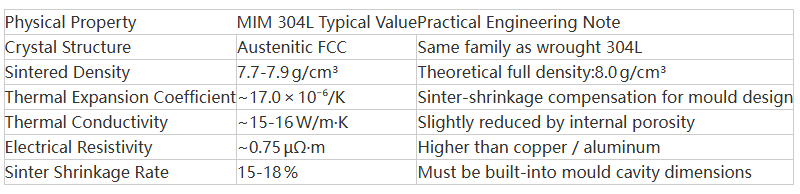
MIM 304L features excellent ductility after qualified sintering, yet post‑sinter cold forming capacity is limited compared with wrought sheet material, so complex bending operations are generally not performed on finished sintered MIM parts.
Chemical and Corrosion‑Resistance Properties of MIM 304L
MIM 304L forms a self‑healing chromium‑oxide passive film just like wrought 304L. Nevertheless, surface‑connected micro‑pores act as channels for corrosive medium penetration, making its pitting‑corrosion susceptibility higher than fully‑dense wrought material under chloride‑containing environments.
Good performance: Indoor atmospheric environment, dry working conditions, fresh‑water exposure, general household and industrial hardware.
Risk scenarios: Salt‑spray, coastal / marine atmosphere, sweat‑rich medical auxiliary hardware, chloride‑containing cleaning liquid. In these cases, 316L MIM grade is strongly recommended instead of MIM 304L.
Important practical reminders:
Water‑atomized powder with higher oxygen impurity will further degrade corrosion performance of MIM 304L finished parts.
Surface post‑treatments including passivation, electropolishing can improve corrosion resistance by sealing or removing surface‑open pores.
MIM 304L is not suitable for long‑term service in sulfur‑containing high‑temperature gas environments.
Thermal Properties of MIM 304L Stainless Steel
Melting range: approx 1400 °C, consistent with wrought 304L.
Continuous service temperature: recommended maximum 870 °C for non‑load‑bearing conditions; residual pores accelerate internal oxidation under long‑time high‑temperature exposure.
Sintering temperature window for MIM 304L: 1320‑1380 °C under vacuum or hydrogen‑nitrogen mixed protective atmosphere. Too‑low temperature causes insufficient densification; over‑temperature triggers grain over‑growth and performance decline.
Typical Industrial Applications for MIM 304L Stainless‑Steel Parts
MIM 304L is widely selected for medium‑corrosion‑risk miniature complex‑geometry mass‑volume components:
Consumer electronics & smart wearables: internal structural clips, housings, locking hardware.
General industrial hardware: miniature valves, fastener components, instrument accessories.
Household & kitchen equipment: small functional sintered metal parts.
Non‑implant medical auxiliary parts for non‑chloride service environments.
Power‑tool and lock‑system internal mechanical components.
Clear limitation: Avoid MIM 304L for salt‑spray, marine and high‑chloride working‑condition projects; switch over to MIM 316L.
How Harbermetal helps you with typical mim 304 stainless steel engineering review scenarios
Many MIM projects run into avoidable risks because design teams copy wrought‑304 datasheet requirements directly to MIM drawings without understanding sintered‑material limitations. At Harbermetal, our engineering team carries out systematic pre‑tooling DFM and material review for MIM 304L projects, solving several frequent real‑world engineering scenarios:
Scenario 1: Customer specifies wrought‑304 salt‑spray test standard for MIM 304L partsOur engineers point out that residual micro‑porosity in sintered MIM material makes it difficult to reach wrought‑steel‑level salt‑spray performance. We propose three feasible solutions: upgrade to gas‑atomized high‑purity 304L powder + enhanced passivation / electropolishing; switch material grade to MIM 316L; or revise test criteria matching sintered‑material practical capability according to actual service environment.
Scenario 2: Project requires non‑magnetic performance for MIM 304L componentsWe inform clients that MIM sintering process may induce minor magnetism even for austenitic 304L. We clarify test conditions, define acceptance thresholds at quotation phase, and adjust sintering atmosphere and cooling curve to minimize magnetic phase formation, rather than promising absolute zero‑magnetism as wrought material.
Scenario 3: Confusion between water‑atomized and gas‑atomized MIM 304L powder selectionAccording to end‑product corrosion requirements, cost budget and batch‑volume, we give objective suggestions: adopt cost‑competent water‑atomized powder for indoor dry‑environment general‑purpose parts; deploy low‑oxygen gas‑atomized powder for parts with higher corrosion‑resistance expectation, and explain corresponding powder‑cost difference.
Scenario 4: Customer applies wrought‑steel fatigue‑load indexes directly onto MIM 304L drawingWe remind buyers of fatigue‑performance reduction caused by sintered residual porosity. For high‑cyclic‑load components, we evaluate whether HIP densification treatment is necessary, or propose geometry optimization / material‑grade substitution schemes to meet service‑life targets.
In all above scenarios, Harbermetal completes material‑risk assessment before mold investment, preventing costly later‑stage mould revision, sample scrap and project schedule delay.
It is tempting to copy wrought‑304 datasheet parameters straight to your MIM drawing. But sintered MIM 304L has porosity‑related differences in corrosion, magnetism and fatigue performance that wrought steel does not have. You do not need to spend numerous iterations testing powder and sintering parameters yourself. Send your drawings and working‑condition requirements to Harbermetal, and our engineers will identify MIM‑304‑specific risks and give feasible material‑and‑process recommendations before you build any mould.
Harber Industrial Limited (
harbermetal.com) is ISO‑certified direct Chinese MIM & powder‑metallurgy factory with more than 10‑years specialized MIM manufacturing experience. We are fully familiar with property differences between MIM sintered 304L and wrought 304 stainless steel.
Core strengths for MIM 304L stainless‑steel projects
Pre‑production DFM & material engineering review: Evaluate drawing specs, service‑environment, magnetism, corrosion and fatigue‑load requirements; distinguish applicability for water‑atomized / gas‑atomized 304L powder, flag sinter‑related performance risks before tooling.
Precise sintering‑process control: Strict vacuum / protective‑atmosphere sintering parameter control to achieve target sintered density, minimize oxygen content and stabilize mechanical and corrosion‑resistance performance.
Full‑chain in‑house post‑processing capacity: Support passivation, electropolishing, sandblasting, PVD coating, laser marking to improve surface and anti‑corrosion performance for MIM 304L finished components.
Cross‑industry delivery experience: Supply MIM 304L parts for consumer electronics, industrial instruments, lock hardware, power‑tool assemblies and non‑implant auxiliary‑device hardware, and can provide hardness, salt‑spray and dimension inspection reports upon request.
Free manufacturability assessment: Submit 2D/3D drawings and technical specifications via harbermetal.com. Our application‑engineers deliver material‑grade advice, powder‑scheme comparison and transparent quotations both for prototype sampling and mass‑volume‑production.
Contact information:Email: sales@harber‑
mim.comTel: +86 0769‑82389116
Conclusion
MIM 304L (the practical MIM version of 304 stainless steel) is a versatile cost‑effective sintered austenitic stainless‑steel material. However its mechanical, corrosion‑resistance and magnetic properties are influenced by powder atomization type, sintered density and residual micro‑porosity, and cannot be simply copied from wrought‑304 stainless‑steel datasheets.
MIM 304L performs excellently for indoor, dry‑environment general‑purpose miniature complex‑geometry parts. For chloride‑rich, salt‑spray or high‑cyclic‑fatigue‑critical applications, you should consider upgrading to MIM 316L or adopting HIP post‑densification treatment. Always perform DFM material‑feasibility review at early‑design‑phase to avoid unexpected quality risks. Cooperating with an experienced full‑chain MIM manufacturer such as Harbermetal helps you correctly apply MIM 304L and balance performance and project‑budget.
Frequently Asked Questions About MIM 304 Stainless Steel
Q: Is MIM 304L equal to wrought 304L stainless‑steel?A: No. MIM sintered parts contain residual micro‑porosity, leading to slightly lower fatigue performance and higher pitting‑corrosion risk in chloride environment, even with identical alloy chemical composition.
Q: Should I always select gas‑atomized powder for MIM 304L?A: Not necessary. Water‑atomized powder can satisfy requirements for ordinary indoor dry‑working‑condition components. Gas‑atomized low‑oxygen powder is recommended for high‑corrosion‑resistance demanding scenarios, though with higher raw‑material cost.
Q: Can MIM 304L pass salt‑spray test?A: It depends on powder quality, sintered density and surface‑treatment. MIM 304L is not optimized for long‑term salt‑spray exposure. If salt‑spray is mandatory requirement, MIM 316L is the preferred grade.
Q: Why does my MIM 304L part show magnetism although 304 is supposed to be non‑magnetic?A: Sintering thermal history and minor phase transformation may introduce weak magnetism for MIM austenitic stainless‑steel. Magnetism requirement must be clearly specified and verified by real‑sample testing, instead of only referencing wrought‑steel data.
 en
en
 de
de jp
jp kor
kor fra
fra spa
spa ru
ru pt
pt it
it