en
 de
 jp
 kor
 fra
 spa
 ru
 pt
 it


What Is an Alloy? A Complete Engineering Guide (2026)
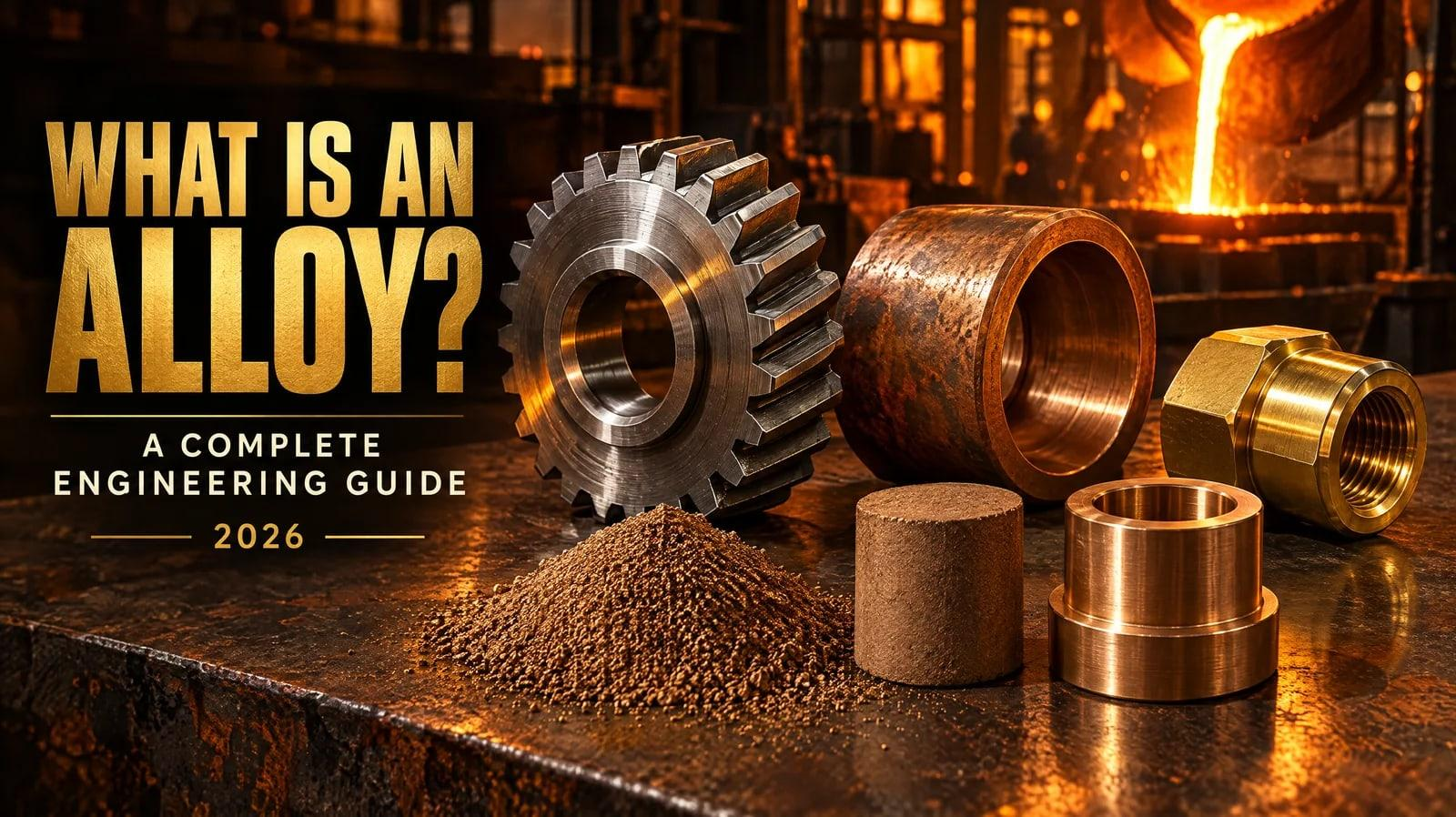
For example, steel, bronze, and brass are well-known alloys. An alloy is a mixture of a metal with at least one other metal or nonmetal. Engineers intentionally add elements to metals to make them stronger, harder, more resistant to corrosion, or more conductive than the original metal.
You know what steel, iron, brass and bronze are and that alloys are stronger than the original material, but do you know why, or what other factors to consider when choosing between alloys? This guide will briefly cover what alloys are, then dive into some of the common types of alloys and the properties/drawbacks of each. We’ll also cover some of the differences between working with unalloyed metals and alloys (Think powder metallurgy and metal injection molding).
Key Takeaways
● Alloys are metallic materials made from a base metal combined with at least one other element. That element can be another metal or a nonmetal.
● Alloys are designed, not accidental. Engineers tune strength, corrosion resistance, ductility and conductivity through composition.
● Steel is an iron-carbon alloy, brass combines copper and zinc, and bronze combines copper and tin. Stainless steel adds chromium and nickel to iron.
● Alloys are classed as substitutional or interstitial by atomic arrangement. Brass and bronze are substitutional, and steel is interstitial.
● Alloying involves trade-offs: adding carbon to iron exchanges ductility for strength.
● Most alloys are made by melting and cooling, but MIM can process nearly any metal powder, from low-alloy and stainless steels to superalloys.
● Published compositions for the same alloy vary by source, so confirm the grade against the relevant standard before specifying a material.
What Is an Alloy in Simple Terms?
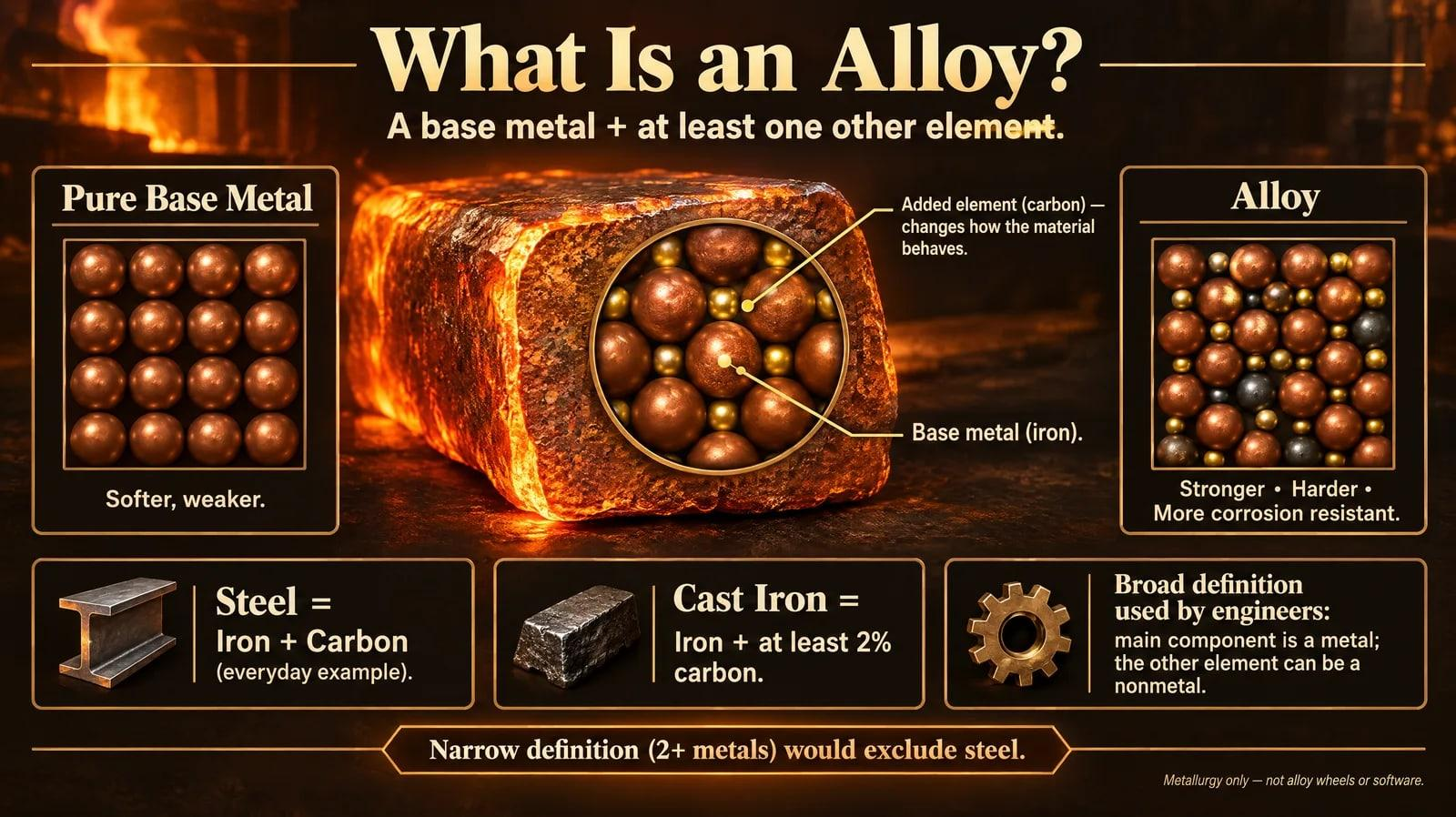
Steel is an alloy of iron and carbon. If one or more elements (metals or nonmetals) are added to a metal a new material is formed. This material is called an alloy. This new material has different properties, e.g. hardness, strength, corrosion resistance etc. than the base metal.
In metallurgy, an alloy is a mixture of metals or a mixture of a metal and another element. Alloys are widely used in industry for their desirable properties. Other uses of the word “alloy” are discussed in separately: alloy wheels, deficiency in a software company, and specification languages.
Carbon steel and cast iron are very common engineering materials. Cast iron contains carbon, a nonmetal. Thus, if alloys are defined as materials composed of two or more metals, then it would exclude steel. On the other hand, if an alloy is defined as a material whose primary constituent is a metal, then cast iron would be iron with at least 2% carbon (Science Notes, 2026).
Is an Alloy a Mixture or a Compound?
You may find different descriptions of alloy even within a publication. For this reason, a grade standard should be used instead of a blog post when you need to specify alloy. For example, in the table below you can see two conflicting statements about whether an alloy is a mixture or not.
Topic | One source says | Another source says |
Definition | Metal Supermarkets requires the combination to be a solid solution, compound, or mixture. | MSE Student says there are no special rules about solid solution, phases, or ratios. |
Bronze composition | Xometry gives about 88% copper and 12% tin. | A patent description gives 90–95 weight % copper (Source: USPTO patent description). |
For the purpose of determining work for real, check against the ASTM International standards or check for the grade against the Unified Numbering System (UNS) designation.
How Do Alloys Work? Why Added Atoms Change Properties
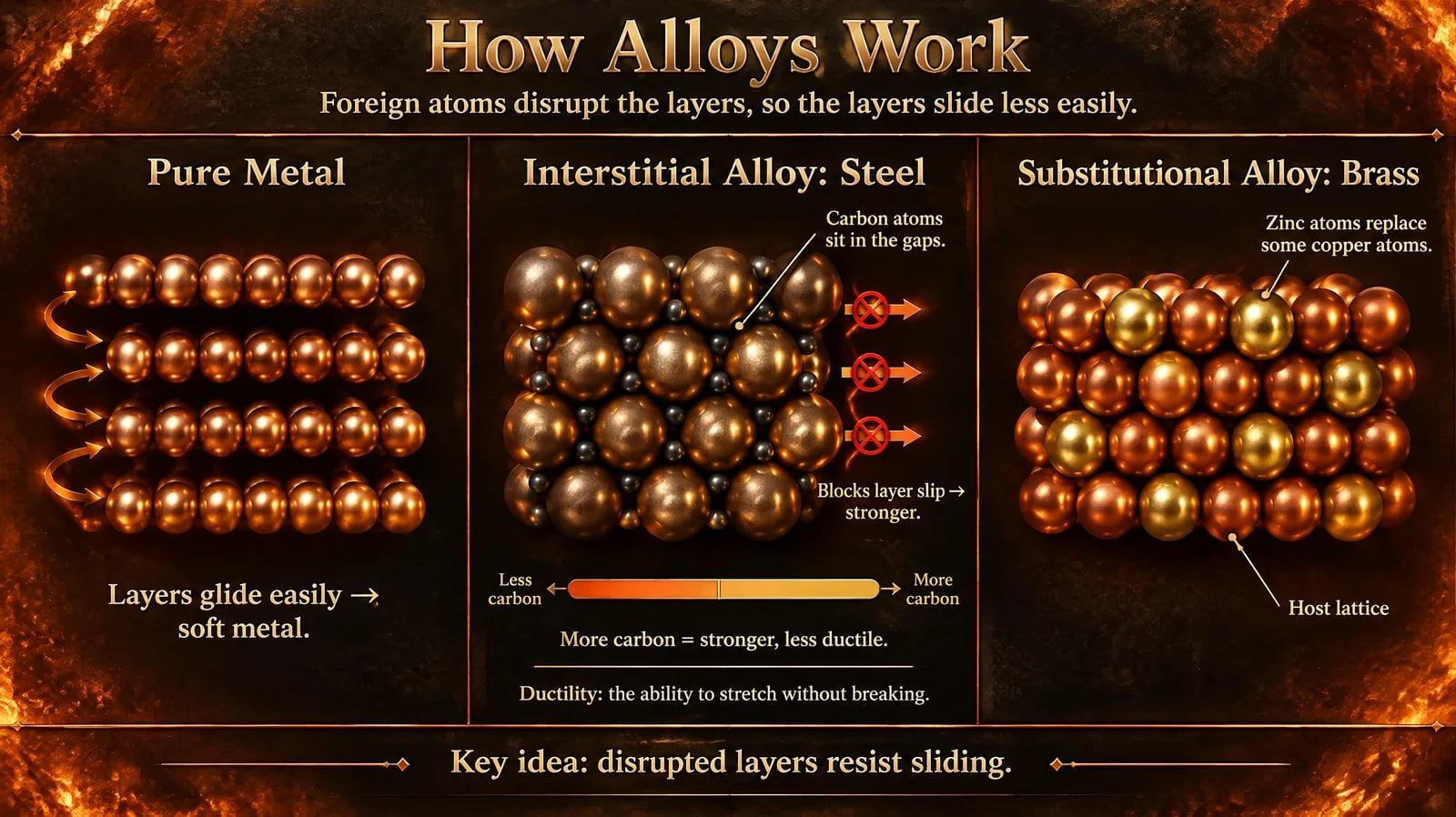
In a pure metal, changes in shape occur easily because the layers of atoms can move over one another. Adding different types of atoms disrupts the orderly arrangement of atoms in the metal and makes it more difficult for the layers to move, making the metal an alloy. There are two basic types of alloys.
Interstitial Alloys: The Steel Example
Steel, an interstitial alloy of iron and carbon, is the most common example of this type of alloy. The small carbon atoms sit in the interstitial spaces between the larger iron atoms, making it more difficult for the layers of atoms to slip over each other. The result is that steel is stronger than the individual metals, but it has less ductility (ability to be stretched), and the harder you make it by adding more carbon, the less forgiving it becomes.
Substitutional Alloys: The Brass Example
In a substitutional alloy, atoms of one element replace some of the atoms in the host lattice. For instance, brass is a substitutional alloy formed when some copper atoms are replaced by atoms of zinc. This can happen when the elements are similar in size, since the crystal structure of the substance is not affected.
An easy way to keep this in mind is to think of interstitial alloys as having a large size difference between the two atoms (small atom in host with large atoms), and substitutional as having similar size atoms. This is not strictly true as you can have substitutional alloys that have a large difference in atom sizes, it’s just a handy rule of thumb.
What Are the Most Common Alloy Families and Their Uses?
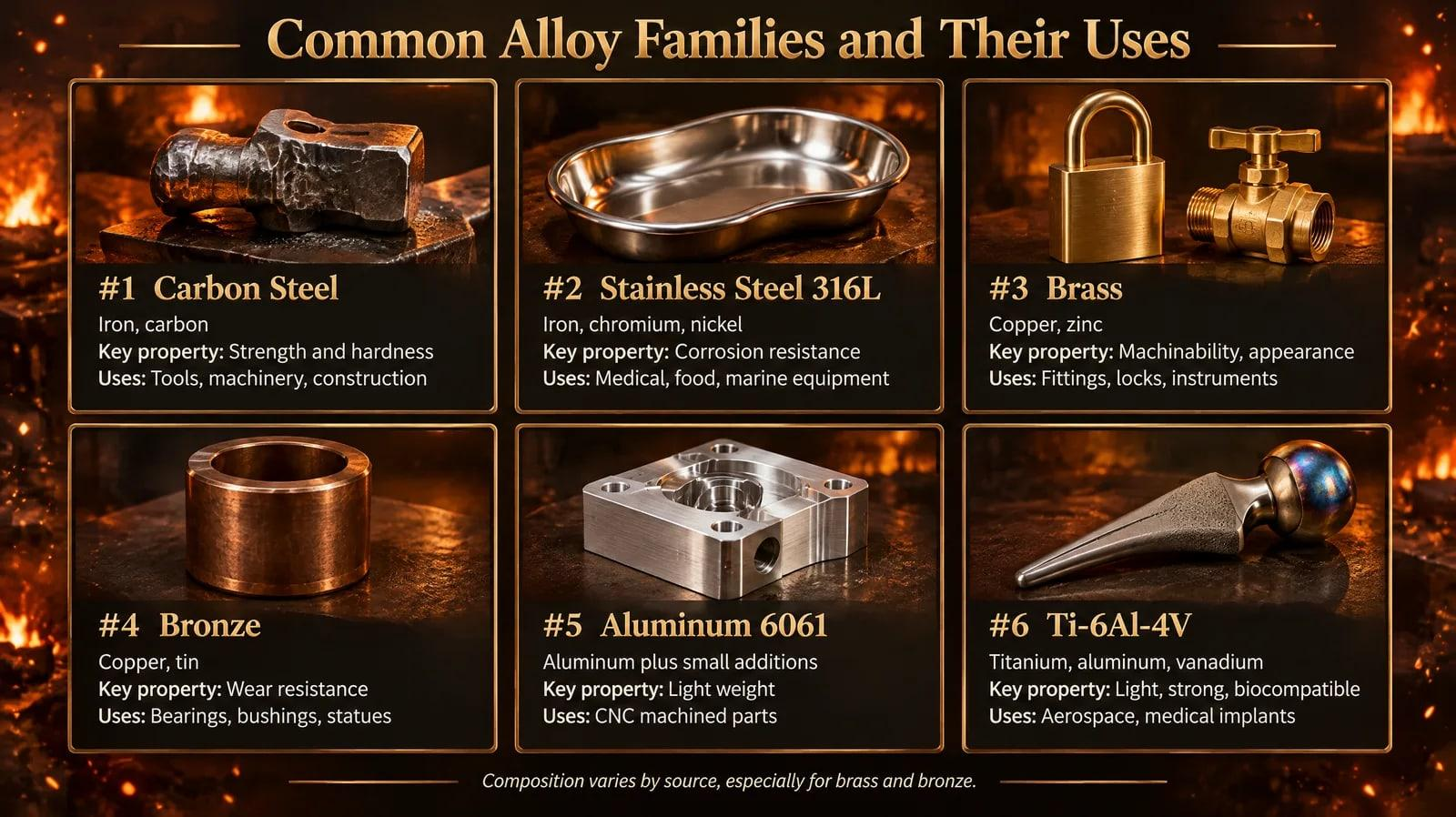
Steel, stainless steel, brass, bronze, aluminum alloys, titanium alloys are the basic alloy families. Each alloy is made from a base metal. Various elements are added to the base metal to impart desired properties. The table below gives the composition of some of the important alloys.
Alloy | Main elements | Key property | Typical uses |
Carbon steel | Iron, carbon | Strength and hardness | Tools, machinery, construction |
Stainless steel 316L | Iron, chromium, nickel | Corrosion resistance | Medical, food, marine equipment |
Brass | Copper, zinc | Machinability, appearance | Fittings, locks, instruments |
Bronze | Copper, tin | Wear resistance | Bearings, bushings, statues |
Aluminum 6061 | Aluminum plus small additions | Light weight | CNC machined parts |
Ti-6Al-4V | Titanium, aluminum, vanadium | Light, strong, biocompatible | Aerospace, medical implants |
The composition of brass and bronze alloys, in particular, can vary depending on the source. Brass, however, is a common choice for precise lock parts as it is a durable and resistant-to-wear alloy that machines well.
A quick calculation reveals a bit of an issue with the data in that table. If you take the low percentages for tin and copper, you get a total of 97% (impossible since bronze is primarily comprised of just tin and copper). If you take the high percentages you have more than 100% (again, impossible). This discrepancy points to why bronze percentages should be used as a guideline only. According to one table bronze is comprised of 85 to 88% copper and 12 to 25% tin (Source: Xometry, 2025). Keep in mind, the exact percentage of each metal varies based on the intended use for the bronze. Listed below is the average percentage of copper and tin in bronze alloy.
Alloy vs. Pure Metal: When Is Each Better?
It’s important to remember, however, that alloying is a trade-off, as with every advantage there is a penalty. When ductility or electrical conductivity are critical considerations, the pure metal form is the better material, but in applications where strength, hardness or corrosion resistance are important, an alloy is the better choice.
Property | What alloying adds | Downside |
Strength and hardness | Carbon in iron makes steel | Less ductility |
Corrosion resistance | Chromium and nickel in stainless steel | Not universal; brass and bronze corrode more in some environments than others (Source: USPTO patent 6794060) |
Machinability | Lead in brass and bronze acts as a chip breaker and tool lubricant | Lead is toxic; a patent names bismuth as a possible replacement (Source: USPTO patent 11649527) |
Electrical conductivity | Rarely a gain | Foreign atoms tend to lower it versus the pure metal |
All of the documents considered contain trade-offs in the materials where a benefit is mentioned alongside a cost/disadvantage. Knowing the cost/disadvantage of a material before selection could help in better material choice compared to just knowing the advantage.
How Are Alloys Made? Melting, Casting, and Powder Routes
Most alloys are prepared by melting the base metal and adding the other elements, then cooling the liquid metal to form a solid. The solid alloy can be cast into the desired shape or formed into bar or sheet, or it can be machined into a finished part.
In this route, the alloy is made in the form of powder prior to the shaping step. Atomization involves forcing molten alloy through a nozzle to form droplets that solidify into a powder. Each particle formed has the complete alloy composition. Mixing of the alloying elements is, therefore, achieved before shaping takes place. This method is particularly applicable to complex alloys such as stainless steels, nickel- and titanium-based alloys.
A powder can be thought of as thousands of tiny alloy ingots. After the powder is formed into the final shape by pressing, injection, or printing, it is heated in a process known as sintering. Sintering involves heating the powder below its melting point, allowing the particles to bond and form a solid.
Which Alloys Work in Powder Metallurgy and Metal Injection Molding?
Metal injection molding (MIM) is used to produce metal parts by injecting fine metal powders into a mold, in a similar fashion to that used for plastic injection molding. The metal powder is bound together with a temporary ‘glue’ which is plastic like in nature and is removed prior to the process of sintering. Wikipedia reports It’s claimed that MIM can reach 99% density and a surface roughness of 1 μm Ra but these are general claims and should not be thought of as guaranteed specs.
According to one published list, stainless steels (such as 304L and 316L), tool steels (M2 and others), soft magnetic alloys, Kovar, cobalt-based alloys, nickel-based alloys, titanium-based alloys and more are used for MIM parts.
Alloy | Type | Typical industry |
316L | Stainless steel | Medical, consumer hardware |
17-4PH | Precipitation-hardening stainless steel | Industrial, aerospace |
Ti-6Al-4V | Titanium alloy | Medical, aerospace |
Kovar (ASTM F15) | Nickel-iron-cobalt alloy | Electronics |
CoCr (ASTM F75) | Cobalt-chromium alloy | Medical, dental |
Depending on the size, complexity and industry, it may make more sense to consider machining or casting for large, simple components. But if you have small complex parts to build, we likened to metal injection molding (MIM), take a look at our use cases: precision metal parts Powder metallurgy (PM) is another manufacturing option to consider. With PM, metalpowder is compacted using a rigid die and then heated to sinter. Umicore describes the PM process like this: While PM can be used to manufacture complex shapes, it’s more applicable to simpler parts.
Grand View Research claimed that the MIM market size is expected to reach USD 6.5 billion in 2025, Global Market Insights projected USD 4.2 billion and TechSci Research projected USD 6.92 billion in the same year. The largest projection is approximately 65% higher than the lowest one (6.92 ÷ 4.2 = 1.648). Global Market Insights claims that the value of the US market for MIM in 2025 will be USD 680.9 million in 2025, which is roughly 16% of the value they project for the whole world in the same year. Market Research Future projected the size of the entire MIM market at USD 2,765.47 million in 2024. All of these estimates should be seen as giving a sense of the scale of the market, rather than as absolute numbers.
Our analysis of the top five engineering-related pages for the term “alloy” also revealed an issue; none of them mentioned powder-based manufacturing, which is where many searches for engineering-related terms lead.
How Do You Choose an Alloy? A Property-First Checklist
Before you pick the right alloy for your part, consider these three considerations in order: What load or environment will your part see? Do you have a shape/volume requirement? What standard/grade do you need? Once you’ve answered these questions, you’re ready to learn more about the different metals you can use for your part.
1. ASTM or UNS grade? Is there a standard grade (ASTM or UNS) you must use per your industry?
2. Part size, complexity, and quantity: Is the part large or small? Simple or complex? Do you need lots of parts or just a few parts? Part environment: Will the part be in contact with saltwater? Will it need to be biocompatible?
3. Will it support heavy loads?
The table is based on the property you require.
Need | Alloy family | Typical route | Trade-off |
Strength | Carbon and tool steels | Casting, machining, MIM | Less ductility |
Corrosion resistance | Stainless steel (316L) | Machining, MIM | Cost; not resistant everywhere |
Light weight | Aluminum 6061, titanium alloys | CNC machining | Titanium costs more |
Conductivity | Copper alloys (brass, bronze) | Casting, machining | Lower than pure copper |
Biocompatibility | Ti-6Al-4V, CoCr, 316L | MIM, machining | Strict grade requirements |
When Is an Alloy the Wrong Choice for a Part?
Not every application is a success for MIM, however. The addition of certain metallic elements to create an alloy can actually be detrimental to the part’s functionality. For example, copper is best used in its pure form as a conductor of electricity because its conductivity is impaired by alloying. Certain applications also require the exclusion of certain elements, such as lead, owing to toxicity concerns; leaded copper or brass are therefore not suitable for many parts used in food processing. Finally, for simpler, larger parts, the cost of machining or casting may be more economical than MIM. Make sure to check that your application’s requirements accurately match up to the benefits of MIM technology, and not its disadvantages.
Frequently Asked Questions
Is steel an alloy?
Steel is an alloy of iron and carbon, where carbon atoms occupy interstitial sites in the iron unit cell. Many alloys make use of interstitial alloys. Many steels have other elements to control the metals strength and corrosion resistance. For example, stainless steel contains chromium and nickel.
What is the difference between brass and bronze?
Brass and bronze are substitutional alloys. Brass is an alloy of mainly copper and zinc, while bronze is an alloy of mainly copper and tin. Different sources give different composition ranges for these alloys, so you should check the composition ranges from the grade standard, not from an online page.
Can an alloy contain a nonmetal?
Steel is an alloy of iron and carbon, where carbon is a nonmetal element, and cast iron is another example: