en
 de
 jp
 kor
 fra
 spa
 ru
 pt
 it


What is a CNC milling machine? Everything You Need to Know
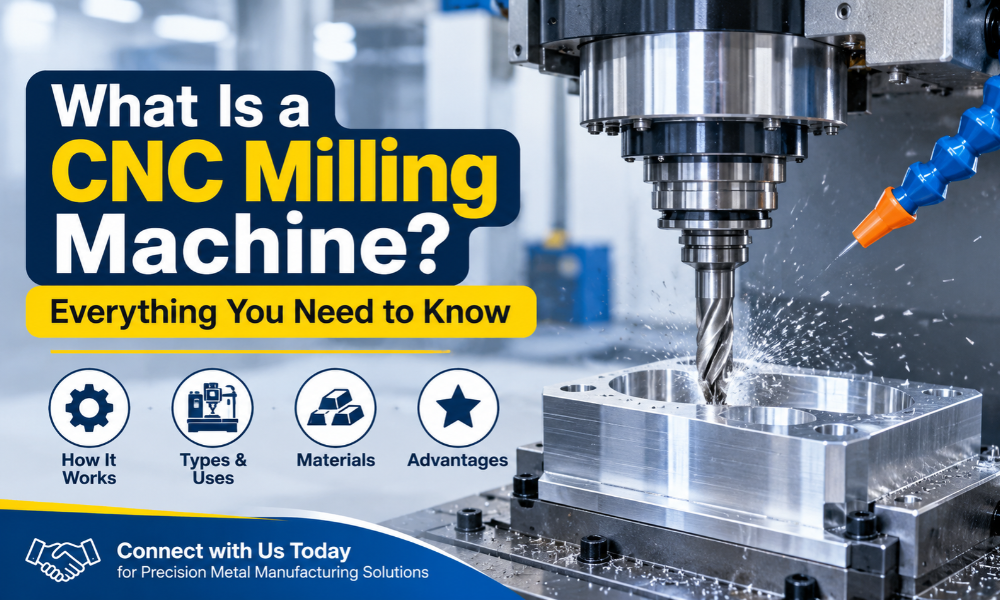
CNC milling machines are essential pieces of equipment used in modern manufacturing to produce complex components of varying materials. In this process, the machine uses computer controls to move the cutting tools over a work piece to remove material and achieve the desired shape and/or dimensions of the finished component. From medical devices to automotive and aerospace components, virtually every size and shape of component can be manufactured using CNC milling operations. For someone new to manufacturing and/or engineering, this overview will provide a basic understanding of CNC milling technology as well as provide examples of where and how it is used to assist them in determining the most appropriate manufacturing process to take for their project.
What Is a CNC Milling Machine?
A CNC milling machine is a manufacturing system that uses computer controls to manipulate and position a rotating cutting tool to remove material from a work piece. With this cell we will define CNC milling and describe in which direction/cases the machine will move to create shapes, holes and slots of varying difficulty/sizes, using C/N programming to do so. We will also discuss the differences between CNC mills and more traditional (or “manually” controlled) milling machines. In addition, we will also describe some of the terminology associated with CNC mill machines to further define and/or familiarize the reader with this technology.
How Does a CNC Milling Machine Work?
To begin, a design is created using CAD software and converted to machine instructions using CAM software. The operator attaches the workpiece to the machine and loads the appropriate cutting tool as well as the G-code for the operation to be performed. After the process has been initiated by the machine, the controlled movements of the tool and spinning spindle determine the position of the cut. Once the excess material has been removed from the part to achieve the final size and shape of the desired component, we then perform various finishes to the part (i.e. cleaning, polishing, etc.) to prepare it for use. This section will provide a detailed description of each of the steps outlined above for CNC machining.
We will also discuss the main types of CNC milling machines based on the number of axes of movement and configuration of the spindles. Three axis CNC mills are typically used to create various features on a part (i.e. slots and/or holes) whereas four axis mills can accomplish the same operations from multiple side/s of the part. Machining of more complex components, however, would require the use of a 5 axis mill. We will also identify the general applications for each type of mill based on the orientation of the spindle (i.e. horizontal vs. vertical).
What Are the Main Types of CNC Milling Machines?
Discuss the types of materials that can be milled using CNC machines. To what extent do the properties of the material being machined affect the selection of the tool and the machining speed (i.e. the speed at which the tool impinges on the work piece)?
We will review common metals such as aluminum, steel (both carbon and stainless), brass and copper as well as some tougher engineering plastics e.g. ABS, Nylon, POM and polycarbonate. We will briefly touch on some composite materials and discuss why manufacturers have to take into hardness and strength of the material, as well as the level of heat and/or environment where the material will be used, to determine the most appropriate material to use for a particular application.
What Materials Can CNC Milling Machines Process?
to provide examples of commonly utilized milling operations to various cutting operations to create different shapes on a work piece. We will cover face milling to create flat surfaces, end milling to create pockets/profiles, side milling to machine vertical surfaces and slot milling to create channels/grooves. We will also discuss drilling and boring to create precise holes as well as contour milling to create edges and/or surfaces of complex geometry. Each of these operations should be discussed with respect to the functional requirements of the part being machined (i.e. milling operation to achieve the required part geometry).
What Do Milling Machines Do? Common CNC Milling Operations
Explain what milling machines are used for in various manufacturing industries. In the automotive industry we will look at the production of engine and transmission parts and other custom precision fittings. In aerospace we will look at the production of brackets and other light weight metal components requiring high precision machining. Of interest to me have been medical applications including parts for surgical instruments and other equipment. In the electronics industry we see applications in the production of enclosures, connectors and precision machine housings, to name a few.
What Are CNC Milling Machines Used For?
There are numerous additional advantages of using CNC milling compared to traditional milling methods. For instance, operation of the machine can be entirely controlled by computer, thus improving the dimensional accuracy and consistency of the production process, as well as reducing the level of operator involvement throughout the process. Additionally, obsolete methods of production can be easily altered to implement new, more complex, designs of the finished product (i.e. decreased human error). Overall, CNC milling machines can significantly improve the overall efficiency and speed of a given manufacturing operation.
What Are the Advantages of CNC Milling?
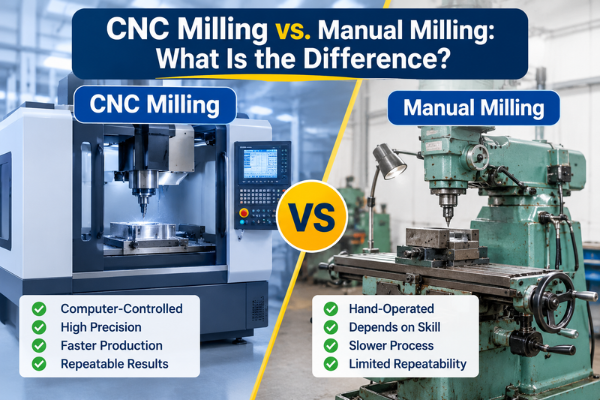
CNC milling is significantly different from conventional manual mill operations. To begin with, the speed of the process is higher in CNC operations compared to manual operations. Additionally, in CNC milling there is little to no involvement of the machine operator during the actual machining process. In manual milling, the operator controls the movement of the machine and/or cutting tool to perform the operation. In fact, conventional milling machines are also known as manual milling machines. A comparison of the main elements of the two processes (i.e. operation, accuracy, volume of production, complexity of the machining operation and level of automation) is given below. In general, manual milling is appropriate for shorter and/or less complex operations, whereas for longer and/or more complex repetitive processes CNC milling should be used.
CNC Milling vs. Manual Milling: What Is the Difference?
To assist readers in differentiating these processes, we will cover the main principles of each as well as the applications for which each is best suited, based on the nature of the component to be manufactured. In CNC milling, material is removed from the workpiece by means of one or more rotary cutters. In CNC turning, the workpiece is rotated against a cutting tool to remove material to create cylindrical components. CNC drilling is used to create holes in the workpiece and CNC grinding is used to achieve smooth, precise surfaces.
CNC Milling vs. Other CNC Machining Processes
What are the critical factors in selecting the right milling machine for your project? Of primary importance are the dimensions of the part, the complexity of its design, the type of material being milled, the tolerance and the surface finish required on the milled part. Other considerations include the format (3-, 4- or 5-axis) of the machine, its capacity, speed and lifespan, as well as the cost of operation and maintenance of the machine. With all of the above variables in mind, manufacturers are better able to assess the appropriateness of a given milling machine to achieve the desired end result of their project.
How to Choose the Right CNC Milling Machine
Explain the important factors manufacturers should consider when selecting a suitable milling machine for their projects. Discuss component size, design complexity, material type, required dimensional tolerances, and surface finish requirements. Introduce the importance of choosing between 3-axis, 4-axis, and 5-axis configurations based on machining needs. Also cover spindle speed, machine capacity, cutting tool compatibility, production volume, operating costs, and maintenance requirements. Explain how evaluating these factors helps manufacturers select suitable equipment for efficient and accurate production.
Connect with Us Today for Precision Metal Manufacturing Solutions
Choosing the appropriate manufacturing process can significantly impact the reliability of your metal component. Introducing Harber’s expertise in metal injection Harber MIM as well as other precision metal component manufacturing with integrated tooling and manufacturing capabilities.
The parts we manufacture are used across a variety of industries including automotive, medical, electronics and more.
To precisely meet your component design, material and production quantity requirements we recommend you partner with a capable and experienced manufacturer. To learn more about our services to best meet your requirements, please Contact With Us Today.
FAQ:
What is a CNC milling machine?
A CNC milling machine is used to create precision parts by removing material from a workpiece using an rotating cutter. Depending on the application, this can include creating holes, slots and/or pockets as well as other more complex features, in industries such as automotive, aerospace, medical and electronics, to name just a few.
How does CNC milling work?
In CNC milling, instructions generated by a computer are used to control the motion of the cutting tool (or tools) and the workpiece. To generate these instructions for the milling machine, a CAD (Computer Aided Design) file is processed using CAM (Computer Aided Manufacturing) software.
What is the difference between CNC milling and manual milling?
As with other CNC machining processes, the key difference between CNC and manual milling is the level of control of the machine by an operator. With CNC milling, the machine is controlled by the computer to perform relatively complex, repetitive tasks.
What kinds of materials can be processed by a CNC milling machine?
Almost any material can be processed by a CNC milling machine including, but not limited to the following metals (i.e. aluminum, copper, brass and titanium) and engineering plastics (i.e. ABS, nylon and polycarbonate).
What are the various types of CNC milling machines?
The main types of CNC milling machines include 3-axis, 4-axis and 5-axis machines as well as horizontal and vertical configurations, dependent upon the requirements of the component being produced.
Conclusion
Recently, milling technology has evolved and allowed manufacturers to produce more complex and accurate components. In this paper we will discuss the different types of milling machines and their characteristics, as well as various milling operations and applications. With this information we hope to assist you in selecting the most appropriate milling operation for your requirements.
Finally, we will discuss the features of a CNC milling machine and how it can be used to achieve high levels of precision and repeatability in the production process. When considering any milling operation, it is important to have an understanding of the milling machine as well as the various milling tools/accessories to fully exploit the capabilities of the machine for the task at hand.