en
 de
 jp
 kor
 fra
 spa
 ru
 pt
 it


Precision Aerospace CNC Machining | High Tolerance Aerospace Machined Components
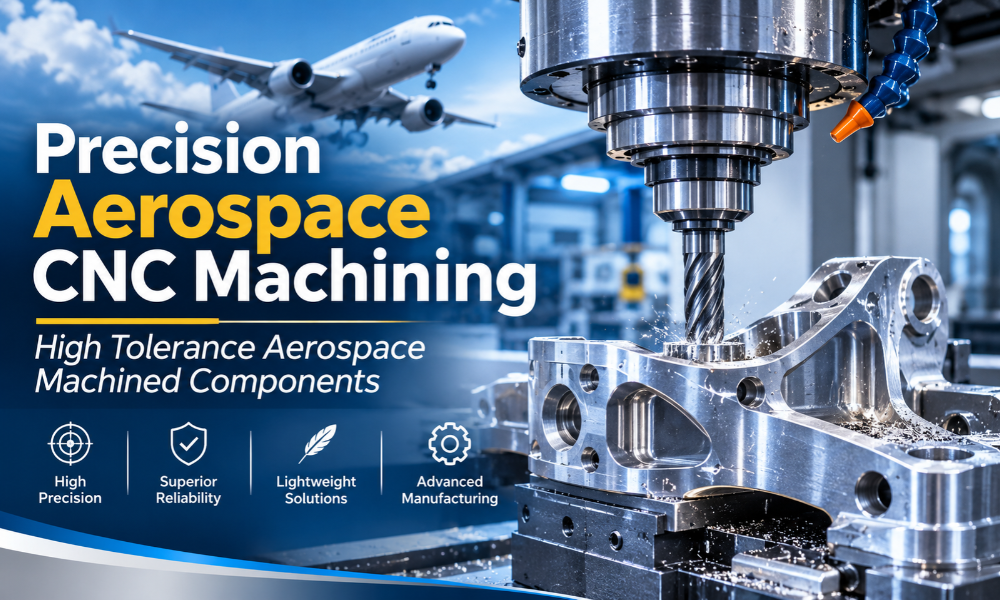
Aerospace CNC machining is critical in the production of components for the aerospace industry to create reliable, strong and consistent parts to be integrated into aircraft and spacecraft. With the use of advanced CNC machines in the production facility we are able to manufacture aids for the aerospace industry to be used in aircraft (such as structural components and engine components) as well as precision connectors and other equipment used in the space industry. We encourage potential customers to review the methods we use in our production processes, the materials we use as well as the quality assurances we have in place to ensure consistent and reliable finished products.
What Is Aerospace CNC Machining?
As previously mentioned, CNC manufacturing is the process in which machine tools controlled by a computer perform various cutting operations on a given work piece in order to create the final desired product. Some of the more common CNC operations include milling, turning, drilling, etc. CAD/CAM systems, in conjunction with a skilled CNC machinist, are often used to create and produce the final component as defined by the engineering specifications.
Why Is Precision Machining Important in the Aerospace Industry?
There is frequently extremely close tolerance required of the components machined for use in the aerospace industry, both to ensure there is good clearance between mating components as well as to ensure that components in a given assembly will function as designed. In consequence of this, very small variations in the dimensions of the components produced may adversely affect both the function and/or the performance of the overall assembly. Therefore, to ensure component reliability and consistent performance for the aerospace industry, it is essential that each component machined be of high quality and of the expected tolerances.
Common CNC Machining Processes Used in Aerospace Manufacturing
The following are the major Machining processes employed to fulfil the manufacturing requirements of typical aerospace industry components.
Firstly, we have CNC milling, which is used to cut/create various shapes, pockets and slots onto the body of the aerospace component. More complex milling operations include 4-axis and 5-axis milling.
For cylindrical aerospace components (i.e. shafts and bushings) we can use CNC turning, as well as drilling and/or boring processes to create the necessary mounting features.
Additionally, to process aerospace components with very complex and/or irregular shapes as well as to work with very hard materials used in aerospace applications we would employ Electrical Discharge Machining (EDM).
Materials Used in Aerospace CNC Machined Components
There are several factors (e.g. strength, weight, temperature/resistance to environment, and machinability) considered when selecting materials for aerospace part use. Aluminum alloys are very common in aircraft structures because of their low density. Titanium alloys also have a good strength to weight ratio and are often used in other aerospace structural components. Stainless steels may be used in aerospace applications to take advantage of their corrosion resistance; however, they are not as strong as other grades of steel. In high thermal loaded/aerosputastic (i.e. engine and turbine) applications, nickel based superalloys may be used. The selection of the right material is very important in the manufacturing of reliable aerospace components.
Common Aerospace CNC Machined Parts and Their Applications
Identify the fabricated parts manufactured via precision machining that are found on aircraft and spacecraft and explain their functions. Some of these may include various structural components of an aircraft such as those used on the wing, body (fuselage) of the aircraft and/or the engine of an aircraft. There are also aircraft engine components such as turbine and compressor parts. Other examples may include brackets, connectors, fasteners (e.g. screws and bolts) and bushings used in the landing gear of an aircraft.
Advanced Technologies in Aerospace Precision Machining
Discuss the most recent advances in machin ning technologies to effect improvements in the quality of machined components and increase overall productivity. 5-Axis CNC machines allow for the production of more complex shapes with reduced number of set ups compared to 3-Axis machines. In addition, with CAD/CAM software, the design engineers not only create the drawing of the component to be manufactured, but also simulate the machining operation to verify the tool paths of the cutting tool. Automation and robotics can further increase the productivity of the machining process by eliminating or drastically reducing the need for human intervention.
Aerospace CNC Machining vs. Traditional Machining
Compare and contrast conventional machining with CNC machining with regards to accuracy, repeatability, throughput, flexibility in design, and level of automation. In aerospace applications, for example, CNC machining allows the production of complex components in a consistent and repeatable manner, while in traditional machining the experience and skill of the operator determines how well the specification of the component is fulfilled. Create a simple comparison table to summarize some of the key differences between the two technologies including (i) Precision, (ii) Production speed, (iii) Type/flexibility of components (e.g. complexity), (iv) Repeatability and (v) Suitability for aerospace manufacturing. Based on the above comparison, elaborate on the reasons for using CNC machining in the manufacture of aerospace components.
Applications of CNC Machining in Aircraft and Space Manufacturing
There are a range of industries dependent on advanced machining technologies. For example, the use of these technologies in the aerospace industry can range from the manufacture of aircraft structural components to fabrication of helicopter engine components to the integration of interior fittings of an aircraft. Additionally, they may be used in the manufacture of various structural and mechanical components of landing gear for aircraft and/or space vehicles. Overall, these facilities are used for the manufacture of prototypes and/or test components as part of research and development activities in the space industry.
How to Choose the Right Aerospace CNC Machining Supplier
When deciding upon a machining vendor, there are several considerations for the manufacturer of aerospace components. Some of these include the vendor’s level of experience manufacturing aerospace components, their availability of advanced CNC milling and turning machines, and their ability to process (e.g. machine) various types of metal including aluminum, titanium and stainless steels as well as other alloyed steels.
Of utmost importance are vendor’s adherence to and/or utilization of aerospace quality standards, as well as the availability of in-house inspection and/or quality control staff.
Additional factors to consider when choosing a machining vendor include the ability to rapidly and efficiently produce prototype components to спектр as well as future high volume production runs of the components of interest to the aerospace manufacturer.
Custom Aerospace CNC Machining Solutions from Harber MIM
We strive to partner with clients to understand their precision engineering requirements and component designs in order to successfully create the aerospace components they need.
Supporting the specific requirements for these components requires us to implement the most appropriate manufacturing processes and supporting technology.
We have found that in order to provide the optimum value manufacturing partner to our clients, they should provide us with the engineering drawings and specifications for the materials to be used, as well as the desired tolerances and quantities to be produced.
Regarding the above requirements, we recommend prospective clients contact themselves to us directly at to discuss their needs to assess the most appropriate manufacturing services and solutions Harber MIM is capable of providing.
In the meantime, Contact With Us Today to learn more about our capabilities for precision manufacturing based on your aerospace component requirements.
FAQ:
What is aerospace CNC machining?
CNC machining in aerospace applications includes a wide range of techniques including milling, turning and drilling. We employ the use of multi-axis CNC machines to manufacture complex components associated with aircraft and spacecraft. Tight tolerances on these components are essential to ensure proper fit and integrity of the overall assembly. Other industries also utilize CNC machining to produce components of a wide range of shapes and sizes; however, in the aerospace industry the primary constraint on the components is the environment in which the component will operate.
What materials are commonly used in aerospace CNC machining?
We use a variety of high-strength, light-weight metals in aerospace component fabrication including various aluminum and titanium alloys as well as stainless steels and nickel based super alloys.
Why are tight tolerances important in CNC machined parts used in aerospace applications?
Components manufactured using CNC machining have tight dimensional tolerances to ensure ease of assembly and proper fit. If dimensional tolerances are too large there is the risk of inadequate fit, which can adversely impact the safety and performance of the aircraft/spacecraft.
What are the various processes involved in CNC machining of aerospace components?
The common processes employed in the fabrication of aerospace components include various forms of CNC milling, turning and drilling as well as EDM. The process chosen depends on the geometry and tolerance of the part to be manufactured as well as the volume to be produced.
How do you evaluate an aerospace CNC machining supplier to be most reliable?
When evaluating potential suppliers of aerospace CNC machining services, you should assess their CNC equipment and infrastructure as well as their quality control procedures and experience with aerospace materials to determine if they will be able to meet the specifications defined in the engineering drawings.
Conclusion
Manufacturing parts for planes and other aircraft and spacecraft using aerospace CNC machining continues to be an effective means to achieve high quality components. To enhance component reliability, we manufacture parts using the most appropriate materials, with appropriate tight dimensions (tolerances) and using the most applicable machining processes for the given component. Additionally, partnering with a proficient manufacturing facility can also assist customers in developing reliable components for aircraft.