en
en
 de
de jp
jp kor
kor fra
fra spa
spa ru
ru pt
pt it
it
Metal Injection Molding Guide: Precision MIM Components 2026
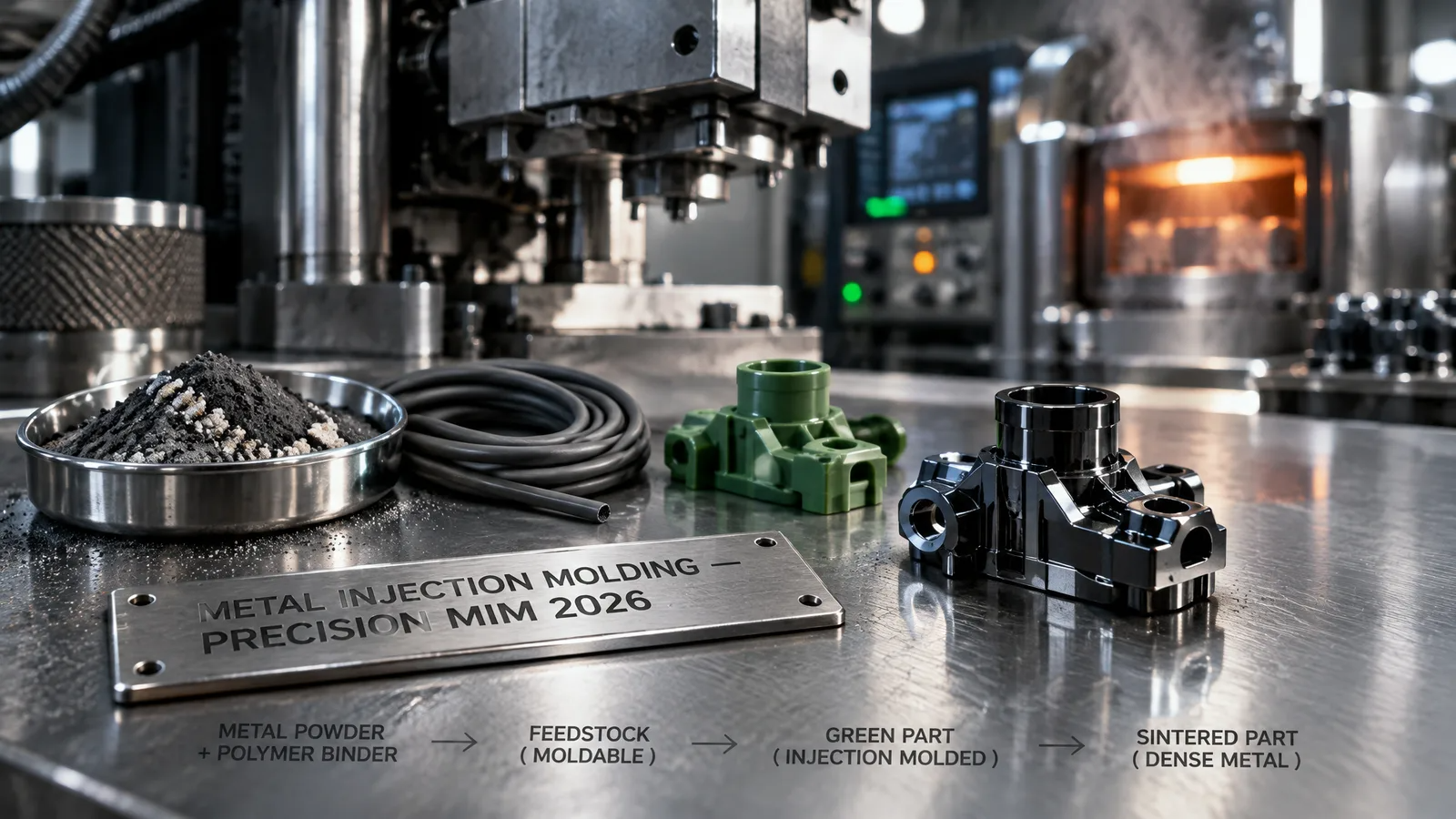
Metal Injection Molding (MIM) is a manufacturing process for producing complex metal components. Fine metal powder is mixed with a polymer binder to form a feedstock which is then injection molded. Next, the binder is removed (debinding) and finally sintered to produce a dense metal part. It is ideal for small ,complex ,high volume components for automotive, medical ,electronics.
Your hunch is that it lurks somewhere between casting and machining. If a supplier has already said that it’s MIM for a much smaller, more intricate part that you need at scale Many guides do not provide clarity on the location of the cost, tolerance, and volume lines. This guide about MIM technology will fill this gap, providing 2026 data from published sources, a side-by-side process comparison, and a checklist for whether MIM is a fit for your part.
Key Takeaways
● Metal Injection Molding (MIM) utilizes fine metal powder combined with polymer binder in a feedstock that can be shaped using standard injection molding equipment.
● The process of feedstock preparation, injection molding, debinding and sintering has four main steps with 15% dimensional shrinkage in the part due to sintering.
● Metal injection molding (MIM) usually comes out cheaper than CNC machining on runs above 2000 – 5000 units, despite tooling that can run $10,000 – $50,000 or more.
● The tolerances of the as-sintered will run close to ±0.3% of a dimension, tightening to around ±0.025mm with added secondary machining.
● MIM works with stainless steels (316L, 17-4 PH), titanium, and cobalt-chromium alloys for automotive, medical, electronics, and firearms.
● The independent market reports for 2026 cluster between approximately $5 billion and $6.7 billion, all pointing to ongoing growth to 2030. MIM is suitable for small, complex, high-volume parts generally under 100 grams per shot that are expensive to machine or cast.
What Is Metal Injection Molding (MIM)?
Metal Injection Molding (MIM) is a metalworking process that combines the powder of a metal with a binder to form a feedstock, which can then be shaped, using standard plastic injection moulding equipment, into a solid metal part after being processed. There is disagreement over the number of steps that make up the injection molding workflow. Some sources prefer 4 steps while others want a breakdown into 5 steps. However, overall, it seems to make little difference as practically every source agrees on the four stages: feedstock preparation, injection molding, debinding, and sintering. The only difference is that the first stage is sometimes called ‘compounding’ and that is split off as a separate first step within feedstock prep. Utilizing a standardized four-step framework can prevent buyers from getting confused when comparing supplier documentation.
A review of how others describe it reveals a confusion from whether compounding is treated separately or folded into feedstock preparation, rather than any real disagreement about the technology. Understanding the difference is essential when reading a vendor’s process sheet to map to a thyristor for a different vendor.
Why MIM Matters in 2026
In 2026, MIM matters as independent market research firms now report converging growth data, showing sustained demand, not speculative demand. According to Research and Markets, the market will grow at a compound annual growth rate of 9.2%. Thus, it will increase from $4.71 billion in 2025 to $5.14 billion in 2026. Market Data Forecast has a separate forecast for 2026 where they are estimating the market to be between $6.09 to $6.68 billion for 2025-2026. Similarly, they are projecting $14.05 billion by 2034.
Evaluating just the two 2026 estimates of $5.14 billion and $6.68 billion (the midpoint) puts the market at $5.9 billion this year, a useful sanity check when a single source’s number looks shaky. The demand for electrical vehicles parts, wilful adoption of lightweight and high-strength materials, and growth of the medical, precision devices are anticipated to drive the growth in the forecast period. Indo-MIM, Schunk Sintermetalltechnik, GKN Sinter Metals and Fine Sinter Co named producers are in the midst of this growth.
How Does the Metal Injection Molding Process Work Step by Step?
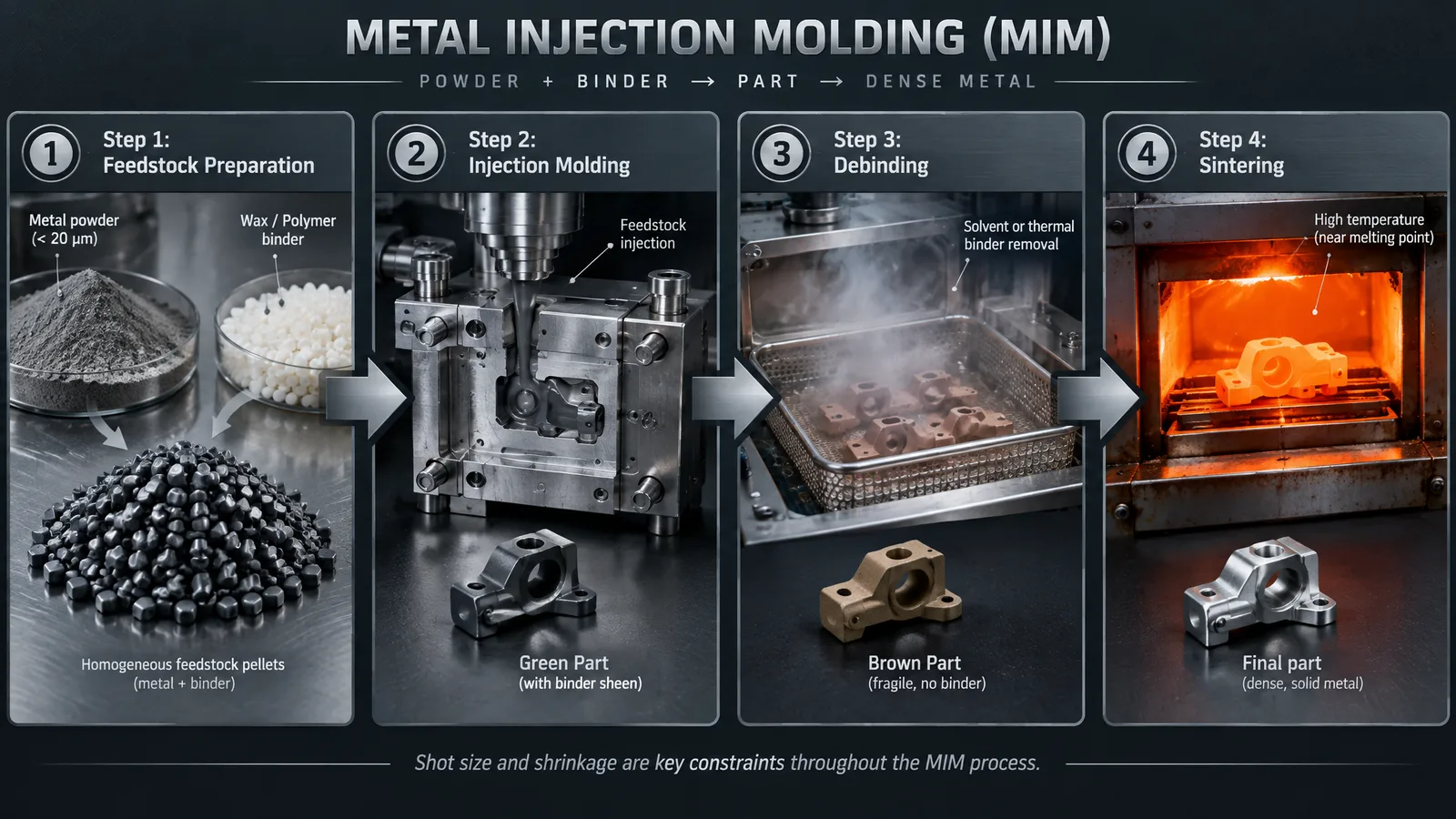
The MIM process includes feedstock preparation, injection, debinding, and sintering procedures. Also, these give shape to the final geometry as well as density and mechanical properties of the part. The blending of a metal powder, typically under 20 microns, with a wax or polymer binder occurs in this phase.
Prepare Feedstock for Process. A uniform and modelable substance is made from metal powder and binder. Injection Molding is Step 2. The reaction of these powder metal processing methods occurred mainly in molds Here, the feedstock is injected into the mold cavity. The result is “green part”, which retains its shape but still contains binder. Step 3: Removing Binder The solvent or thermal debinding process eliminates the majority of the binder, producing a fragile “brown part.” Sintering Process Stpe 4. The metal fuses the powder particles from the brown part by heating it close to the melting point of the metal.
In effect, it is shot size and shrinkage that take new buyers by surprise in practice. The mold for each shot size is typically less than 100 gram with the part shrinking around 15% on each axis during sintering. In other words, your CAD model needs to be scaled up before molding, be sure to confirm this detail with your supplier before tooling is cut.
MIM vs. CNC vs. Die Casting vs. Investment Casting
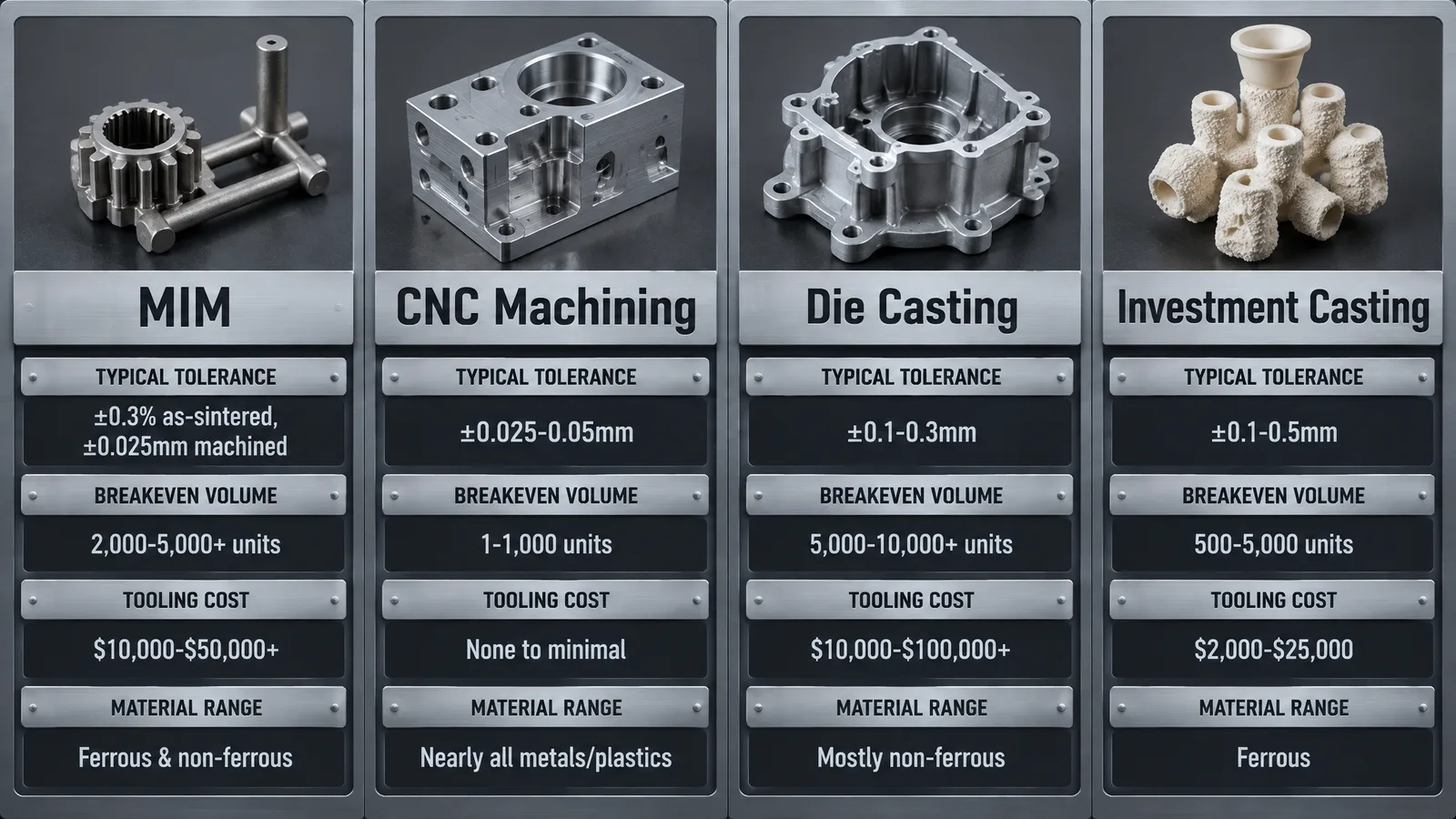
MIM differs from CNC machining, die casting, and investment casting mainly in tooling cost, tolerances and production volume where each process becomes most economical. The given table arranges all the four next to each other.
Process | Typical Tolerance | Breakeven Volume | Tooling Cost | Material Range |
MIM | ±0.3% as-sintered, ±0.025mm machined | 2,000-5,000+ units | $10,000-$50,000+ | Ferrous & non-ferrous |
CNC Machining | ±0.025-0.05mm | 1-1,000 units | None to minimal | Nearly all metals/plastics |
Die Casting | ±0.1-0.3mm | 5,000-10,000+ units | $10,000-$100,000+ | Mostly non-ferrous |
Investment Casting | ±0.1-0.5mm | 500-5,000 units | $2,000-$25,000 | Ferrous & non-ferrous |
By calculating the tooling numbers, we can arrive at a reasonable estimate of tooling costs per part. The low end ($10,000 tooling / 5000 unit breakeven) comes out to around $2 tooling cost per part. The high end $50,000 / 2000 units is closer to $25 per part. As a general rule of thumb, MIM outperforms machining above about 5,000 units for small complex parts, and the break-even quantity is simply tooling cost divided by costo-per-part gap versus CNC.
What Materials, Tolerances, and Design Constraints Apply to MIM?
Metal Injection Molding parts are typically manufactured from stainless steel 316L or 17-4 PH as well as titanium alloys and cobalt-chromium alloys. The choice of these materials are because of their corrosion resistance, biocompatibility or strength needs. Stainless steel is the most commonly used material. It represents over 40% of total consumption on the full industry.
Tolerance confusion often occurs as various sources quote different figures depending on whether machining follows sintering. The as-sintered parts are roughly ±0.3% of a dimension. This may be tightened to about ±0.025mm for critical features due to secondary machining. If the quotation mentions just one figure for tolerance in practice, ask whether that refers to the as-sintered or post-machined condition. We’ve seen buyers getting the mix-up of the two in specs most often.
What Industries and Products Use MIM Parts?
MIM parts are found in automotive, medical device, electronics, and firearm manufacturing whenever a small, geometrically complex metal component is needed at volume. MIM-produced rocker arms supplied through Schunk have made their way into BMW vehicles, contradicting the claim that automotive use is generic. Turbocharger components, orthopedic implant hardware, and electronics heat sinks are common application areas, with Biomerics and ARC Group Worldwide being notable suppliers to the medical and industrial sectors respectively.
When engineers screen suppliers, they often look at the capabilities of the precision metal parts a vendor makes as well as that vendor’s material certifications.
How Do You Decide If MIM Is Right for Your Part?
MIM process is best suited for a part that is small in size, geometrically complex, required in large volumes, and made out of a MIM compatible metal. You need to run your part against this checklist.
● The weight of the component is around 100g per shot.
● The yearly output is around 5,000 units.
● Which features does the geometry of the part possess that are expensive to machine?
● The alloy you will be using should be 316L, 17-4 PH, or titanium (supported material).
● Requirements for either intolerance of ±0.3% as sintered or light secondary machining can be accepted.
If your component answers yes to the majority of these questions, it is worth talking to a MIM supplier. In case of very small structures or micro scale geometries, reviewing micro MIM injection mold capabilities specifically does save a redesign cycle later on.
Conclusion
Metal Injection Molding qualifies as a precision manufacturing method due to its ability to produce small complex metal geometries at an affordable price and in high volumes when CNC and casting don’t work. It’s not a blanket substitute for CNC machining, die casting, or investment casting; it’s the right tool for the particular combination of size, volume, and complexity of the part. If your part fits the checklist above, approach a MIM supplier using your drawing, target volume and material spec for a real quote rather than a rough estimate.
FAQs
1. What is MIM
Metal Injection Molding Metal Injection Molding refers to the process with which fine metal powder is mixed with the help of a polymer binder for mouldable feedstock. The metal part is produced using injection molding, followed by debinding and sintering processes.
2. The major operations involved in a MIM process.
The steps or stages of the Metal injection molding Process (MIM) involved are as follows: At each stage of the process, the component goes from a molded “green part”, to a debound “brown part”, and finally to a dense metal part after sintering.
3. When is MIM cheaper than CNC machining?
As per the article, at approximately 2000-5000 production volume or more, MIM can become more cost effective for small, complex parts. However, the actual break-even point might differ depending on tooling cost and MIM vs CNC machining cost difference.
4. What tolerances can Metal Injection Moulding achieve?
According to the article, typical dimensional tolerances of as-sintered MIM parts will be around ±0.3%. Tolerances of ±0.025 mm can be achieved once secondary machining is employed to tighten up.
5. How can you detect if MIM is fit for your component?
MIM (Metal injection molding) is generally a good candidate for relatively high volume production of small complex parts that are made of compatible materials which include 316L stainless steel, 17-4 PH stainless steel and titanium. The factors to be considered include part weight, annual production volume, geometry, material and tolerance requirements.