en
en
 de
de jp
jp kor
kor fra
fra spa
spa ru
ru pt
pt it
it

Custom Metal Injection Molded Watch Components
Smartwatches and modern watches are looking for small size, durability, accuracy and aesthetics in custom metal injection molded watch components. In addition, many of these parts are complex in shape, which can be challenging to manufacture using conventional machining processes. Metal Injection Molding (MIM) is a viable manufacturing process for complex metal components that can be produced in volume. In addition to traditional watches and wearable devices, the process of custom Metal Injection Molded Watch Parts can be adapted to specific dimensions, materials, tolerances and finishing.
What Are Custom Metal Injection Molded Watch Components?
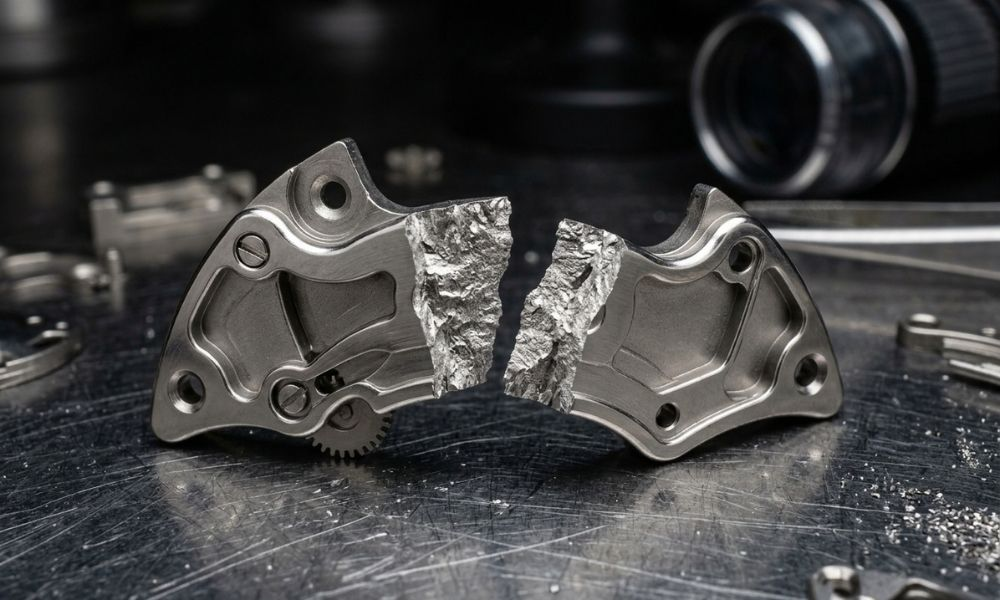
Custom MIM watch components are metal components that are manufactured using the Metal Injection Molding (MIM) process, which are designed to meet the requirements of a particular metal watch product. Custom parts are not just the standard parts that are available off the shelf; they are specifically designed to fit the watch manufacturer's needs. The process involves the preparation of fine metal powder, adding a binder to the powder, molding the material in a mold, eliminating the binder, and finally sintering the molded part to obtain the desired metal properties. This is particularly beneficial for small components that have complex geometries, critical tolerances, and require frequent manufacturing.
Which Watch Components Can Be Made Using MIM?
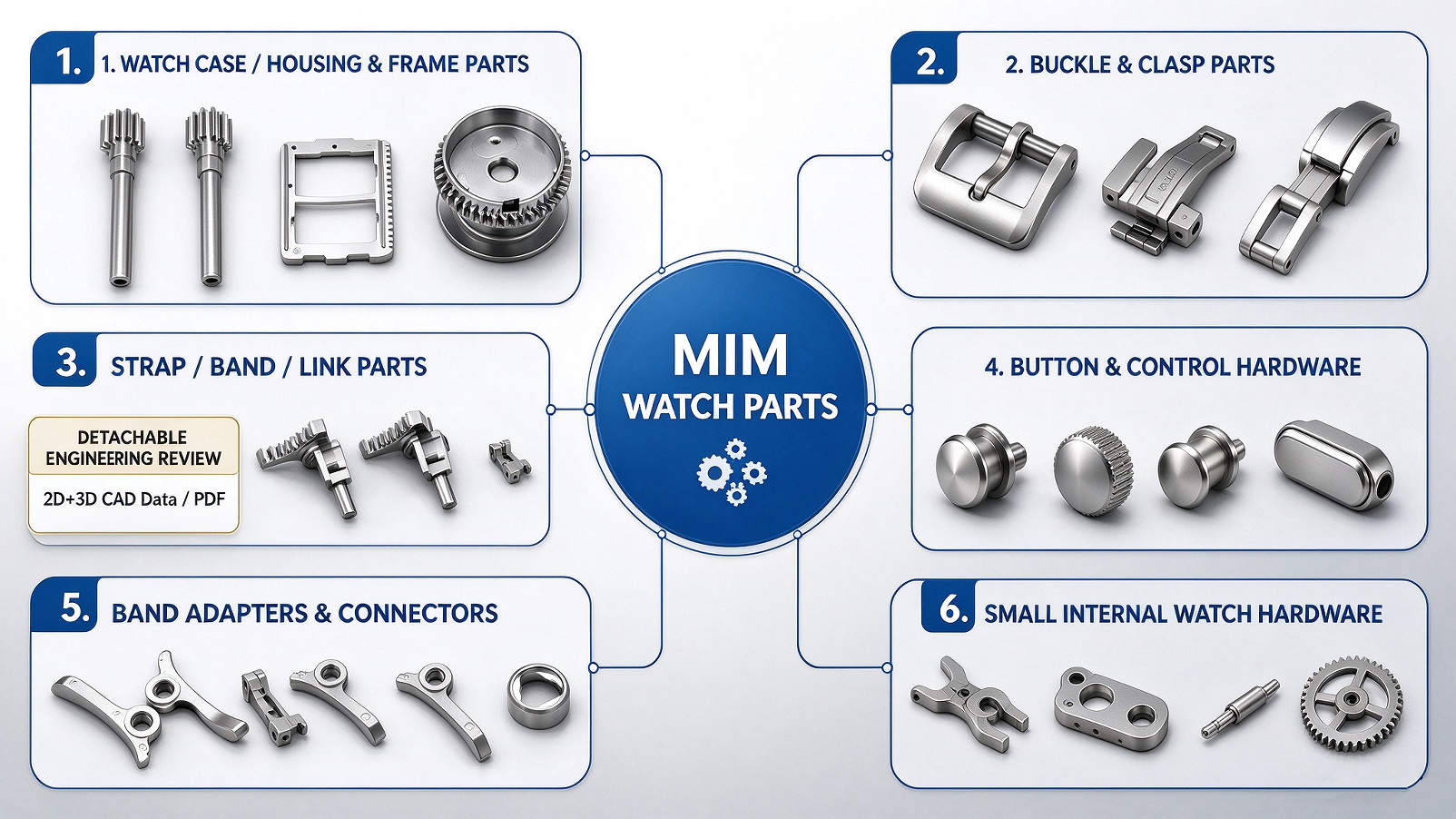
The components can be made using MIM for numerous small-scale watch and smartwatch components. The specific application will vary by component design, material, size, tolerance and volume of production.
Watch Cases, Frames, and Back Covers
The shapes and clean surface of watch frames, cases and back covers can be intricate. These components can be moulded close to their final shape, thus minimizing machining required after the moulding process. It can also be used for design details like curves, openings, grooves, etc.
Crowns, Buttons, and Control Components
Such components as crowns, pushers, buttons and others require precise dimensions because they should fit well with the other watch parts. These small parts can be manufactured consistently by MIM and enable the manufacturers to choose the appropriate metals and surface finishes for the desired surface finish.
Straps, Connectors, Clasps, and Small Hardware
Small connectors, clasps, hinges, locking members and adapters are common on watch straps. These components must be strong and have reliable dimensions to assemble and use every day. MIM is ideal for making multiple quantities of small, complex metal components.
Internal and Smartwatch Components
There are numerous small components within smartwatches that need to fit into a compact area. The MIM can be used for internal connectors, brackets, supports and structural inserts. An ability to create complex shapes makes it possible for manufacturers to incorporate several features together into a smaller metal part.
How Metal Injection Molding Works for Watch Components
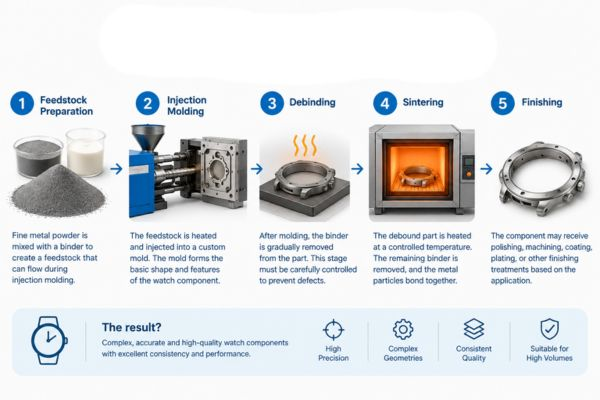
The MIM process consists of various controlled steps and the quality of each stage influences the quality of the final product.
1. Feedstock preparation: Feedstock is prepared by mixing fine metal powder with an appropriate binder system that enables feedstock to flow during injection molding.
2. Injection molding: Feedstock is heated and pushed into a form that is already made. The mold sets the general outline and details of the watch part.
3. Debinding: The binder is slowly drained out of the part after molding. This stage is very critical and needs to be closely monitored to avoid defect.
4. Sintering: The debound part is put into a furnace and heated at a controlled temperature. The remaining binder is burned off and the desired density and strength are obtained as the metal particles fuse together.
5. Finishing: The component can be polished, machined, coated, plated or finished in another way according to its application.
Materials Used for Custom MIM Watch Components
The material depends upon the strength, weight, corrosion resistance, appearance and operating conditions required. One of the popular choices is stainless steel, as it is durable and has a good level of corrosion resistance. Surface appearance and corrosion resistance are important, and 316L stainless steel can be used, 304 stainless steel can be used for selected hardware applications. When greater strength is needed, 17-4PH stainless steel should be considered. In situations where low weight and strength is paramount, titanium and other suitable alloys may be used.
The selection of material should be made for the intended use of the component rather than just for looks. The manufacturer should also take into account the finishing process and the performance that is required after the process.
Surface Finishing Options for MIM Watch Components
The surface finish may significantly affect the look and feel of a watch part. The surface finish on the visible parts may require a smooth and high quality surface while surface finish of the non-visible parts may be less critical.
These methods include polishing, brushing or wire drawing, sand-blasting, plating and PVD coating. A smooth and reflective surface can be achieved by polishing, and a controlled directional texture can be achieved by brushing. Smooth out matte finish with sand blaster.
Decorative aspects or other surface properties can be achieved by plating or PVD coatings.
The choice of finishing will depend upon the design of the component, its location, the wear it is likely to endure, the material it is constructed from and the appearance desired.
Benefits of Custom Metal Injection Molding for Watch Parts
Manufacturers may want to consider MIM for watch components for a number of reasons. Firstly, it can create small, intricate and three dimensional objects with the same shape over and over. It can also eliminate the need for multiple machining processes, which could allow for multiple features to be formed in the mold.
If the parts are required in higher quantity, MIM can deliver consistent parts after developing the right tooling and process. It also is compatible with a variety of metal materials and finishes. Therefore, Custom Metal Injection Molded Watch Components can assist manufacturers in striking the right balance between intricate designs, manufacturing consistency, and efficiency.
But not every part of a watch is appropriate to use MIM. Simple components, very low production volumes or designs that are not conducive to injection molding may be better produced by another method.
Custom MIM vs. CNC Machining for Watch Components
While both MIM and CNC have their own significance in the watch-making industry, they function differently.
Factor | Metal Injection Molding | CNC Machining |
Complex shapes - | Highly suitable for many small complex parts | Suitable, but complex parts may require several operations |
Production volume - | Well suited to repeat and higher-volume production | Flexible for low to medium volumes |
Material waste - | Generally lower for near-net-shape production | More material is removed during machining |
Tooling - | Requires dedicated molds | Uses machining tools and fixtures |
Small components - | Well suited to many small parts | Also suitable, depending on geometry |
Design flexibility - | Best for designs that suit molding | Broad flexibility for machined geometries |
Design Considerations for MIM Watch Components
The design is the key factor prior to production. The size, wall thickness, weight, tolerances, openings, and the complexity of a component are all factors that need to be taken into account by engineers. They also must consider changes in material behavior and dimensional changes during debinding and sintering.
Another design aspect is mold design. The quality of the production can be influenced by location of the gate, parting lines, draft requirements, etc., and by the placement of features. The designers should also determine if there are any sections that will need secondary molding after the molding process. The ability to review design in 2D drawings and accurate 3D CAD models simplifies the design evaluation process before the start of tooling.
Quality Control for Custom MIM Watch Components
For watches, uniformity of dimensions is often critical, as only slight differences can impact assembly. The material, molding process, dimensional accuracy, surface appearance and final part performance should therefore be covered by the quality control.
Dimensional inspection, visual surface inspection, material checks, density measurements or functional and assembly testing may be used by manufacturers. There may also be additional inspections to make of critical components depending on the customer's requirements. Maintains process control and minimises the variation between production runs, enabling reliable final assembly.
When Should You Choose MIM for a Watch Component?
If the watch component is small, detailed, complex and is needed in multiple quantities, MIM can be considered. It can be particularly beneficial in cases where multiple machining operations are necessary with conventional methods or material loss is significant.
Manufacturers should look at the geometry, production volume, material required, tolerances, surface finish, and tooling cost of the component before making their decision to use MIM. Simple, low volume parts might not be the right candidate for MIM parts; however, complex parts in larger quantities may be.
How to Order Custom Metal Injection Molded Watch Components
A manufacturer generally requires all technical information before he can give a quote. This can consist of a 2D engineering drawing, 3D CAD model, material specification, critical dimensions, tolerances, surface finish, production quantity and application.
If possible, it's also helpful to include a prototype or sample requirement. The information will enable the MIM manufacturer to evaluate if the design will be suitable for the process and to recommend materials and finishes, as well as tooling and production.
Why Custom MIM Is Useful for Modern Watch Manufacturing
The watches and smartwatches of today still feature compact components, intricate designs and strict assembly requirements. Manufacturers, accordingly, require production methods which are capable of dealing with small parts and also, are repeatable.
MIM can provide a solution to this need with the ability to provide complex geometry, repeatable production, and various material and finishing options. Custom Metal Injection Molded Watch Components are designed to create parts for specific applications, allowing for the creation of parts beyond just standard designs.
FAQ:
What watch components can be made with MIM?
MIM can be used for various small metal parts, including frames, cases, crowns, buttons, connectors, clasps, back covers, brackets, and other internal or external components.
Is MIM suitable for stainless steel watch parts?
Yes. For various applications of a watch, different stainless steel grades can be considered such as 316L, 304 and 17-4PH.
Can MIM produce small and complex watch components?
Yes. The great benefit of MIM is the capability to produce parts of small size and complex 3D design in repeat production.
Is MIM more cost-effective than CNC machining for watch components?
This will depend on the component and the quantity of production. For appropriate complex parts that are made in large quantities, the investment in tooling is required for the production of which MIM can become more efficient.
Conclusion
When creating small, intricate and lasting watch parts, selecting the proper manufacturing process is crucial. For appropriate applications MIM can provide a complex geometry, repeatable production, material flexibility and finishing options. The development of Custom Metal Injection Molded Watch Components can be tailored to specific design needs and performance specifications, allowing manufacturers to produce custom parts for a variety of traditional watches and smartwatches.