en
 de
 jp
 kor
 fra
 spa
 ru
 pt
 it


Cobalt Chromium Alloy: Everything You Need to Know (2026)
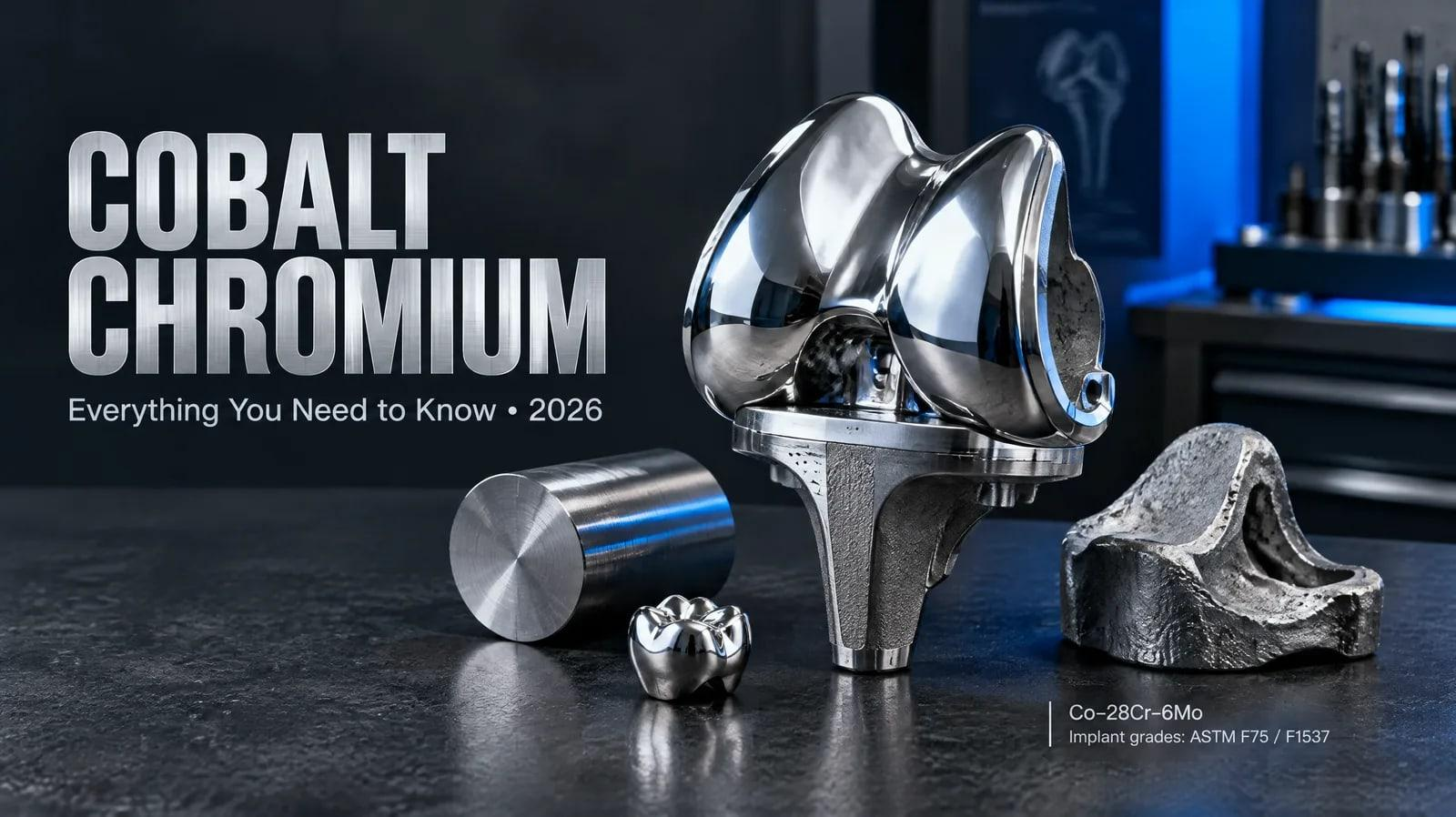
Cobalt chromium, also called CoCr or cobalt chrome, describes a group of cobalt-based alloys, normally being alloyed to chromium and often molybdenum, respectively.Cobalt chromium alloys are valued for wear resistance and corrosion resistance, capable of functioning at elevated temperatures, and for having high strength (high tensile strength up to about 850MPa). Its applications include dental and orthopedic implants, gas turbines, and high-wear components. According to ASTM, the Co-28Cr-6Mo implant grade is either cast or wrought.
Cobalt chromium is the hard, white metal in implants and dental crowns and even in rings. But most pages skip over the part where the many names and ASTM grades differ and where CoCr is the wrong choice. All of this in one place with sources you can check – composition, grades, properties, manufacturing, cost and safety.
Essential Points
● Cobalt chromium alloy (CoCr, cobalt chrome) is a family of cobalt-based alloys, and its names CoCrMo, cobalt chrome and Co-Cr alloys all refer to the same Co-28Cr-6Mo implant family in everyday use.
● The commercially pure grade titanium, Ti-6Al-4V ELI used in orthopedic implant, is provided to ASTM F136 specification.
● The ASTM F75 specification permits 27-30% chromium, 5-7% molybdenum, and not exceeding 0.50% nickel, with the balance being cobalt (See: USPTO patent 9078753).
● CoCr makes ideal materials for joint bearing surfaces, dental frameworks, turbine parts and other high-load and wear-critical applications.
● 316L stainless is much cheaper than titanium, which is much lighter and the mainstream choice for 3D-printed implants. Cobalt chrome is in between the two at roughly €230–€460/kg (Makerverse, 2026).
● CoCr metal-on-metal bearings for hip applications release cobalt and chromium ions. The FDA identifies this as a specific risk, and evidence on thresholds for systemic harm is mixed (FDA, 2019).
● Nickel-chromium alloys are a separate nickel based family though some implant grades (ASTM F90, F562) combine cobalt, chromium and nickel.
What is cobalt chromium alloy and how comes it has so many names?
The name cobalt chromium refers to a family of cobalt-based alloys which is also written as cobalt chrome, CoCr or CoCrMo according to CASRAI’s CoCr 2026 guide and ASTM specs. The shorthand spreads because the ASTM titles say Cobalt-28 Chromium-6 Molybdenum, and people condense it.
By understanding the numbers you can decode any name. Co-28Cr-6Mo is about 28% chromium, 6% molybdenum, and cobalt for the rest. With that one habit, supplier datasheet reading will become a cinch.
What’s the difference between cobalt chrome and cobalt chromium?
Absolutely, in day to day use. “Cobalt chrome,” “cobalt chromium,” “cocrmo” and “Co-Cr alloys” all point to the same family, and CoCrMo is its best-known member. Some members substitute tungsten for molybdenum or incorporate nickel; refer to the decoder table below. Nickel is the base metal for the different family of nickel-chromium alloys such as Inconel 718.
What does the cobalt chromium alloy contain?
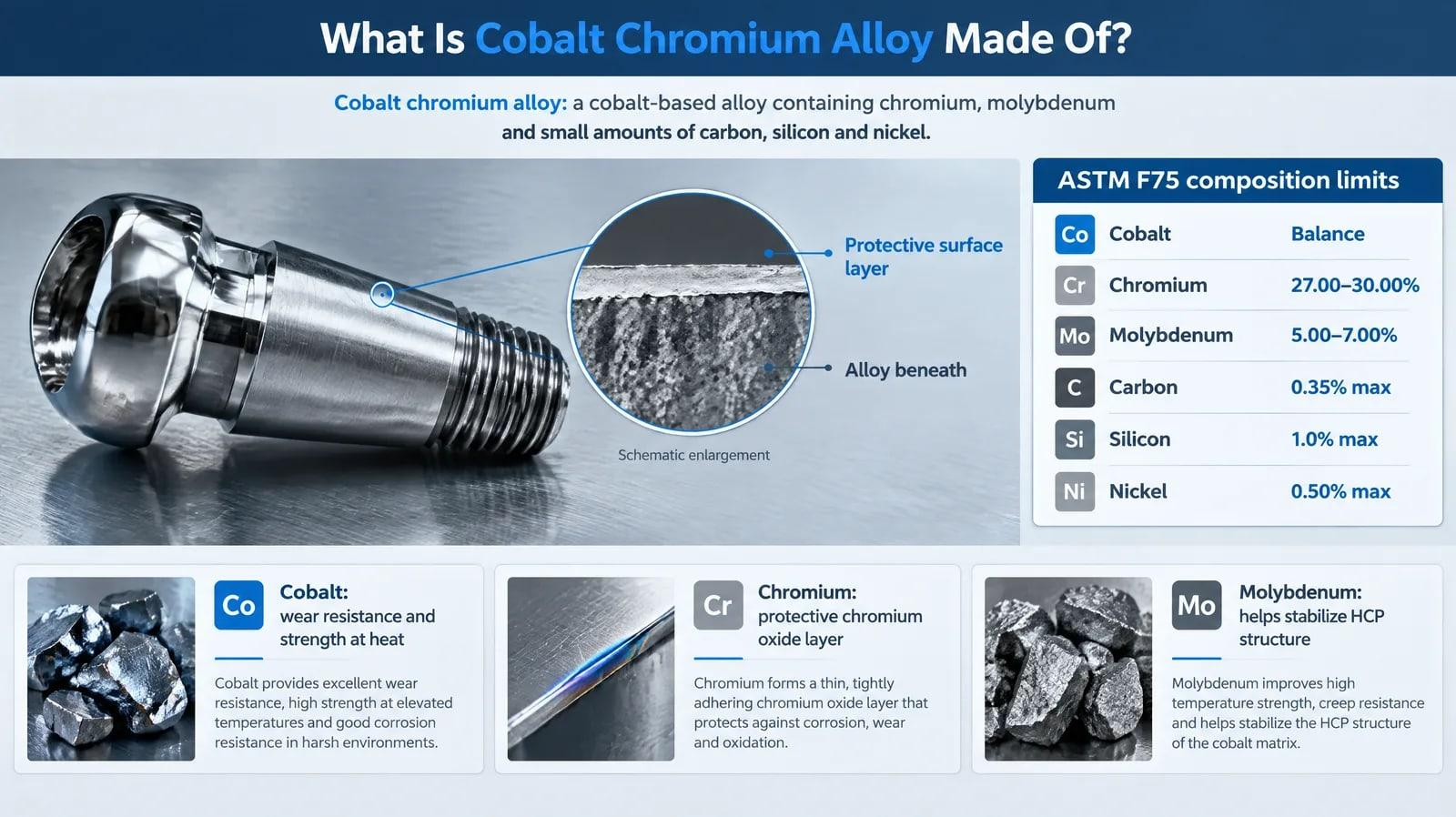
Cobalt chromium alloy mainly consists of cobalt, in addition to chromium, molybdenum and small quantities of carbon, silicon and nickel. According to ASTM F75, cobalt-chrome alloy must have a composition of chromium 27.00–30.00%, molybdenum 5.00–7.00%, max carbon 0.35%, max silicon 1.0% and max nickel 0.50% with cobalt being a balance (USPTO 9078753, Arcam ASTM F75 datasheet).
Every element is assigned a task.
● Cobalt is the base metal, which carries wear resistance and strength at heat.
● Chromium creates a stable and tightly adhering chromium oxide layer and prevents corrosion.
● Tungsten and molybdenum stabilise the HCP structure when added to chromium.
● The face-centered cubic (FCC) structure is stabilized by nickel, iron and carbon. The FCC-to-HCP transition in cobalt alloys under stress causes work hardening. .
Below is practical example from the F75 limits. The other 65.5 g is cobalt and minor elements, in a 100 g casting at the midpoints (28.5 g chromium, 6 g molybdenum). The combined weights of carbon, silicon, and nickel can reach a maximum of 1.85 g, thus, cobalt’s weight comes to 64–66 g. The primary metal in CoCr is cobalt, which is largely why CoCr prices move with cobalt prices.
What are the ASTM Grades? The CoCr Family Decoder.
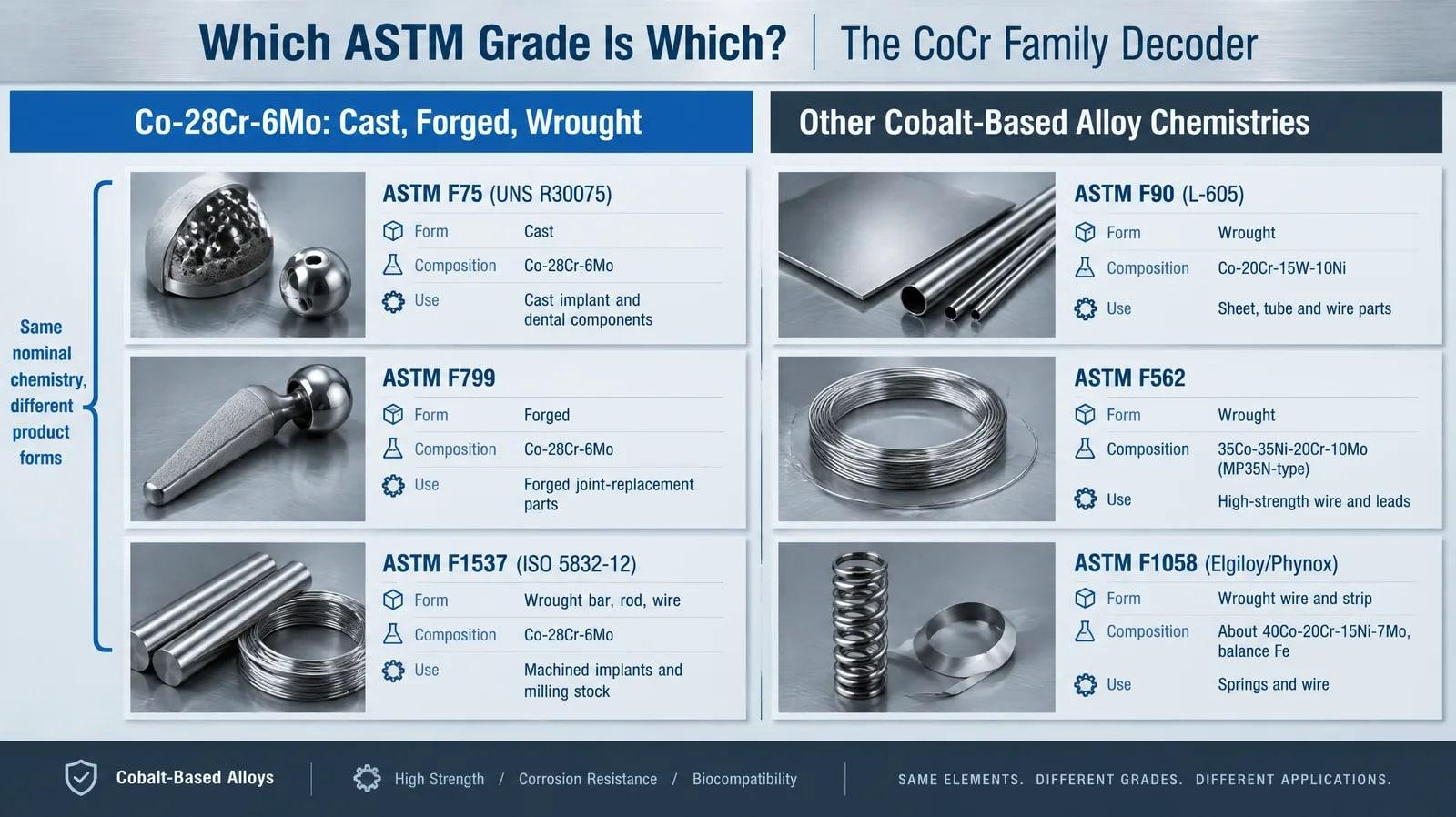
There are six ASTM standards for cobalt-based implant alloys, differing in form, chemistry and application. This decoder table compares them alongside one another.
Standard | Form | Nominal composition | Typical use |
ASTM F75 (UNS R30075) | Cast | Co-28Cr-6Mo | Cast implant and dental components |
ASTM F799 | Forged | Co-28Cr-6Mo | Forged joint-replacement parts |
ASTM F1537 (ISO 5832-12) | Wrought bar, rod, wire | Co-28Cr-6Mo | Machined implants and milling stock |
ASTM F90 (L-605) | Wrought | Co-20Cr-15W-10Ni | Sheet, tube and wire parts |
ASTM F562 | Wrought | 35Co-35Ni-20Cr-10Mo (MP35N-type) | High-strength wire and leads |
ASTM F1058 (Elgiloy/Phynox) | Wrought wire and strip | About 40Co-20Cr-15Ni-7Mo, balance Fe | Springs and wire |
Three of the six standards (F75, F799, F1537) describe Co-28Cr-6Mo insulated cast, forged and wrought chemistry. Each of the three contains approximately 10-35% nickel. Our two readings of the table show that the former changes more often than the latter.
What distinguishes ASTM F75 from ASTM F1537?
The cast Co-28Cr-6Mo alloy is covered under standard ASTM F75, while the wrought bar, rod and wire have standard ASTM F1537. F75-23 refers to 2023 Reference Standard for cast CoCrMo casting alloy. We have a trap here: F75 does not apply to a completed surgical implant out of castings, so a finished implant needs its own requirements.
Nickel-Containing Grades Application in Stainless Steel
F90 and F562 are cobalt-based alloys that also contain nickel. So when an implant is made with "nickel chromium cobalt alloy", it means these grades, not nickel superalloys like Inconel 718 or Hastelloy C.
Cobalt chromium mechanical properties are great. Numbers Have Essential Properties.
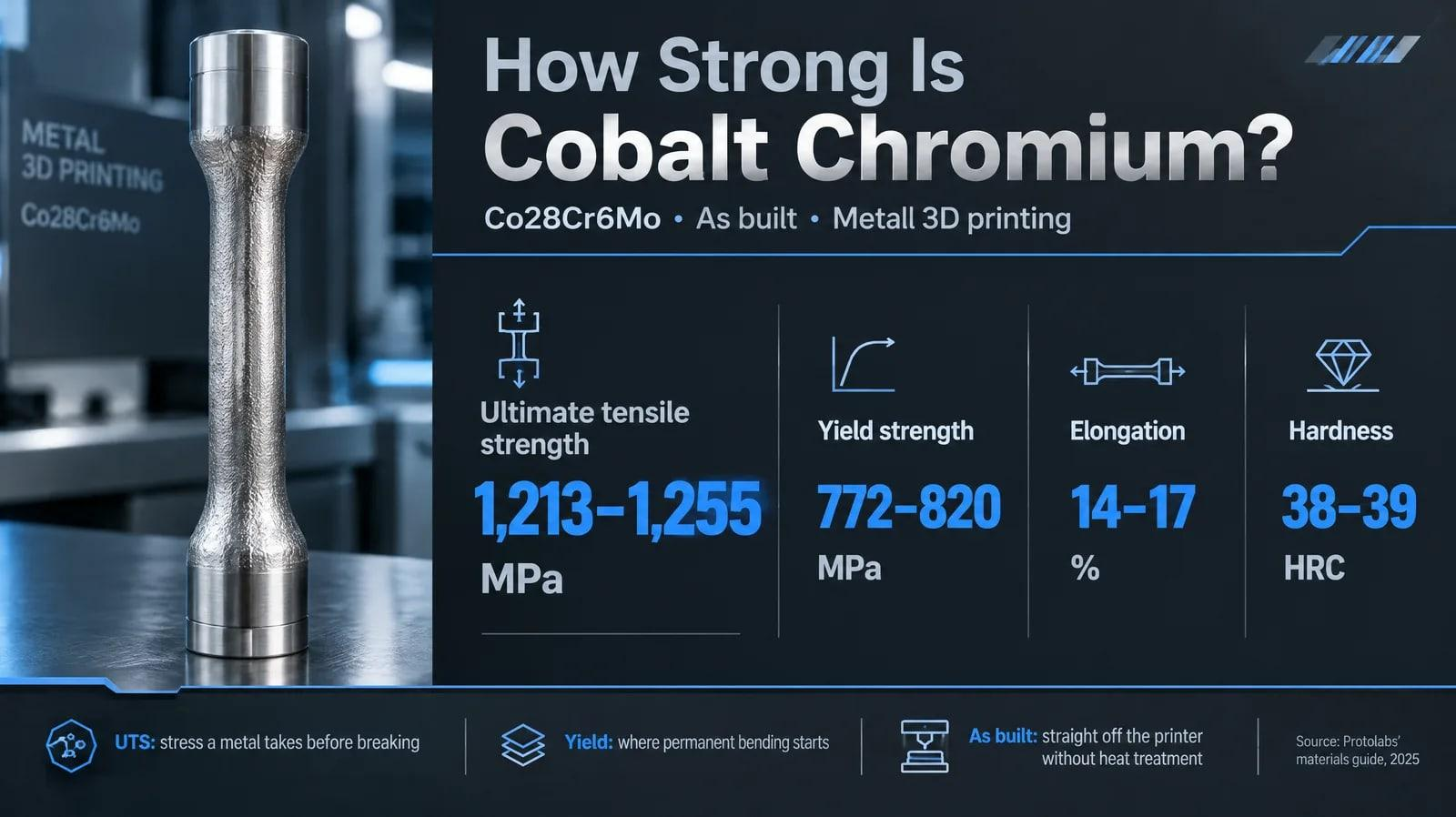
Ultimate tensile strength of 1,213-1,255 MPa and hardness of 38-39 HRC for Co28Cr6Mo from metal 3D printing. The materials guide from Protolabs, which has 316L and Ti6Al4V in the same format lists these figures. The definition of some terms first; ultimate tensile strength (UTS) is the “stress” a metal takes before it breaks, yield is where the permanent bending starts and as built means straight off the printer without heat treatment. According to Protolabs metallic 3D printing guide the CoCr and 316L materials are from that source, whereas Ti6Al4V is from its powder bed fusion page.
Material | Condition | UTS (MPa) | Yield (MPa) | Elongation | Hardness |
Co28Cr6Mo | As built | 1,213–1,255 | 772–820 | 14–17% | 38–39 HRC |
Ti6Al4V | Stress relieved | 993–1,055 | 855–951 | 15–18% | 33–35 HRC |
316L | Stress relieved | 565–586 | 379–386 | 75–78% | 88–90 HRB |
As-built CoCr has approximately twice the ultimate tensile strength and yield strength of 316L, with ratios in the range of 2.1–2.2 and 2.0–2.2, respectively. In comparing UTS of CoCr against Ti6Al4V, the picture splits. While the UTS of CoCr is 15–26% greater, its yield is lower than stress-relieved Ti6Al4V. The meaning of "stronger" is dependent on your number of choice. Different tempering methods would shift each row.
CoCr possesses “red hardness”, which means it retains hardness and strength at higher temperatures. This property explains why it is used for turbine and tool grades.
What's the use of cobalt chromium alloy?
Cobalt chromium alloy is applied in implants, dental work, turbines and wear parts, where wear heat or corrosion would destroy a softer metal. The easiest way to sort their uses is by classifying the property doing the work.
● A CoCr head and bearing surfaces (the surfaces are made of CoCr) of the joint replacement is worn against a socket made of polyethylene (UHMWPE).
● According to a dental patent, cobalt provides an expansion coefficient that is quite similar to that of gold. That is important when porcelain is fired onto a metal frame.
● Gas turbines and Stellite-type wear alloys depend on red hardness for high-temperature strength.
● Cobalt chrome rings are very hard, which helps them resist scratching and keep their finish.
The entire choice of material is justified by one property. If the substitute is strong but not of the same thermal expansion coefficient as dental porcelain, cracking can occur. Similarly, one which matches hardness but not corrosion resistance, where the implant fails within the body. Sourcing wear parts buyers can also browse industrial tools and parts from Harber Metal.
What is the production process of cobalt chromium? Casting, Wrought, Milling, and 3-D Printing.
Cobalt chromium is fabricated by methods like casting followed by forging or wrought processing, bar milling, or powder-based 3D printing, each giving a different microstructure. Co-Cr-Mo undergoes casting within the temperature range of 1350-1450 C, causing the alloy to form a coarse-grained cored structure. The Cast F75 material exhibits a pattern of dendritic solidification and carbide networks forming between the dendrites.
Wrought material has higher strength. The ASTM F1540 specification is for applied laser beam welding of metal powder based on titanium alloy. It describes the fabrication methods for final mechanical parts. You can refer to the selection guide of Protolabs for further understanding of titanium-based metal alloys. This makes wrought about 33–38% stronger in UTS than as-built printed metal 242 ÷ 182 and 242 ÷ 176 which we obtained from those data.
Post-processing changes printed parts. According to Arcam's specifications, their EBM process produces elongated grains with carbide precipitation and that, via heat treatment, becomes a more isotropic structure. One research concluded that a directed-energy-deposition (DED) sample was softer than the conventional sample yet more wear resistant, thus hardness does not predict wear. If your supply chain includes cast or machined components, discover how cast versus machined routes compare for automotive projects.
How To Choose Cobalt Chromium vs Titanium vs 316L Stainless Steel.
Job choices are won by CoCr, titanium (Ti6Al4V) and 316L stainless steel and the correct pick will depend on budget, load and body contact. CoCr is appropriate for dental frameworks and surfaces. Titanium wearing appears lighter and fuses with bones. 316L is the low-cost workhorse.
The below prices are 2026 metal powder prices in € per kg from Makerverse 2026; strength figures are from the Protolabs table above.
Dimension | Cobalt chrome | Ti6Al4V | 316L |
Strength and hardness | Highest UTS and hardness | High yield, lower UTS | Lowest strength, very ductile |
Wear | Best for bearing surfaces | Moderate | Lower |
Weight and biocompatibility | Heavier; cobalt and nickel concerns | Lightest, bone-friendly | Heavier; contains nickel |
Powder price per kg | €230–€460 | €1,150+ | €60–€115 |
Manufacturability | Harder to machine, longer lead times | Mainstream for 3D printing | Easiest to source and process |
Cobalt chrome powder is about 3.8–4 times more expensive than 316L based on those prices (230 ÷ 60, 460 ÷ 115). Ti6Al4V is 2.5–5 times more expensive than cobalt chrome. The prices mentioned are for powders, not parts. Machining and post-processing alter final prices.
The three metals work well together. A typical hip design combines a CoCr articulating surface with a titanium structural component, placing each metal where it works best.
Is Cobalt Chromium Safe in the Body and Who Must Avoid It?
Cobalt chromium is typically safe in bulk form but carries real risks for some patients including a risk of metal-on-metal bearings, nickel or cobalt sensitivity, and wear debris. It is advisable to keep the three issues apart.
Wear of metal-on-metal bearing.
Metal-on-metal (MoM) hips have a ball and cup that are made of cobalt and chromium alloy. As per the Arthritis Foundation, they were supposed to last longer than ceramic or polyethylene part but proved otherwise. The FDA indicates that metal-based hip implants contain cobalt and chromium ions that can enter the blood stream (FDA, 2019). According to the agency, the U.S. “All-manufactured hip implants have risks, including wear of the component material.” FDA, 2019 The "Food and Drug Administration" This is about MoM bearings not all CoCr use.
When the proof contradicts.
According to many experts, blood levels greater than 7 parts per billion are concerning. But experts are unclear on what concentration is dangerous. 7 ppb does not represent an enforceable limit, but a commonly mentioned concern level. A case series cites contradictory evidence on whether elevated blood cobalt and chromium correlate with systemic toxicity, and states that the FDA provides no specific systemic threshold.
Allergy and nano-particle fallout
The most common metal allergen is nickel followed by cobalt and chromium (ClinicalTrials.gov record). The background text of the patent says that ASTM F75 is biocompatible in bulk, but nano-size particles entering tissue cells can cause serious inflammation.
When CoCr is Not the Right Option.
● According to the FDA, MoM patients at higher risk include those with a component misalignment and those with suspected metal sensitivity (cobalt, chromium or nickel).
● Due to its lesser weight and biocompatibility, titanium often fits better where weight is important.
● According to a patent granted by the USPTO, high-carbon wear grades are more difficult to weld due to heating due to eutectic-reaction stresses and cracking.
Commonly Asked Queries.
Is it possible to 3D print cobalt chrome?
Yes. Cobalt chrome is listed as a 3D printing metal by Protolabs. The selective laser melting, also called SLM or DMLS, and electron beam melting process this. For printed implants, titanium alloy powder is mostly chosen as the material of choice, so favour CoCr when weight is less important than wear or stiffness.
How Does the Price of Cobalt Chrome Compare with Titanium and Steel?
In 2026, cobalt chrome powder had a price of about €230–€460 per kg, compared with €60–€115 for 316L stainless steel and €1,150+ for Ti6Al4V. CoCr parts add cost due to machining difficulty and lead times.
Is Cobalt Chromium Stronger Than Titanium or Stainless Steel?
It varies according to the measure. The tensile strength of as-built CoCr is approximately twice that of 316L and greater than stress-relieved Ti6Al4V. Titanium, nonetheless, has a yield strength that is higher in the same Protolabs data. Heat treatment and process alter the data.
Cobalt chrome rings and jewelry – are they safe?
Not by default. Jewelry sources say that it is generally safe but nickel, cobalt and chromium can all cause hypersensitivity. According to ASTM F75, the cap on nickel is 0.50%, while other grades hold far more. Check the exact alloy composition before buying if you have a severe metal allergy.
Differences Between Cobalt-Chromium and Nickel-Chromium Alloys
Cobalt-chromium alloys use cobalt, as base metal, nickel-chromium alloys, such as Inconel 718, use nickel. Nickel-chromium superalloys are designed for high temperature and corrosive applications. Some cobalt-based implant grades, such as F90 or F562, still contain nickel, which is where the names get confused.
Conclusion.
Always start selecting the grade by standard: F75 for cast, F1537 for wrought, and if allergy is a concern, check the nickel content. Next, choose the process by the properties you need, since wrought, cast and printed CoCr behave differently. Lastly, assess the associated risks of bulk CoCr and metal-on-metal bearing applications. If in doubt, use CoCr with titanium, not one metal for two jobs.